

Texas Education Commissioner Mike Morath won’t take action against Fort Worth ISD after a middle school received its fifth straight F.
“It doesn’t change things substantially,” Morath told the Fort Worth Report on Friday afternoon. “There’s a team in place, and the team’s got a plan.”
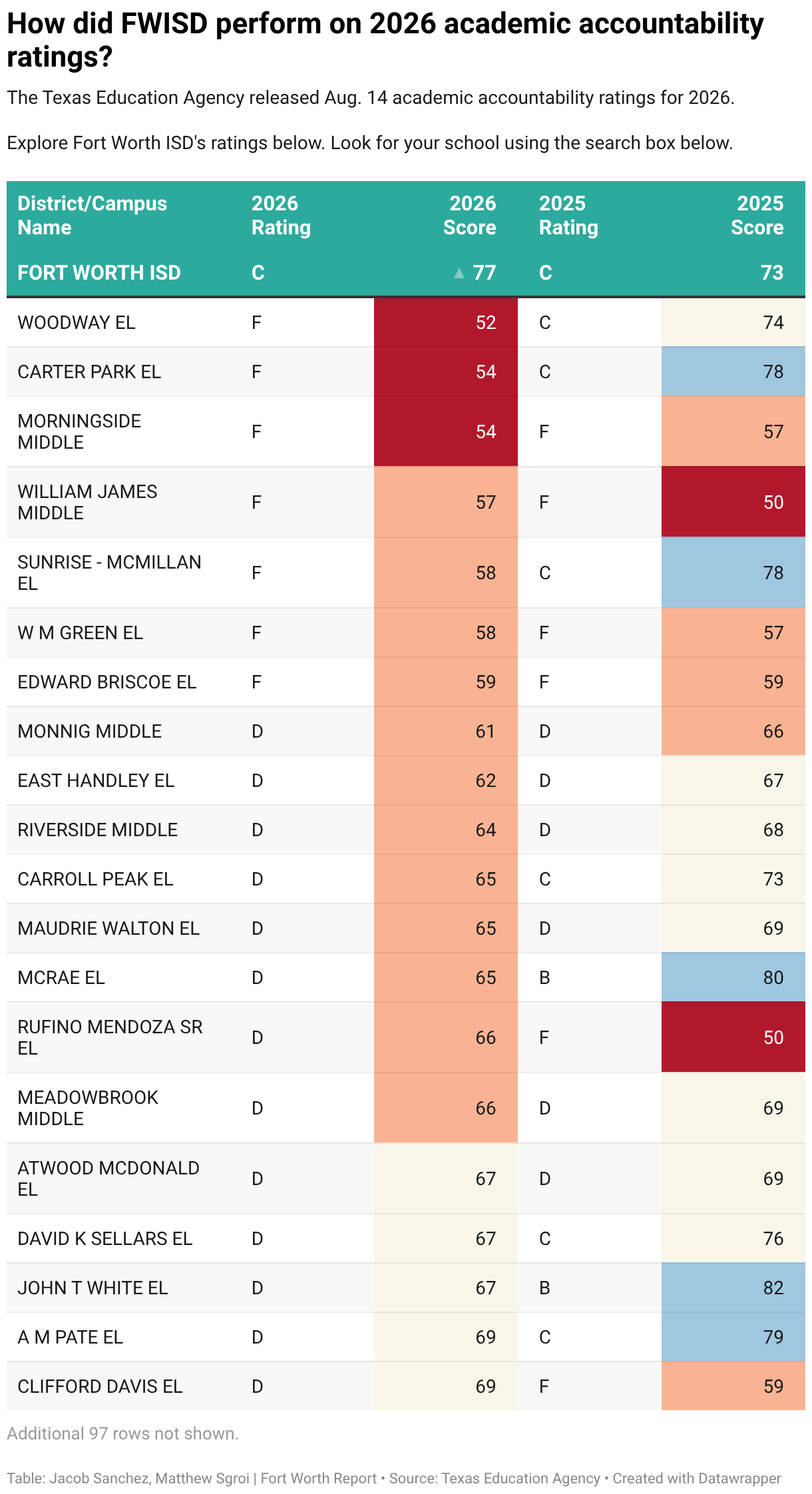
William James Middle School received its fifth consecutive F rating Aug. 14 as the 60,000-student district maintained a C overall. The ratings are largely based on how well students do on STAAR, or State of Texas Assessments of Academic Readiness.
Typically, five straight F’s means the education commissioner has to either close the campus or appoint a board of managers to govern the district. But FWISD is already in the middle of a state intervention.
“Our real high hope is that the students at William James will see a significant improvement in the quality of their experience this school year relative to what has happened for many, many years,” Morath said.
Superintendent Peter Licata said the district bears responsibility at William James and other struggling campuses, including at two schools that received their fourth F.
“At every campus where students are not yet seeing the outcomes they deserve, we must own the results and respond with urgency,” Licata said. “Our expectation is clear: Every student in Fort Worth ISD deserves access to an excellent school, and we will continue raising the bar until that expectation is a reality across our entire district.”
Licata was appointed superintendent after Texas Education Commissioner Mike Morath intervened over years of low academic performance and a campus that received five consecutive failing academic accountability grades under the Texas’ school rating system. Morath also appointed a nine-member board of managers alongside the superintendent.
Board President Pete Geren said the ratings carried both good and sobering news. He cautioned that the letter grades obscure the figure he considers most important: how many students read at grade level.
“We see progress, but we can’t forget that when we finished the school year, only 41% of our kids were reading at grade level,” Geren said. “That data is really lost in these A-F ratings.”
Licata sees encouraging signs in the ratings. FWISD is making progress, which he has attributed to the leadership of his predecessor, Karen Molinar.
Zach Leonard, a leader with Families Organized Responding Takeover, called the results promising and encouraging while also crediting Molinar’s leadership. But he said the gains do not change the group’s opposition to the state takeover.
Trenace Dorsey-Hollins, executive director of the parent advocacy group Parent Shield, said the ratings show what the district’s students are capable of but credited the gains to work that predated the takeover, not the intervention.
“But it shows that our kids have potential,” Dorsey-Hollins said.
FWISD entered this year with two consecutive years of improvement in its overall rating. This year’s C had a score of 77. The district scored 73 in 2025, up from 70 in 2024.
That 4-point gain masks considerably more movement campus by campus.
Among 117 campuses with ratings in both years, 41 improved by at least one letter grade, 53 stayed the same and 23 declined.
“We will celebrate the gains our students, teachers and school leaders have earned while staying relentlessly focused on the campuses where we must accelerate improvement,” Licata said.
The number of A- and B-rated campuses grew from 43 to 52, while D- and F-rated campuses fell from 35 to 25.
The improvement stretches back further. An analysis by the Fort Worth Education Partnership found FWISD’s number of F-rated campuses has fallen from 45 in 2023 to seven this year. The share of district campuses rated D or F dropped from 61% to 21% over the same period.
Some of the swings were dramatic:
Diamond Hill Elementary climbed from a D to an A.
M.H. Moore Elementary moved from a D to a B.
West Handley Elementary jumped from an F to a C.
“Three consecutive years of improvement, more schools earning A and B ratings, and fewer schools rated D or F demonstrate that our work is making a difference,” Licata said. “But progress is not the finish line.”
The district now has seven F-rated campuses, down from last year’s 11. Morningside Middle School received its fourth consecutive F.
Carter Park, Sunrise-McMillan and Woodway elementary schools each fell from a C to an F.
“We still have nearly 13,000 of our kids in schools that were rated D and F at the end of last year, and that’s not acceptable,” Geren said.
FWISD has begun addressing its systemic academic underperformance. Licata placed William James and 23 other chronically low-performing schools under a district-built turnaround model called the Elevate Network.
The district infused $25 million into the schools to ignite academic turnaround. Elevate teachers are eligible to earn up to six-figure salaries.
Classrooms in Elevate schools follow a more structured two-step teaching model than the one rolled out to the rest of the district. Teachers first deliver whole-class instruction that includes checks for understanding. Using data gathered from those checks, teachers pull students who don’t grasp the material into small groups.
Other campuses now teeter on the edge of retriggering the intervention law. Morningside Middle School, W.M. Green Elementary and Edward Briscoe Elementary received their fourth F. Briscoe shuttered in May as part of FWISD’s five-year school closure plan that elected trustees approved.
Campuses with four or five failing ratings need strategies tailored to the barriers their students face, Leonard said, rather than simply receiving the same Elevate model. He pointed to issues such as food insecurity and high student mobility.
“Without removing those barriers, we’re going to continue seeing problems in some of those schools,” he said.
Dorsey-Hollins sees promise in specific pieces of the Elevate model that will help push growth and close gaps. But like Leonard, she questioned applying a single model across campuses with different needs. Some students require more individualization than a uniform approach allows, she said.
The Elevate model is the district’s answer to turning the chronically underperforming campuses, Geren said.
“The district is hyper-focused on those schools,” he said.
On the first day of school, some Green Elementary parents said they were taking a wait-and-see approach to the takeover. Others welcomed the intervention.
“We needed this,” said Patrice Smith, a grandmother of two Green students.
Texas assigns A-F ratings based on three broad areas: student achievement, school progress and how well districts and campuses are closing gaps among groups of students. At the high school level, ratings incorporate measures including graduation rates and college, career and military readiness.
The grades measure performance during the 2025-26 school year, most of which unfolded before Licata and the appointed managers took control. The results provide a new benchmark for the district under state intervention, but they are not a clean measure of the state-appointed leadership’s work.
The results are still far from Morath’s criteria to return control back to elected trustees: eliminate campuses with multiple years of unacceptable ratings; meet or exceed state or regional averages for students reaching grade level in reading and math; and improve the appointed board’s governance performance.
Next year’s ratings should be judged not only by whether A’s and B’s rise and D’s and F’s fall, but by whether the improvement is sustainable, Leonard said.
“We just hope that this momentum continues,” he said.
Jacob Sanchez is education editor for the Fort Worth Report. Contact him at jacob.sanchez@fortworthreport.org or @_jacob_sanchez.
Matthew Sgroi is an education reporter for the Fort Worth Report. Contact him at matthew.sgroi@fortworthreport.org or @matthewsgroi1.
Disclosure: FWISD manager Pete Geren leads the Sid W. Richardson Foundation, a financial supporter of the Fort Worth Report. FWISD manager Laurie George is a member of the Report’s reader advisory council. At the Fort Worth Report, news decisions are made independently of our board members and financial supporters. Read more about our editorial independence policy here.
This <a target=”_blank” href=”https://fortworthreport.org/2026/08/14/middle-school-triggers-takeover-law-as-fort-worth-isd-sees-slight-rating-improvement/”>article</a> first appeared on <a target=”_blank” href=”https://fortworthreport.org”>Fort Worth Report</a> and is republished here under a <a target=”_blank” href=”https://creativecommons.org/licenses/by-nd/4.0/”>Creative Commons Attribution-NoDerivatives 4.0 International License</a>.<img src=”https://i0.wp.com/fortworthreport.org/wp-content/uploads/2021/04/cropped-favicon.png?resize=150%2C150&ssl=1″ style=”width:1em;height:1em;margin-left:10px;”>
<img id=”republication-tracker-tool-source” src=”https://fortworthreport.org/?republication-pixel=true&post=729121&ga4=2820184429″ style=”width:1px;height:1px;”><script> PARSELY = { autotrack: false, onload: function() { PARSELY.beacon.trackPageView({ url: “https://fortworthreport.org/2026/08/14/middle-school-triggers-takeover-law-as-fort-worth-isd-sees-slight-rating-improvement/”, urlref: window.location.href }); } } </script> <script id=”parsely-cfg” src=”//cdn.parsely.com/keys/fortworthreport.org/p.js”></script>