
EL PASO, Texas (Border Report) — The U.S. Customs and Border Protection Commissioner Rodney Scott said the agency will not build a 30-foot wall or install stadium lighting through Big Bend National Park, Big Bend Ranch State Park or the Black Gap Wildlife Management Area.
Instead, Scott said CBP plans to build one new access road, improve existing roads, install detection technology and place vehicle barriers in limited, strategic locations.
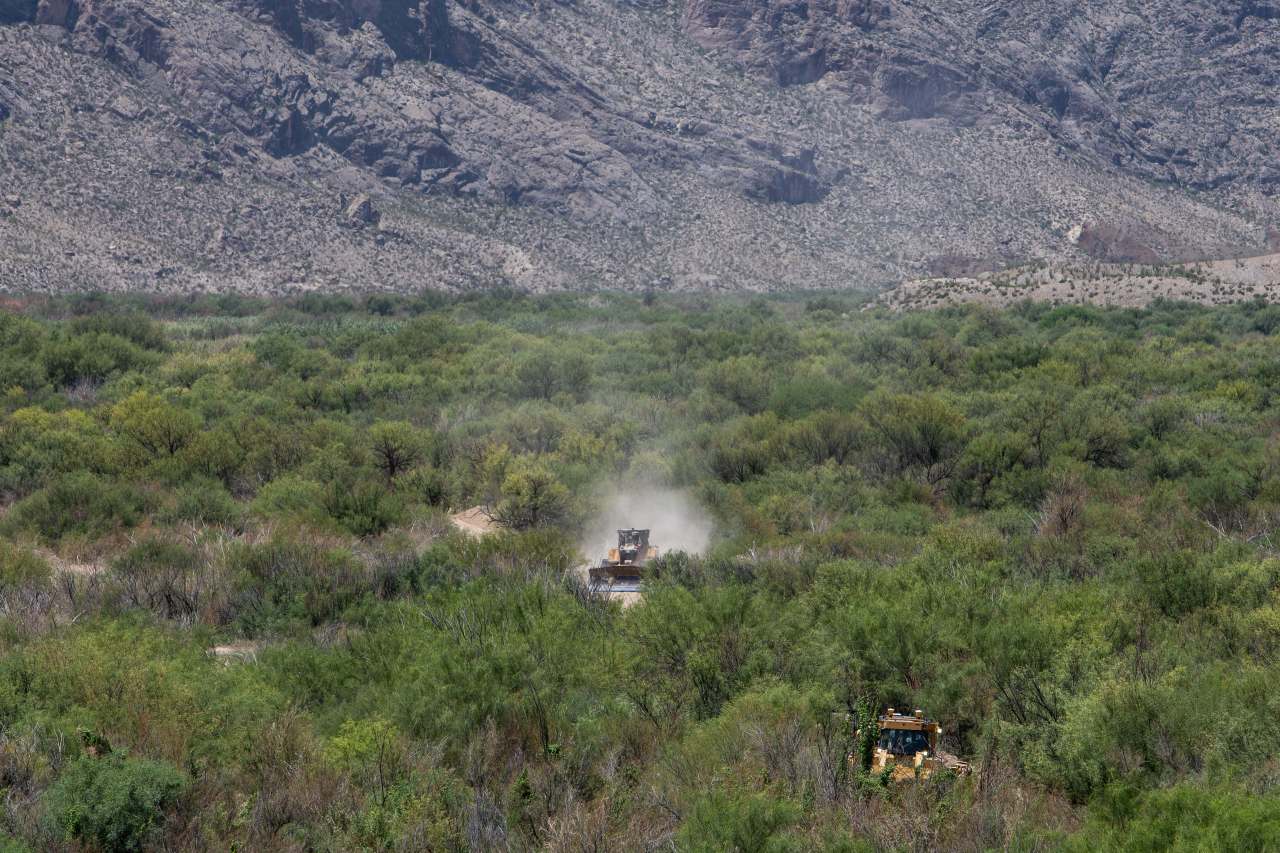
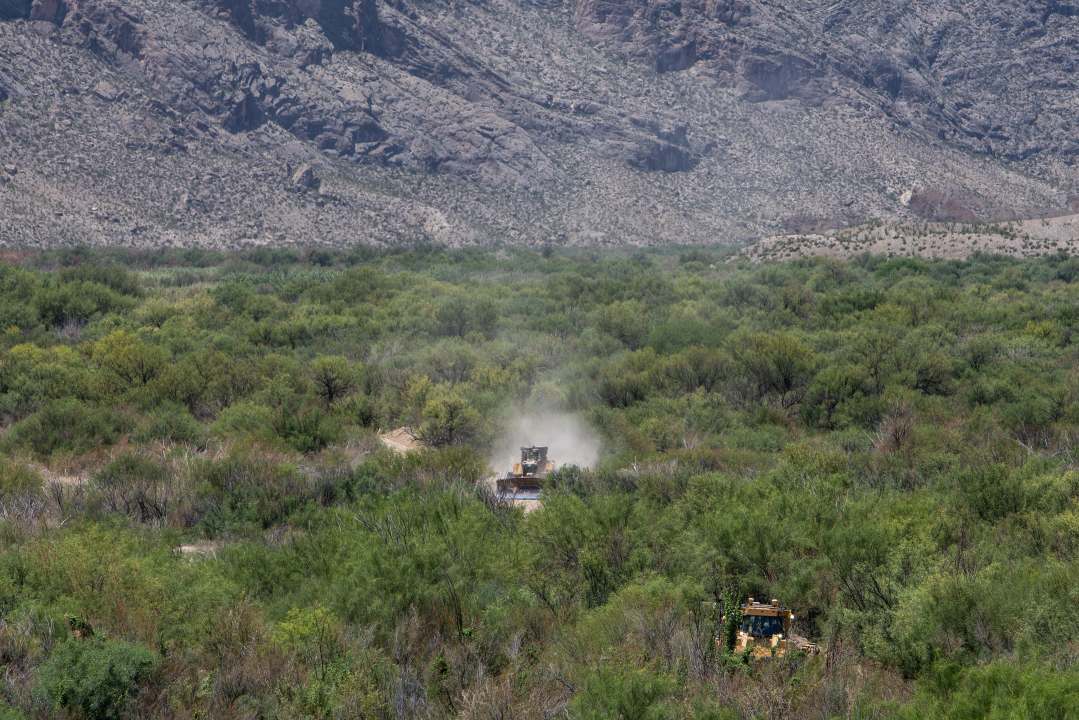 A bulldozer clears a pathway in Big Bend National Park, Texas, Aug. 12, 2026. The Trump administration has moved heavy-duty construction equipment into Big Bend National Park and started work on a border security project despite bipartisan concern about damage to the environmentally sensitive area of West Texas. (Kaylee Greenlee/Bloomberg via Getty Images)
“Big Bend belongs to the American people, and our job is to keep it safe,” Scott said in a statement provided to Border Report.
Big Bend residents, local sheriff question CBP border infrastructure plans
He also mentioned the first step in securing the border is knowing who and what is entering the country. “These improvements will help our agents detect illegal crossings, respond faster, and assist visitors in danger.”
Scott added his agency will continue strengthening security across the Southwest to prevent cartels from shifting their routes and exploiting the Big Bend region.
Strong security presence at the US-Mexico border aims to disrupt cartel operations
“We are securing this park to protect its legacy — keeping it safe, secure, and pristine so American families can enjoy the beauty of our country, free from fear of cartel activity, for generations to come.”
Scott also sought to clarify activity currently visible in the region.
“What people are seeing right now is survey and design work — NOT construction of a wall through the park,” Scott said.
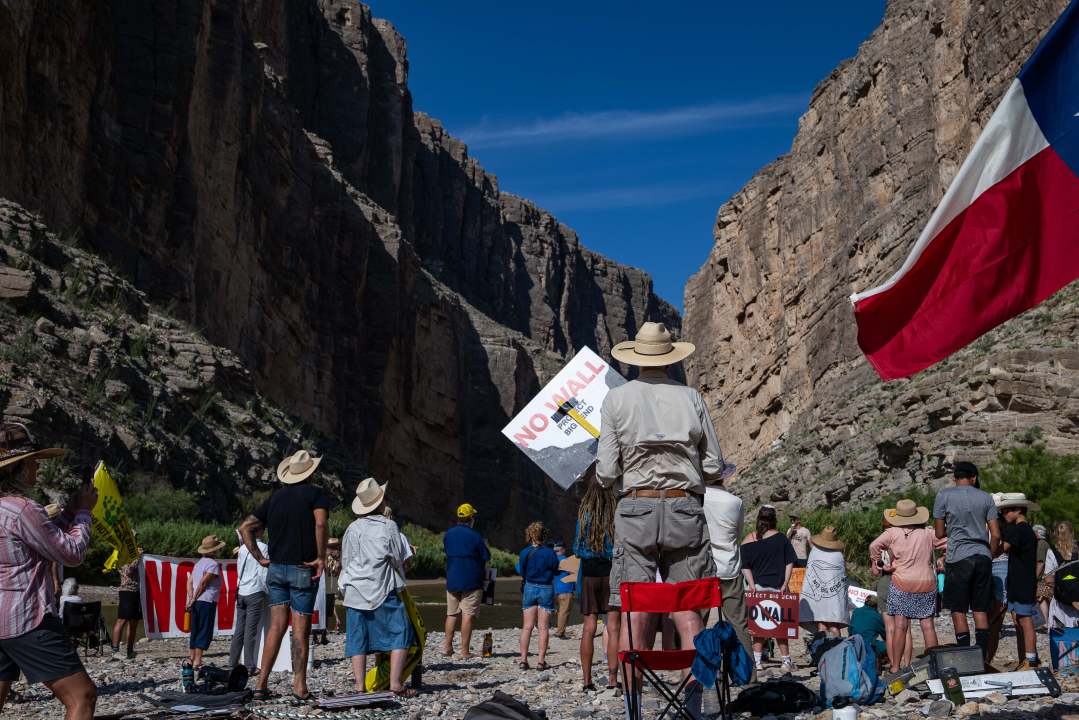 Demonstrators protest at Santa Elena Canyon in Big Bend National Park, Texas, on Wednesday, Aug. 12, 2026. The Trump administration has moved heavy-duty construction equipment into Big Bend National Park and started work on a border security project despite bipartisan concern about damage to the environmentally sensitive area of West Texas. Photographer: Kaylee Greenlee/Bloomberg via Getty Images
No Big Bend Wall, a coalition of border wall opponents in the Big Bend Region, questioned Scott’s statement.
In a statement to Border Report, the group said Scott and other officials in Washington, D.C., are contradicting and downplaying what they are seeing first-hand.
“Here on the ground it’s a different story than the one they are spinning in DC,” No Big Bend Border Wall said. “It’s not just one new road. It’s an unprecedented 80 miles of new road cut through our National Park. It’s pointless clear-cutting alongside existing park roads. It’s closures of our public lands and roads.”
The group also said CBP’s plan has raise questions to which they have not received answers:
Will they trench for fiber optics?
What type of lighting will we see added to the park, and how much of it?
How wide will the patrol road be?
How will it affect visitor access to the river?
What campgrounds, trails, or backcountry roads will be affected?
What happens when the construction is done? Who will maintain all of this infrastructure they are adding while our national park service budgets are getting slashed?
They also raised concerns about the use of limited resources for border wall construction.
“At the end of the day, we don’t want or need any of it,” No Big Bend Wall. “The border is already secure here. We believe that there are modern, proven border security solutions that don’t require vehicle barriers, steel bollards, additional patrol roads, lights, or new fiber optics.
Other say Scott’s the announcement does not address all concerns about border construction in the broader Big Bend region.
Proposed ban on Big Bend border wall fails in US House funding panel
Arlinda Mesa, a descendant of a victim of the Porvenir Massacre, told Border Report the historic site is outside Big Bend National Park, closer to Marfa and along the Rio Grande.
“It’s a win for Big Bend Park, but it still does not protect the site of Porvenir,” she said.
Porvenir was a small farming and ranching community in Presidio County where 15 Mexican and Mexican-American men and boys were killed by Texas Rangers on Jan. 28, 1918.
Porvenir is in northwest Presidio County along the Rio Grande, across from Pilares, Chihuahua, and southwest of Valentine.
Big Bend glamping business denounces border wall plans
For descendants of the victims of the massacre, the land is more than the location of a century-old tragedy. Archaeologists continue to investigate the site and have recovered evidence connected to the killings. Arlinda said she fears that construction could permanently destroy evidence still in the ground.
“It’s a crime scene. It’s an archaeological site. And it’s a place of memory,” she said.
She said archaeologists continue working to answer questions surrounding the massacre and believes construction should remain away from the site.
“You just don’t bulldoze over that because, I mean, you’re going to lose all the evidence,” she said. “To me, it’s sacred land.”
Mesa told Border Report she has seen reports that crews are clearing roads near the massacre site and said she fears the work could eventually make way for a physical border barrier. She also said contractors are working on the border wall project about 30 feet from the massacre site.
Big Bend border wall plans canceled for national park after backlash, CBP commissioner says
Valencia also said neither she nor, to her knowledge, other descendants have been contacted by CBP about plans near Porvenir or invited to participate in discussions about protecting the site.
Scott said CBP wants to protect the Big Bend landscape while preventing criminal organizations from exploiting the region.
“The first step in securing our border is knowing who and what is entering our country,” Scott said. “These improvements will help our agents detect illegal crossings, respond faster, and assist visitors in danger.”
Mesa cannot agree more. She does not oppose securing the border; instead, she wants the federal government to use technology in historically sensitive areas.
“Not that I don’t want the borders to be secure,” she said. “I want it to be secure because I believe in that.”
She said cameras, drones and other detection technology could provide security without permanently altering the Porvenir site.
“There are a lot of ways to do it other than destroying it,” she said.
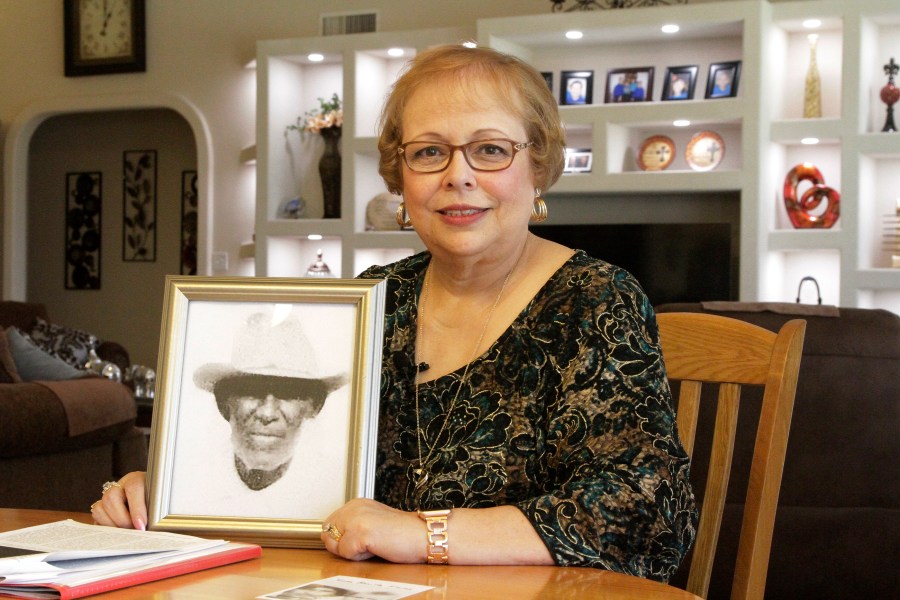 In this April 30, 2019, photo, Arlinda poses at her home in El Paso, Texas, with a portrait of her great-grandfather Longino Flores, who was murdered at the age of 44 by Texas Rangers and U.S. Army soldiers in the Porvenir Massacre of 1918. (AP Photo/Cedar Attanasio)
For Mesa, the dispute is also deeply personal. Her ancestor, Longino Flores, was among those killed at Porvenir.
She described Flores as a family man who lived and worked in the village, where residents raised cattle, sheep and goats and grew crops. The massacre, she said, destroyed not only individual families but the community itself.
“They lost their fathers, their husbands,” she said. “The little community that they had, they lost that community.”
She said her family continued to suffer from the killings for generations, including her great-grandmother, who lost her husband in the massacre.
Arlinda has spent more than 30 years working to preserve the history of Porvenir and said descendants should have a voice before federal construction permanently changes the landscape.
“We just need to protect history, number one,” she said. “And we need to protect the land.”
For her, Scott’s announcement represents a victory for Big Bend National Park and the other protected areas — but not the end of the border-wall fight in Presidio County.
“The saving of Big Bend is great news,” she said, “but it’s not for Porvenir.”
Aracely Lazcano can be reached at alazcano@borderreport.com
Editor’s note: This article has been updated with a statement from No Big Bend Wall, a grassroots advocacy movement and community campaign opposing federal plans to construct a border wall and heavy infrastructure through the remote Big Bend region of West Texas.