

The Tegna Inc. headquarters on March 20, 2026 in Mclean, Virginia. Multiple states have joined a federal lawsuit to block a merger between Nexstar Media Group and Tegna which was approved by the Federal Communications Commission earlier this year.
Andrew Harnik/Getty Images
The Tegna Inc. headquarters on March 20, 2026 in Mclean, Virginia. Multiple states have joined a federal lawsuit to block a merger between Nexstar Media Group and Tegna which was approved by the Federal Communications Commission earlier this year.
Andrew Harnik/Getty Images
The Tegna Inc. headquarters on March 20, 2026 in Mclean, Virginia. Multiple states have joined a federal lawsuit to block a merger between Nexstar Media Group and Tegna which was approved by the Federal Communications Commission earlier this year.
Andrew Harnik/Getty Images
Come September, when viewers of CW39 flip to the channel for the 9 p.m. news, they’ll be greeted with the unfamiliar faces of Len Cannon and Mia Gradney, the evening broadcasters on KHOU, Houston’s CBS affiliate.
The seemingly minor programming switch — CW39 currently leases its nightly broadcast from ABC13 — is among the first shifts in the Houston media market following the proposed merger of broadcasting giants Nexstar and Tegna, which would create one of the largest local television companies in U.S. history.
In April, the Federal Communications Commission approved the $6.2 billion merger of the rival television conglomerates, paving the way for Nexstar to own 256 stations across 80% of the country’s media markets, including 42 stations in Texas, covering approximately 98.1% of the state’s population.
Article continues below this ad
In Houston, Dallas-Fort Worth, Austin and 11 other markets, Nexstar is poised to control at least two stations.
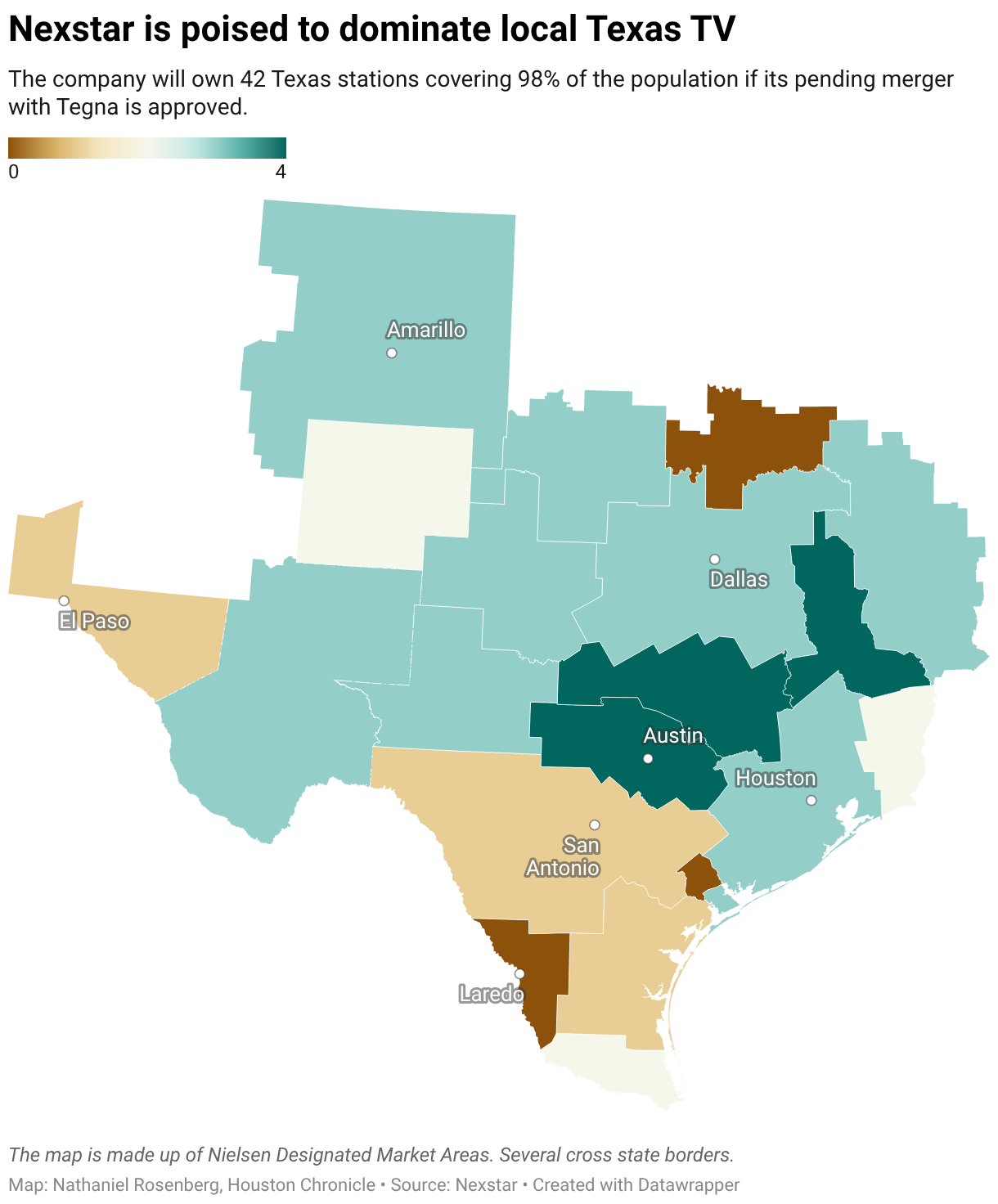
President Donald Trump has trumpeted the deal, saying it “will help knock out the Fake News because there will be more competition.” But the merger is currently held up in federal court, after a bipartisan coalition of 13 states sued to block the union on antitrust grounds. Texas did not join the suit, and the state’s Attorney General’s office did not respond to a request for comment.
Tegna didn’t respond to requests for comment. Nexstar, which is headquartered in Irving, declined to comment on specifics of the merger, citing the ongoing litigation. Its executives have argued that the merger is essential for the survival of local television journalism, which they say is increasingly eclipsed by YouTube, streaming and other social media platforms.
Article continues below this ad
Nexstar CEO Perry Sook speaks on stage during NATPE Miami 2020 – Iris Awards at Fontainebleau Hotel on January 22, 2020 in Miami Beach, Florida.
Jason Koerner/Getty Images
Andy Alford, Nexstar’s president of broadcasting, described the programming shift at CW39, which it has owned since 2019, as an “arm’s-length relationship between two distinct organizations.” Tegna owns KHOU.
At the same time, he heralded the pending merger as an opportunity to produce better journalism in Houston by combining the “talent, resources and capabilities” of KHOU and CW39.
“We continue to believe that a future integration of our newsrooms is a better outcome that will create even greater opportunities to serve our community while strengthening and preserving local journalism,” Alford said in a statement.
But media observers and antitrust scholars warned that in the long run, the merger and other moves by the FCC to lift limits on industry consolidation would likely lead to layoffs of newsroom staff and a decline in both the amount and diversity of local news coverage across Houston, its suburbs and other major Texas media markets.
Article continues below this ad
“It’s unhealthy if one company dominates local broadcasting,” Nikolas Guggenberger, an antitrust and media law professor at the University of Houston, said. “On the labor side, I think it also has the potential to have devastating consequences.”
An ‘inflection point’ for the TV news industry
Both Nexstar and critics of its merger with Tegna agree that the television news business has suffered over the last 20 years. Viewership has steadily declined, with eyeballs increasingly drawn to streaming services and social media, resulting in fewer advertising dollars and decreased revenue in local TV.
Zachary Metzger, the director of the State of Local News Project at Northwestern University, likened the current television landscape to the state of newspapers in 2005: on the verge of a dramatic reduction in staffing and ownership consolidation due to steadily declining earnings.
Mike McGuff, a local media blogger and former CW39 reporter, said the industry-wide decline was a major factor in the carousel of hires and departures at Houston-area stations over the past few years.
Article continues below this ad
Ron Bansett ,an engineer at KHOU-TV runs sound checks in the control room Friday, Feb. 2, 2007, at KHOU-TV building in Houston.
Nick de la Torre/Houston Chronicle via Getty Images
“Houston is probably more stable than a smaller market, but still it’s not as stable as it used to be,” McGuff said. “(Employees) are moving around a lot more, and looking to get out as the stability goes away.”
Last Thursday, in a move celebrated by Nexstar, the FCC eliminated a cap that prevented companies from reaching more than 39% of television viewers nationwide. The commission’s chair, Brendan Carr, presented the change as an opportunity to level the playing field between television and tech conglomerates, which don’t face similar restrictions.
But the lone Democrat on the FCC blasted the move as illegal, and many critics argued that it swept aside a rule meant to safeguard a healthy diversity of perspectives in local news.
“It’s unhealthy if one company dominates local broadcasting; it’s a media pluralism concern,” Guggenberger, the media law professor, said.
Article continues below this ad
TV layoffs loom in Houston, statewide, experts say
The potential impact of the pending merger is still unclear.
Nexstar hasn’t announced any internal changes, including potential staff cuts or plans to physically combine the KHOU and CW39 newsrooms.
But cost cuts are likely, said media professors and experts. Industry consolidation, Guggenberger notes, tends to reduce both wages and overall employment, as workers have less leverage to negotiate higher salaries.
KHOU 11 Reporter Troy Kless delivers a live reporting from East Meadow Drive as the pipeline fire continues burning in the background Monday, Sept. 16, 2024 in Deer Park.
Yi-Chin Lee/Houston Chronicle via Getty Images
“I think we will be seeing a dramatic shrinking of these newsrooms,” Metzger, the media researcher, said. “That trend is only going to accelerate under massive chain ownership.”
Metzger said his research shows that media mergers typically lead to a more impoverished reporting landscape. There’s often less education coverage, less local business news and suburbs are neglected in favor of crime stories and a focus on bigger cities.
If there’s a saving grace for Houston, McGuff argues, it’s that the local television market is both large and less ripe for consolidation than in other major Texas cities. Metzger also thinks it remains a “pretty vibrant news city.”
Most of the prominent stations are already owned by large national media brands (including Nexstar, Disney, Fox and Univision) who are not currently looking to sell, according to McGuff.
But the impacts of the Nexstar merger and FCC changes are more likely to be felt in regions like Austin, Lubbock, or the Rio Grande Valley, where Nexstar is set to own both top stations, rather than the comparatively smaller CW39 and the larger KHOU.
“When these newsrooms shrink down… there no longer is that feeling of ‘these are people who I can I trust, who are telling stories about me and are invested in telling stories about my community'” Metzger said. “People don’t see enough stories about themselves.”