
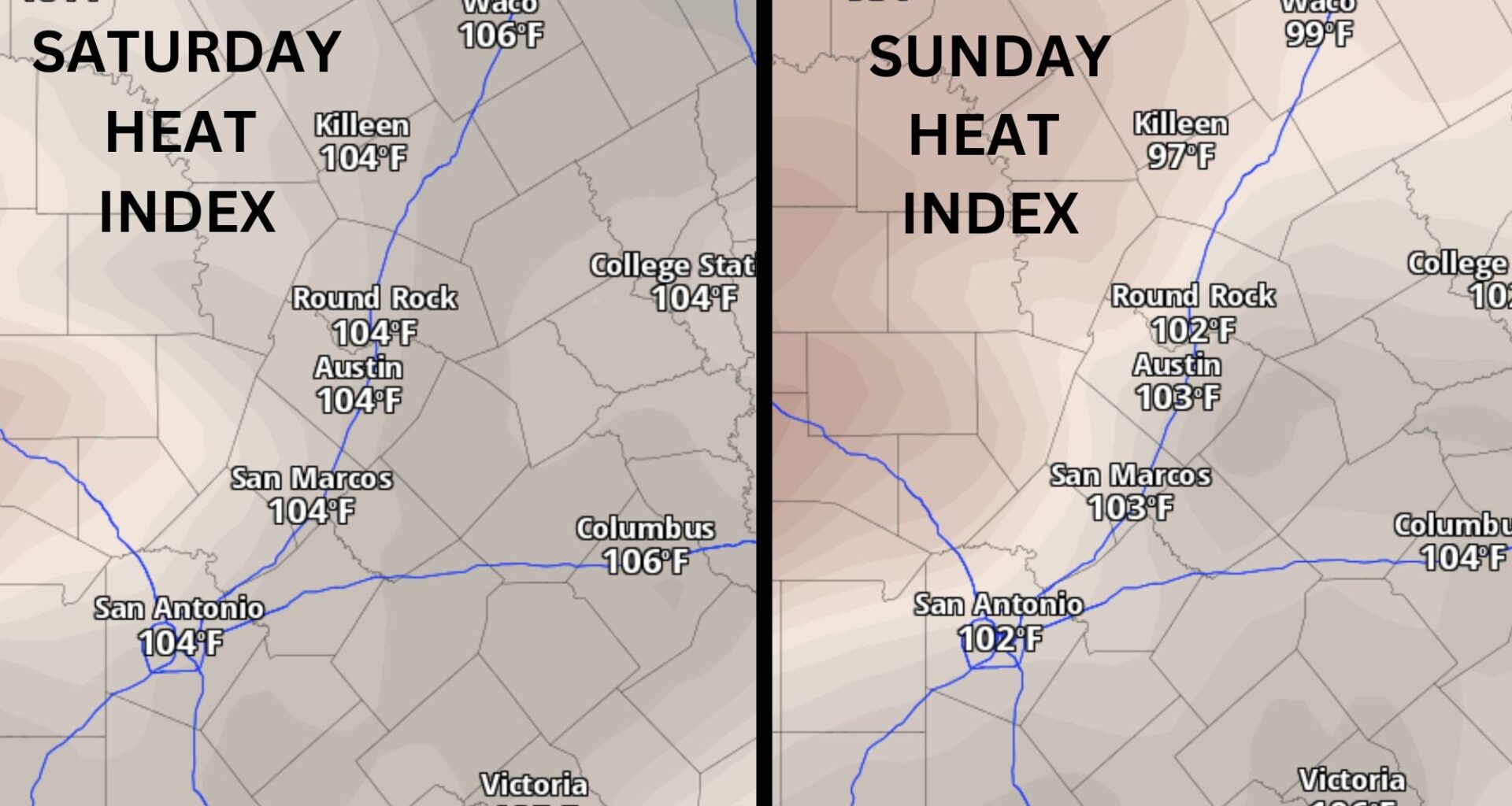
Temperatures in Texas will be in the upper 90s and low 100s but with the humidity, it will feel even hotter, according to the projected heat index values.
Pivotal
Austin recorded its hottest day of the year so far, with temperatures reaching 104 degrees on Thursday at Camp Mabry, the city’s main weather observation site. Then on Friday, Austin wrapped up what is, statistically speaking, its hottest period of the year, when daily temperatures, on average, peak at 99 degrees.

But this whole month of August has been anything but average. Since Aug. 1, Austin’s average peak daytime temperature is 100.6 degrees, nearly 2 degrees higher than normal, and temperatures are expected to stay above 100 degrees Saturday, through the weekend and into much of next week.
Article continues below this ad
Average temperatures, based on 30 years of recent weather history, represent only the middle ground for this time of year. If we lived in a world of averages, Saturday would mark the point when we start a gradual cooling trend. Our average daytime high temperatures would begin to dip, reaching 98 degrees, and then 95 degrees by the end of the month.
Normally, this seasonal shift would mean that, over the next few weeks, the extreme heat — especially the long stretches of consecutive triple-digit temperatures — would gradually become less frequent. But Texas weather has always had a hard time being average, and this week is no different.
Weekend forecast
Hot and dry weather returns Saturday after a brief break Friday, when a few spotty showers and slightly cooler temperatures are expected across the region.
Article continues below this ad
After a cloudy start Saturday, skies will turn sunny, with breezy and hot weather developing through the afternoon. Highs will range from 98 to 102 degrees, with humidity pushing heat index readings to between 102 and 108 degrees.
By Sunday, the ridge of high atmospheric pressure — often referred to as a heat dome — will shift west from the southeastern United States, bringing a renewed surge of summer heat and humidity to Central Texas.
How far does the heat expand?
Currently, excessive summer heat stretches from Texas all the way to the East Coast, with several record-breaking temperatures expected throughout the weekend and at least 16 states under heat alerts.
Article continues below this ad
“Extreme heat warnings across a large section of the central United States with forecast highs in the upper 90s into the 100s along with high summer-time humidity in place will lead to heat indices in the 105- to 115-degree range,” forecasters from the Weather Prediction Center wrote in their Friday weather discussion. “Some record-tying or breaking highs will be possible as many areas see their hottest temperatures of the year so far, or even in the past few years in some cases.”
Record heat is likely over several states across the southeastern United States.
National Weather Service
The heat risk to public health on Saturday, according to the National Weather Service. Parts of the lower Mississippi River Valley will face extreme heat risk from excessive humidity and soaring temperatures.
National Weather Service
The heat risk to public health on Sunday, according to the National Weather Service. Areas from Arkansas to Alabama will face extreme heat risk from excessive humidity and soaring temperatures.
National Weather Service
The heat risk to public health on Monday, according to the National Weather Service. Nearly all of Mississippi and most of Alabama will face extreme heat risk from excessive humidity and soaring temperatures.
National Weather Service
The heat risk to public health on Tuesday, according to the National Weather Service. Most of Mississippi and much of the Gulf Coast into Florida will face extreme heat risk from excessive humidity and soaring temperatures.
National Weather Service
The heat risk to public health on Wednesday, according to the National Weather Service. Much of the southeastern United States will face extreme heat risk from excessive humidity and soaring temperatures.
National Weather Service
It’s not just the daytime temperatures creating problems, it’s the lack of overnight relief, too. Warm morning temperatures will provide little opportunity for the body to recover from the day’s heat. As a result, widespread areas are experiencing major to extreme levels of heat risk to public health, according to the National Weather Service, indicating dangerous conditions for those without access to adequate air conditioning or hydration.
Article continues below this ad
Unfortunately, the heat wave across the Deep South looks to continue well beyond the weekend and into next week for some of the same areas.