
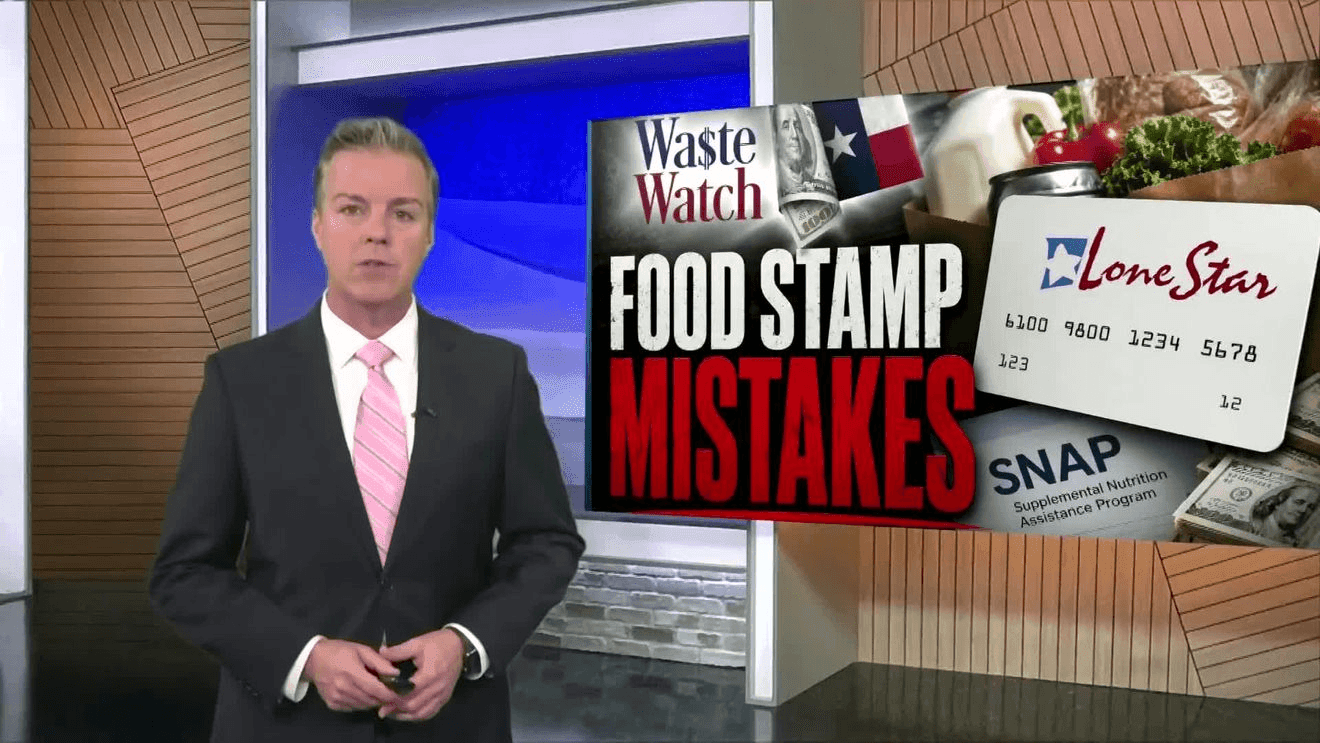
Texas taxpayers could soon be stuck with an $826 million bill because of mistakes in the state’s food stamp program.
In this week’s Waste Watch, KFDM is looking at how errors in the Supplemental Nutrition Assistance Program — better known as SNAP or food stamps — could force Texas to spend hundreds of millions of dollars more.
And this isn’t primarily a story about welfare fraud.
It’s about getting the numbers wrong.
The latest federal figures show Texas had a 9.34% SNAP payment error rate during fiscal year 2025.
The U.S. Department of Agriculture released the numbers June 24.
Dig deeper and the bigger problem is overpayments.
Texas recorded a 6.99% overpayment rate, meaning some households received more food stamp benefits than they should have.
Another 2.35% involved underpayments, meaning some households didn’t receive enough.
Texas did perform better than the national SNAP error rate of 10.62%. But that isn’t good enough to avoid a potentially expensive consequence for Texas taxpayers.
USDA says a SNAP payment error is not necessarily fraud. The error rate measures whether states correctly determine who qualifies for benefits and how much a household should receive. (fns.usda.gov)
Most Texas errors come from the state
The mistakes can originate with recipients or with the government workers administering the program.
But in Texas, most come from the state.
More than 60% of Texas’ SNAP errors come from state workers, Texas Health and Human Services Commission Executive Commissioner Stephanie Muth told lawmakers, according to The Texas Tribune. (texastribune.org)
Those can include mistakes processing a case or calculating eligibility and the proper benefit amount.
And those mistakes are about to become much more expensive.
A $709 million penalty
The federal government wants states to keep their SNAP error rates below 6%.
Texas is currently at 9.34%.
The Texas Tribune reports Texas could face roughly a $709 million federal penalty if it can’t bring that rate down before the new rules take effect.
That’s not the only additional expense.
Texas currently shares the administrative cost of running SNAP with the federal government. Under the new rules, Texas will have to pay 75% of those administrative costs instead of 50%.
Texas HHS estimates that will cost state taxpayers another $117 million.
Do the math:
$709 million federal penalty
+ $117 million in higher administrative costs
= $826 million more for Texas taxpayers
Fraud is a different problem
Food stamp fraud does happen.
It can include people intentionally lying about income to receive benefits they don’t qualify for, selling SNAP benefits for cash, or retailers illegally exchanging benefits for cash or prohibited products.
But USDA stresses that its payment error rate is not a fraud rate.
In this case, the problem can be something much simpler: the wrong information, the wrong calculation or the wrong benefit amount.
SNAP currently provides food assistance to about 3.1 million low-income Texans, including roughly 1.5 million children, according to The Texas Tribune. Texas households receive an average of nearly $400 a month in benefits loaded onto the state’s Lone Star Card.
Texas is working to reduce the error rate before the federal penalty takes effect in October 2027.