
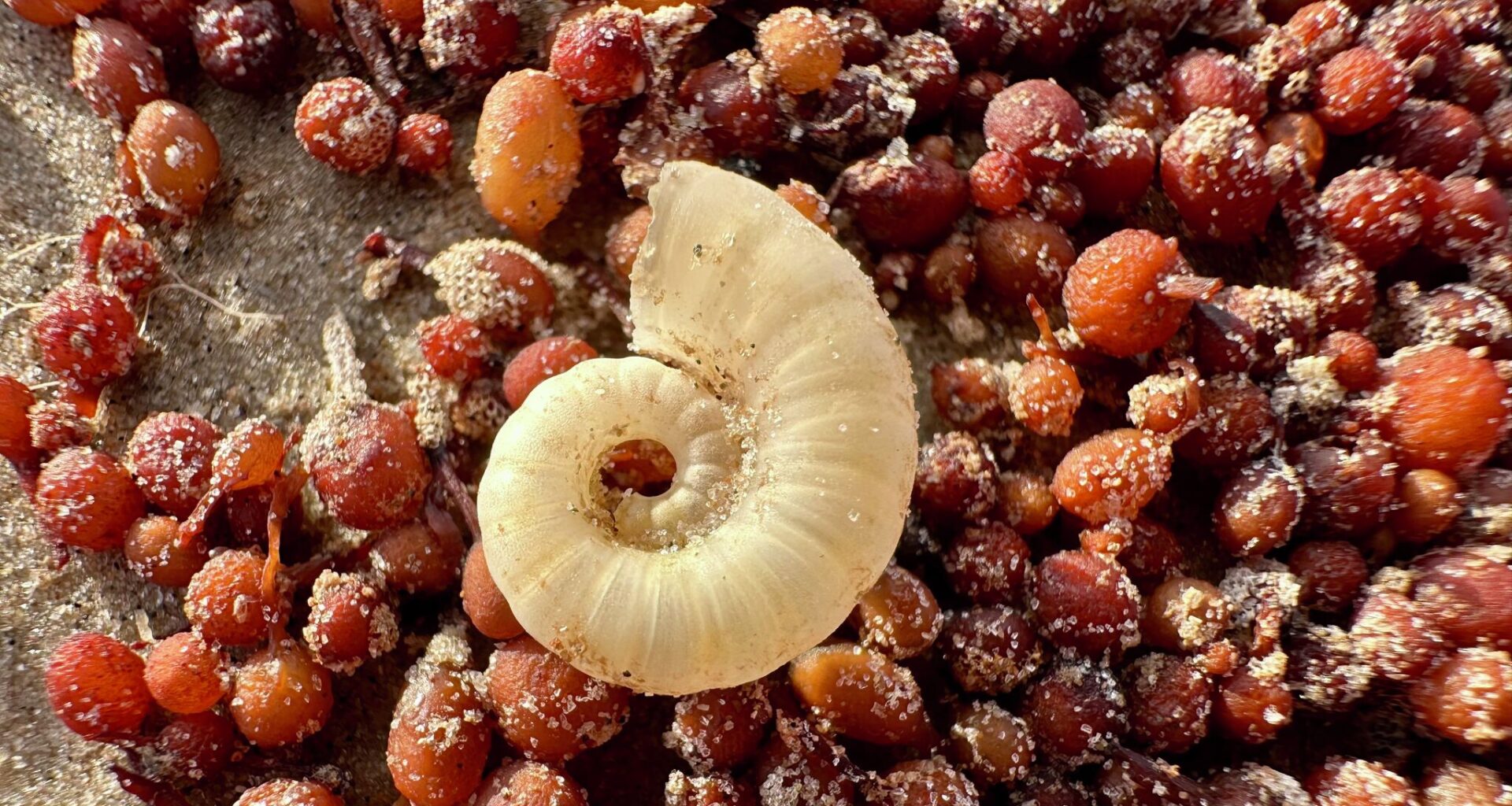
It’s not your typical seashell. And it’s an incredibly rare find that comes from some of the darkest stretches of ocean deep, according to Jace Tunnell, director of community engagement for the Harte Research Institute at Texas A&M University – Corpus Christi.
In his latest beachcombing video, Tunnell can be seen holding up a “nautilus-shaped” object between his thumb and forefinger. What appears to be a bone-white shell curls in a delicate, segmented spiral about an inch across.
“What if I told you this comes from a squid?” Tunnell said.
“It comes from the ram’s horn squid — also called ‘little post horn squid’,” he said.
The shell in Tunnell’s hand came from a species of deep sea cephalopod mollusk called Spirula spirula. It is the only living species of its kind, according to the Australian Museum. The creatures are small, measuring less than 3 inches long. And their lifespans are believed to be short — just 18 to 20 months, according to the museum.
The spiral shaped shell is an internal structure found at the animal’s rear, behind its head and eight retractable arms and two suckered tentacles. Inside the spiral are separate chambers that allow the squid to control its buoyancy as it floats in the mesopelagic layer of the world’s oceans — what is commonly called the “twilight zone” — that lies between 660 to 3,280 feet below the water’s surface. Little sunlight reaches that depth. As a result, the ram’s horn squid is capable of producing its own light through a bioluminescent organ at the very tip of its mantle called a photophore. Captured squids have been observed glowing for hours at a time.
But not much else is known about the tiny animal, with most specimens being found “by accident” when they’re caught up in the nets of deep sea trawlers, Tunnell said. Ram’s horn squids have been observed in their natural environment just once — on October 27, 2020 when scientists at the Schmidt Ocean Institute, based out of Palo Alto, California, conducted a series of dives using a remotely-operated vehicle.
Cameras aboard the research submersible captured nearly five minutes of footage of a single ram’s horn squid swimming off the continental slope of the Great Barrier Reef in Queensland, Australia at a depth of more than 2,700 feet below the surface, according to a scientific article published by the Multidisciplinary Digital Publishing Institute.
When the squids die, their spiral-shaped shells float and can be carried along the water in mats of seaweed, like the clumps of sargassum seaweed that often washes ashore in Texas.
“I’ve been walking along the high tide line and I found four of these today. That’s pretty rare,” Tunnell said.