
BREWSTER COUNTY, Texas — U.S. Customs and Border Protection Commissioner Rodney Scott met Tuesday with border sheriffs and county judges in Brewster County as the fight over border construction in the Big Bend region enters a new phase.
The meeting came after Scott announced construction activity inside Big Bend National Park would be paused while he traveled to the region for an on-the-ground evaluation.
Terrell County Sheriff Thaddeus Cleveland was among the officials in the room. The former Border Patrol agent has known Scott for nearly three decades.
“Yes, Rodney Scott and I are friends. We worked out in Nogales 28 years ago. He actually took me to headquarters with him back in about 2007,” Cleveland said.
Despite that history, the two have not always seen eye to eye on the Big Bend project.
Cleveland said Scott did not design the original plan and instead inherited it from former Homeland Security Secretary Kristi Noem.
“Kristi Noem, she was secretary. She went behind his back. She rolled this out without any type of coordination with Rodney as the commissioner of CBP,” Cleveland said.
That is Cleveland’s characterization of what happened between Noem and Scott.
According to the sheriff, Scott had already scaled back the project before this week’s controversy and could make additional changes following Tuesday’s meeting.
“I think there’s still going to be more reductions made here in the Big Bend area,” he said.
Local leaders could have more say
Tuesday’s discussion focused heavily on giving local leaders a greater voice in what happens next.
“The meeting was great,” Cleveland said. “He said he’s willing and he committed to working with the locals here, the local stakeholders … to ensure their interests are listened to, that their suggestions are listened to and considered, and I think we’ll see some of the project dialed back.”
That could include reconsidering where vehicle barriers are needed.
“If we can defend a vehicle barrier not being needed in a certain area, then he’ll listen to that and consider that,” he said.
Local leaders also raised the possibility of using existing roads rather than cutting new ones through Big Bend.
“There’s plenty of roads in Big Bend National Park that Border Patrol already uses,” Cleveland said.
The discussion included potentially burying fiber-optic infrastructure along those existing routes rather than creating new roads.
Cleveland believes that could benefit both the park and Border Patrol.
Construction paused for at least two weeks
The meeting also provided more clarity about how long the current construction pause could last.
Scott told the group construction would remain paused for a minimum of two weeks, according to Cleveland.
But that does not mean the machinery automatically starts moving again when those two weeks are over.
“He said he’s got the construction paused that will remain paused at least for two weeks,” Cleveland said. “He said he’s not going to start it right back up in two weeks.”
Instead, Scott plans to give stakeholders time to work through their concerns and present recommendations.
Whatever is presented, Cleveland said Scott will review it while considering both national security and local concerns.
“It’s not a one size fits all”
One of the biggest disagreements surrounding the project is whether the same type of border infrastructure should be used across vastly different terrain.
“What works out here in Big Bend won’t necessarily work in San Diego, or what works in San Diego or Arizona is not going to work out here in Big Bend,” Cleveland said. “It’s not a one size fits all.”
He pointed to technology and additional agents as alternatives that could play a larger role in this part of the border.
“Technology, more boots on the ground, men and women with badges on their chests,” he said.
Cleveland argued that roads, barriers and technology can only accomplish so much without enough Border Patrol agents to respond.
“No matter how much infrastructure, such as roads, no matter how much technology, if you don’t [have] enough men and women to go out there and do the job, that other stuff, it’s wasted,” he said.
Contractor complaints raised with Scott
The meeting also touched on concerns involving contractors working along the border.
Cleveland described reports in Val Verde County involving contractors entering private property after locks or chains were cut.
“Some of those were spoke about down in Val Verde County, where landowners’ locks have been cut, chains have been cut,” he said.
According to Cleveland, Scott said he would raise those issues with the contractors.
The sheriff also said some crews being sent into remote areas may not have the same knowledge of the land as local property owners and law enforcement.
“Some of them have forcibly gone into some of these properties,” he said.
Cleveland also stressed that contractors are private citizens carrying out federal contracts and said local law enforcement has a responsibility to make sure disputes involving contractors, landowners or protesters are resolved peacefully
A border security sheriff says Big Bend is different
Cleveland has been one of the most vocal border security sheriffs in Texas, and he made clear his concerns about Big Bend do not mean he opposes barriers everywhere.
“Again, I believe in border security,” he said. “And I believe in barriers where barriers are needed.”
But he draws a distinction when it comes to this region.
“But this area, we don’t need a barrier,” Cleveland said. “We don’t need to take one for the team.”
He also argued that the federal government has technology available that could provide additional security without relying exclusively on physical barriers.
For Cleveland, the debate is also personal.
A native of the region, he spent years working the border and continues to visit Big Bend National Park.
Asked how he felt when he saw bulldozers moving across the landscape, his answer was immediate.
“Extremely disappointed,” he said.
“I’m a native of this area. … It’s beautiful, and there’s damage has been done.”
Despite that disappointment, Cleveland said he remains confident Scott will listen.
“I’m confident in Rodney Scott’s willingness to cooperate,” he said. “He’s a man of his word, a man of integrity.”
“The sounds of the earth crying”
For Billy Bartko, one of the owners of Far Flung Outdoor Center, the controversy has played out both on the ground and online.
Bartko has been watching the work up close and sharing what he sees with the world through social media, where some of the footage has drawn millions of views.
Watching the bulldozers was difficult. Hearing them was worse.
“The sounds of the earth crying when they were taking an excavator and just ripping through the desert is probably the hardest thing,” Bartko said.
He described Big Bend as a serene and fragile habitat.
“Actually hearing them ripping through the rocks and ripping into the earth is devastating,” he said.
Bartko believes some of the damage cannot simply be undone.
He pointed specifically to a new patrol road near Mariscal Canyon, in the foothills of Mariscal Mountain.
“That will never be the same,” he said. “It is completely permanently altered forever.”
He also described work near the Solis takeout and campground and said trees were removed in the riparian area near Santa Elena Canyon.
In his view, the cumulative impact amounts to an essentially irreversible alteration of the landscape.
Relief, but not trust
Now that construction inside the park has been paused, Bartko said there is some relief.
But he is not ready to trust that the fight is over.
“Trust is earned, not given,” Bartko said. “We’re cautiously optimistic.”
“We’re very grateful that they are not tearing up the national park as we speak right now,” he added.
He said there remains “a real underlying sense of distrust” as residents wait to see what comes next.
Next fight comes to San Antonio
The next major decision could come in federal court.
Bartko is part of the legal challenge seeking to stop the project.
“We have a hearing for the injunction,” he said. “It will be on August 28 there in San Antonio in the Western District of Texas Federal Court.”
Bartko said it is his understanding that CBP has agreed to halt work inside Big Bend National Park until Aug. 31, allowing the court hearing to take place before work could resume.
“We should be able to get our TRO hearing done before there’s any more work done inside the national park,” he said.
“We’ve already taken one for the team”
Bartko also pushed back on arguments that protecting national security requires the Big Bend region to accept the project.
He cited the remoteness of the region and the relatively small number of migrant crossings he says occur inside the national park.
“We’ve already taken one for the team,” Bartko said. “Keeping it wild and scenic and its natural state is taking one for the team.”
The crossing statistics Bartko cited during the interview have not been independently verified by FOX San Antonio.
“We’re watching”
Residents also plan to continue documenting what happens during the pause.
“I think it’s critically important that he realize we’re watching and we’re going to keep documenting and displaying what’s going on,” Bartko said of Scott.
He wants greater transparency from the federal government about exactly what is planned for the region.
“We want transparency from the government,” he said. “I think the American people deserve transparency.”
Bartko also described a volunteer effort to rescue plants and protect other resources that could be affected by construction.
“We love the park,” he said. “This is the way of life for us. It’s our backyard.”
The effort has included plant rescue work, monitoring construction, trips to Washington and participation in lawsuits.
“You can never underestimate the heart of a volunteer,” Bartko said. “We’re all volunteering to save Big Bend.”
He also raised concerns about archaeological resources throughout the region, which has been inhabited for thousands of years.
“There is so much archaeological value to this area,” Bartko said.
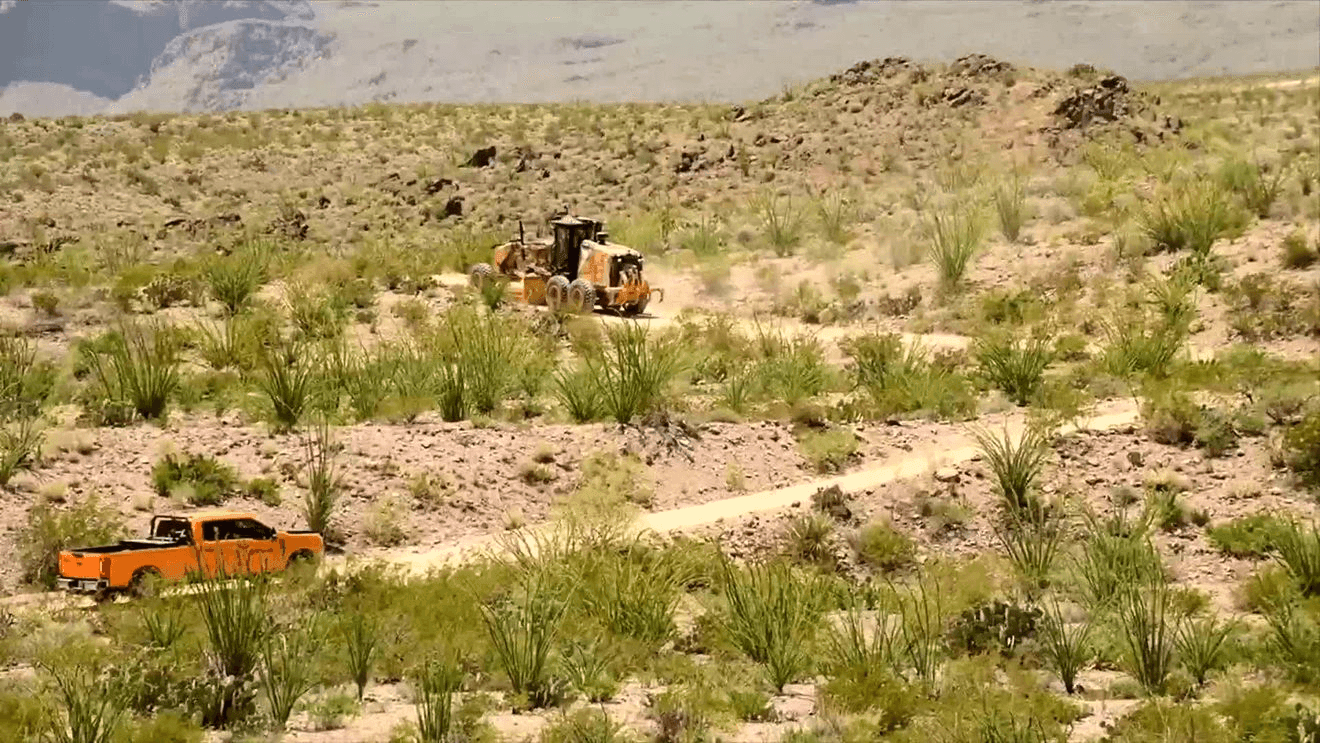
For now, the bulldozers inside Big Bend National Park are quiet.
The project has not been canceled.
But Tuesday’s meeting gave border sheriffs and county leaders a direct opportunity to make their case to Scott about where barriers are needed, where existing roads could be used and whether technology and additional personnel could provide alternatives.
At the same time, opponents are preparing for an Aug. 28 federal court hearing in San Antonio.
The next two weeks could help determine not only when construction resumes, but how much of the original plan remains when it does.