
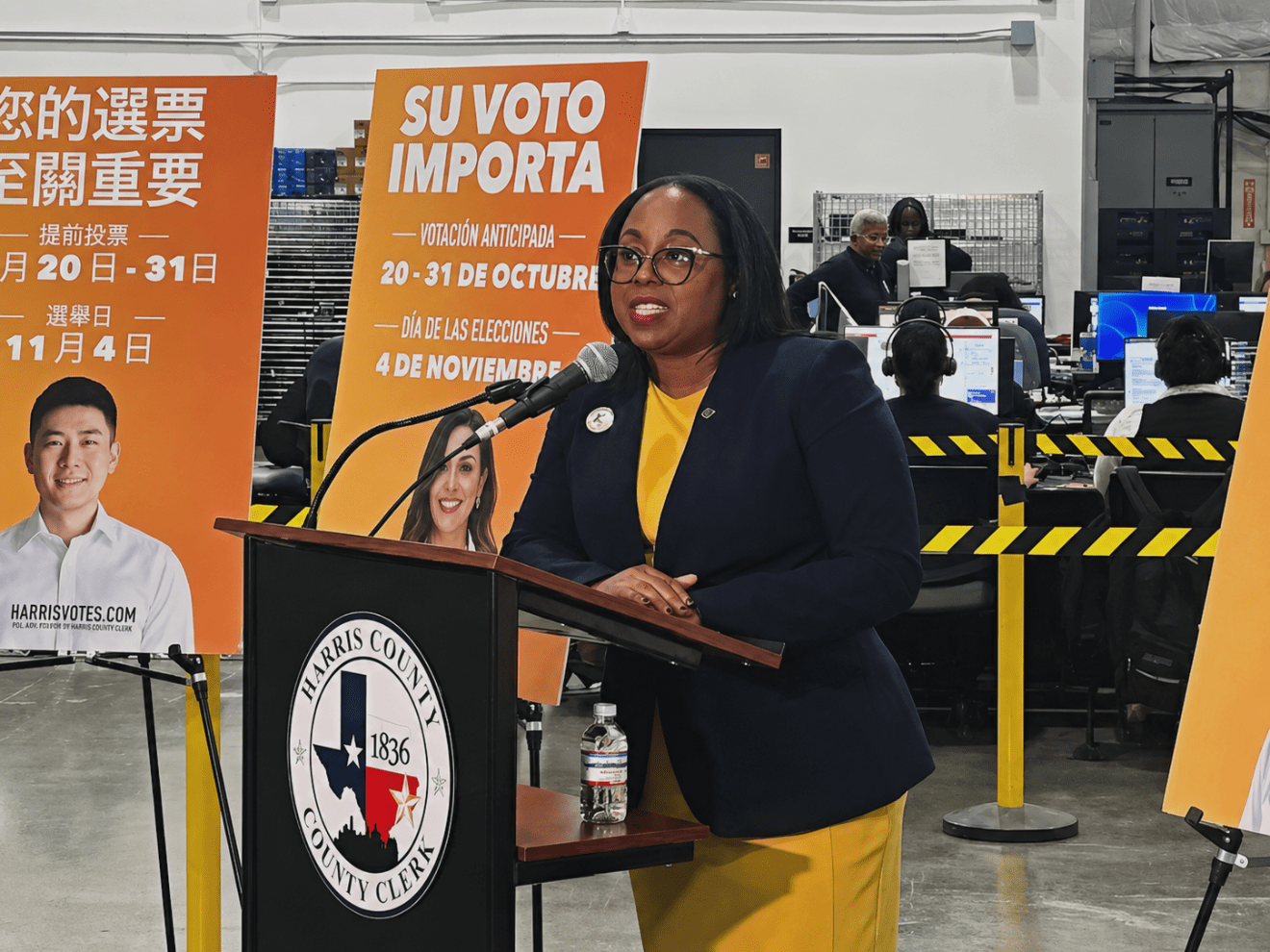
News that officials from the Secretary of State’s Office will audit Harris County elections in November sparked a few online digs about the Republicans sending “hall monitor Karens” to ensure there’s no funny business — but the woman who oversees the process says she welcomes the scrutiny.
The audit, announced last week as a random selection, marks the second time Harris County has undergone state oversight on its election practices in the past four years. It’s the first state audit since County Clerk Teneshia Hudspeth began supervising elections in 2024, after the state abolished the elections administrator’s position the previous year.
Hudspeth told the Houston Press in an email this week that she’s got no problem with Texas officials checking up on her.
“Transparency and accountability are central to our mission, and this process provides another chance to demonstrate the strength and integrity of our election administration,” she said. “We remain committed to meeting all statutory requirements and ensuring that voters can have full confidence in how elections are conducted in our county.”
An audit of Harris County elections in 2021 and 2022 found problems with ballot paper supply, voting equipment training, voter roll maintenance and incomplete polling place paperwork. The preliminary results of the inspection weren’t released until October 2023, so even if there are serious accusations of voter fraud — which are rare — during the November midterms, evidence of such claims won’t be revealed right away.
University of Houston political science professor Brandon Rottinghaus said even in recent surprise upsets — such as Tarrant County Democrat union leader Taylor Rehmet flipping a Texas Senate seat in a January special election — Republicans didn’t claim the election was rigged; they just said more people need to vote in November.
An audit is actually a good thing for Hudspeth, a Democrat who is up for re-election, to prove her office has made improvements since the last audit when she wasn’t in charge, Rottinghaus said.
“Neither party frankly wants to have problems with an election,” he said. “Harris County has become a symbol of the Republicans’ election critique. If this audit shows no significant problems, it means they fixed the problems, so they can brag about that. For the Democrats, a clean audit is an opportunity to show that they complied with the changes the Republicans wanted and were able to address the big issues that were plaguing the county.”
“Basically, it’s a win-win if the audit comes back clean.”
Under a state law passed in 2021 following allegations of a “stolen” 2020 presidential election in which Donald Trump was defeated, two counties with a population above 300,000 and two counties below that threshold are randomly selected each election cycle for a two-year audit period.
The audit announced August 12 will cover an election cycle that runs from 2025 through the end of 2026. Because they’re auditing elections that, in the case of 2025, have already happened, the process likely involves interviews rather than micromanagement on Election Day, Rottinghaus said, based on reports from the previous audit.
“They’ll be asking questions that are meaningful and, in principle, will make the process smoother,” he said. “We want this process to run efficiently, and we want to find the best, most cost-effective way to accomplish that. Specifically, they’re looking for things like: Were ballot allocation procedures followed? Was there a chain of custody that was followed? Was worker training solid and has it improved since last time? Are the voter registration databases properly reconciled with state records?”
Rottinghaus said he’s not sure there’s much of an appetite from Republicans to further the narrative of stolen elections. “Polling suggests that there are people who doubt what happened in the 2020 election but it’s ancient history now,” he said. “I can’t imagine that there’s a big swath of voters who see the election go a way they didn’t expect and will blame that on a party or the administration of voting.”
Texas Republicans, particularly Gov. Greg Abbott and longtime Sen. Paul Bettencourt, R-Houston, have been critical in recent years of Harris County elections, prompting critics to suggest that the audit selection process isn’t actually random, and the GOP is looking for a way to exert more control locally.
Bettencourt’s office filed a complaint in November 2025 suggesting that dozens of active voters were using post office boxes rather than residences on their voter registration cards, which he claims is illegal under a 2022 state law.
The senator acknowledged that, at the time, Harris County Tax Assessor-Collector and Voter Registrar Annette Ramirez had only been on the job for about a year but said the blame lies with her office, which oversees voter registration rolls. As a former Harris County tax assessor-collector, Bettencourt is intimately familiar with the responsibilities of the office.
Ramirez said in a statement last week that she, too, is not concerned about an audit. “Being selected again is another opportunity for us to provide transparency into our process as we continue to fulfill our statutory duties,” she said.
In July, Abbott named far-right former state Rep. Nate Schatzline to a newly created position of adviser on election integrity. Weeks later, longtime GOP strategist Robert Howden was tapped to oversee elections as secretary of state after Jane Nelson’s abrupt resignation, which became effective on July 17.
Rottinghaus said Howden isn’t “a bomb thrower,” and a lot of government watchdogs don’t even know who he is, which signals that Abbott isn’t looking for a fight over election administration. The governor is also on the November ballot, facing Democrat Gina Hinjojsa.
“The governor likes to appoint people who are close to him politically, so it’s not terribly surprising,” Rottinghaus said of the Howden appointment. “[Howden’s] reputation is good and he seems to be someone who is an ally of the governor but not a full acolyte of the notion of the need to dramatically reform elections.”
The professor added that Abbott could have selected Schatzline for the appointment but didn’t. “He picked an experienced administrator who understands state government over an ideological firebrand,” Rottinghaus said.
There’s no question that Harris County, as the third largest in the nation, carries a lot of weight when it comes to big races like the U.S. Senate seat that has Democratic nominee James Talarico and GOP hopeful Ken Paxton pitted against each other.
Polling shows the Talarico-Paxton race is tight, with a recent Texas Southern University survey putting the Democrat in the lead by 2 percentage points. Statewide offices have been dominated by Republicans for more than 30 years, so while a Dem win might be shocking to the political system, it won’t surprise people to the point that they would blame it on the infrastructure of Harris County elections, Rottinghaus said.
The professor said he expects that the audit might reveal at least some minor flaws, but “the question is, do those flaws rise to the level where the process has to be restructured again?”
Related