
Candidates for Austin City Council are raising and spending tens of thousands of dollars months before the November election, when voters will decide five of the city’s 10 district seats.

With the Austin City Clerk’s Office finalizing the ballot Tuesday, the field is now set: 23 candidates are running for the five council seats, offering a clearer picture of the money behind each race.
Campaign finance reports covering the first six months of the year show several incumbents and challengers building substantial war chests. The reports also reveal a crowded open-seat contest, a self-funded challenger with more cash than any other candidate and political action committees raising hundreds of thousands of dollars to influence council races and ballot measures.
Article continues below this ad
Not every candidate has begun raising money. Farrah Abraham, the reality TV personality who is running to represent District 5, reported no contributions or expenditures during the six-month period.
Money alone does not determine the outcome of an election, but a well-funded campaign can have a significant advantage in a competitive race. Campaign money can pay for advertising, consultants, staff, voter outreach, polling and opposition research.
Here’s how candidates raised and spent money from Jan. 1 through June 30.
Which candidates have raised and spent the most money?
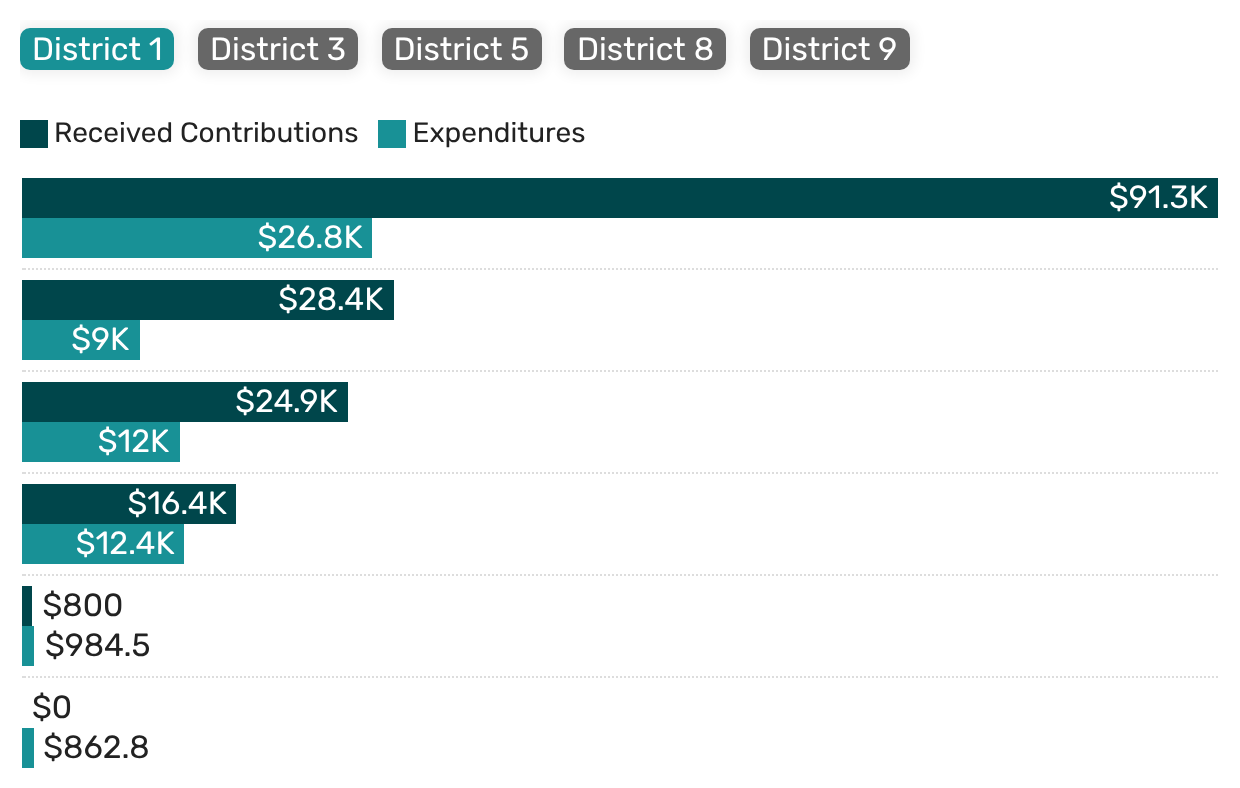
District 1 is shaping up to be a highly competitive race, with eight contenders — the most candidates vying for an open seat. Amber Goodwin, a current Travis County assistant district attorney, leads the field in both contributions and expenditures. She’s raised more than $91,000 during the reporting period and spent nearly $27,000.
Article continues below this ad
The next-highest fundraiser in the District 1 race was Alexandria Anderson, a retired Nike track athlete who serves on multiple city advisory boards. She raised more than $28,000 but also spent less than two of her challengers. Steven Brown, a former co-chair of the Save Austin Now PAC, and Misael Ramos, a community organizer running on a democratic socialist platform, each spent more than $12,000.
Daniel S. White also reported spending thousands of dollars during the period, an early indication that several campaigns are preparing to compete seriously for the seat being vacated by two-term Council Member Natasha Harper Madison.
In District 3, incumbent José Velásquez was running for reelection unopposed until Neha Shah, a product manager with a background in public policy, entered the race. Velásquez leads the district’s campaign finance totals.
In District 5, incumbent Ryan Alter leads in money raised and spent during the reporting period, with challenger David Weinberg close behind on both measures. Reality TV star Farrah Abraham entered the race in January but reported no contributions or expenditures through June 30.
Article continues below this ad
Every District 8 candidate reported raising tens of thousands of dollars.
Paige Ellis, the incumbent, has reached her term limit and must obtain signatures from 5% of qualified district voters to seek another term. On Tuesday, Ellis’ campaign announced that she submitted more than 3,400 signatures, exceeding the 3,044 signatures required.
The signatures still must be verified.
Meanwhile, Ellis’campaign reported raising nearly $40,000 and spending about $12,000, another indication she is moving forward with a reelection effort despite the additional ballot-access requirement.
Article continues below this ad
District 9, which includes downtown, parts of Riverside and the University of Texas campus, contains several major development projects and is closely watched by businesses and other interests active at City Hall.
Zo Qadri, the district’s incumbent, leads the race in both spending and contributions. Richard Heyman, a former University of Texas urban studies lecturer, follows with more than $18,900 raised. Katie Kam, a longtime civil engineer, raised more than $8,000.
Cash on hand changes the financial picture
Money raised during the current reporting period does not provide a complete picture of a campaign’s financial position. Incumbents such as Alter and Qadri reported substantially more cash available than they raised from January through June, largely because their campaign accounts contained money left from previous election cycles.
Article continues below this ad
That sum is commonly referred to as cash on hand: the money a campaign has available after accounting for its receipts and expenditures. It can include funds held in campaign bank and savings accounts and certain other reported assets.
Weinberg, who is challenging Alter in District 5, reported more cash on hand than any other candidate. Unlike the incumbents carrying money from earlier campaigns, Weinberg built much of his balance by lending $275,000 to his own campaign.
Personal loans can give a candidate immediate resources for advertising, staffing and voter outreach, but they are different from contributions because the campaign may repay the candidate.
Article continues below this ad
What about PACs?
Political action committees, or PACs, also raise and spend money to influence candidate races and ballot measures, making them another major force in council elections. Depending on applicable campaign finance rules, PACs can make contributions or spend independently on advertising, voter outreach and other political activity.
Save Austin Now — the conservative-leaning group that successfully campaigned to reinstate Austin’s public camping ban and defeat a city-backed tax hike last November — reported more fundraising than any other local PAC, with $526,231 raised during the first half of the year.
Article continues below this ad
This election cycle, the group’s main focus has been a ballot initiative to require regular, comprehensive performance audits of city government. Its petition was certified in June.
Save Austin Now has backed candidates in previous elections, but it had not announced endorsements for this election at the time of publication.
The Austin Firefighters Association and the Austin Board of Realtors reported the next-highest fundraising totals. Both organizations have historically made endorsements and participated in City Council elections.
Who is donating to Austin council races?
Of the 10 largest contributors during this period, nine donated to Save Austin Now. Their contributions totaled more than $195,000, meaning a substantial portion of the PAC’s reported fundraising came from a relatively small group of donors.
Article continues below this ad
The one exception among the largest contributors was returning District 7 candidate Gary Bledsoe, whose report listed a $27,000 contribution to himself, in connection with the repayment of an outstanding campaign loan.