
The city of Houston has faced a rising number of claims in recent years from drivers who say they’ve been hit by on-duty police officers, and has used a questionable legal strategy that attorneys say can delay cases and payouts to injured drivers by a year or more.
City attorneys have used a provision in state law intended to quickly dismiss baseless lawsuits to contest legitimate claims, two attorneys said, generating rulings the city can appeal – even as appeals courts repeatedly have rejected its arguments.
READ MORE: ICE arrests witness in active Houston Police Department shooting investigation
In one such case, the city argued it isn’t liable for damages because the police car had its lights and sirens on and was on the way to an emergency when the collision occurred – claims that appear to be contradicted by dash camera video of the crash and by the officer’s own police report.
Article continues below this ad
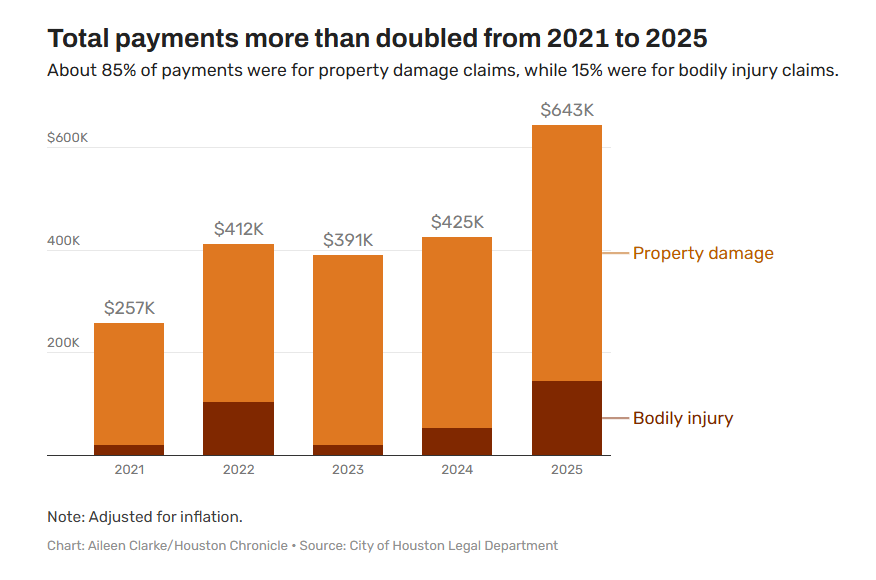
The number of lawsuits filed over crashes involving Houston police jumped 74% from 2021 to 2025, city data show, and payouts in these cases more than doubled. Some 169 such cases were assigned to city attorneys through the first seven months of the year, ahead of last year’s pace.
The legal tactic at issue is supposed to quickly dismiss absurd cases – those that “no reasonable person could believe.” Judges are asked to weigh the legitimacy of a filing’s assertions without considering any evidence in the case.
But the city is filing these motions in numerous cases, said Ajay Ketkar, a Houston appeals court attorney for Kelly Watkins McPheeters.
The intent, he said, appears to be less about securing a dismissal and more about generating a ruling that can then be appealed, delaying the case by a year or more. Ketkar also has seen appeals courts rule against the city’s arguments in many Houston police crash cases in recent years.
Article continues below this ad
“The city of Houston’s misuse of the rule only clogs an already overburdened court system, both at the trial and appellate level, and delays recovery to injured citizens,” Ketkar said.
The office of Mayor John Whitmire, who appoints the city attorney and oversees the legal department, did not respond to requests for comment.
Damages paid in crashes are rising
The city has paid out more than $2.2 million for 344 claims from people seeking damages after colliding with Houston police cars in recent years. The total amount paid out for cases assigned to attorneys between 2021 and 2025 more than doubled, records show.
Through the first seven months of 2026, the city paid more than $113,000 in damages, with another $40,000 in outstanding payments.
Article continues below this ad
Houston attorney Daragh Carter hopes to add to that tally.
Carter represents a woman suing the city over a 2024 police crash that damaged her vehicle and left her with unspecified injuries, court filings show.
City attorneys argue her case should be dismissed because the officer’s lights were on and he was on his way to an emergency when the crash happened.
But dash camera video appears to show the patrol vehicle’s lights weren’t on and that the officer ran a stop sign. The police report of the incident states “emergency equipment and officer’s BWC (body-worn camera) not activated.”
Article continues below this ad
A hearing in the case is set for Aug. 24 in state district court.
“I am surprised the city would claim an officer was responding to an emergency with lights and sirens when the evidence is to the contrary,” Carter said. “And I am concerned this 91a motion to dismiss is not being used as it was intended.”
So-called 91a motions became part of the Texas Rules of Civil Procedure in 2013, two years after the Legislature amended state law aiming to make “the civil justice system more efficient, less costly, and more accessible.”
It’s not uncommon for law enforcement agencies to go back on the initial stances they take in court, said Joanna Schwartz, a law professor at the University of California-Los Angeles.
Article continues below this ad
Cities frequently argue they aren’t liable for an officer’s actions, she said, then agree to pay settlements by a case’s end.
“If anyone else filed a Rule 91a motion as meritless as the ones the city routinely files, they would be required to pay the injured person’s attorney fees,” Ketkar argued. “But because the city is a governmental entity, it bears no financial risk for filing groundless motions, and it has taken full advantage of the immunity from consequences.”
The Chronicle analyzed data provided by the city of Houston Legal Department. Lawsuits and associated payments are categorized by the year they were assigned to an attorney in the city’s legal department, which is not necessarily the year the incident occurred or the lawsuit was filed or resulted in damages paid. The Chronicle removed duplicate entries where an identical claim appeared in a year other than the one in which it was assigned to a city attorney.