
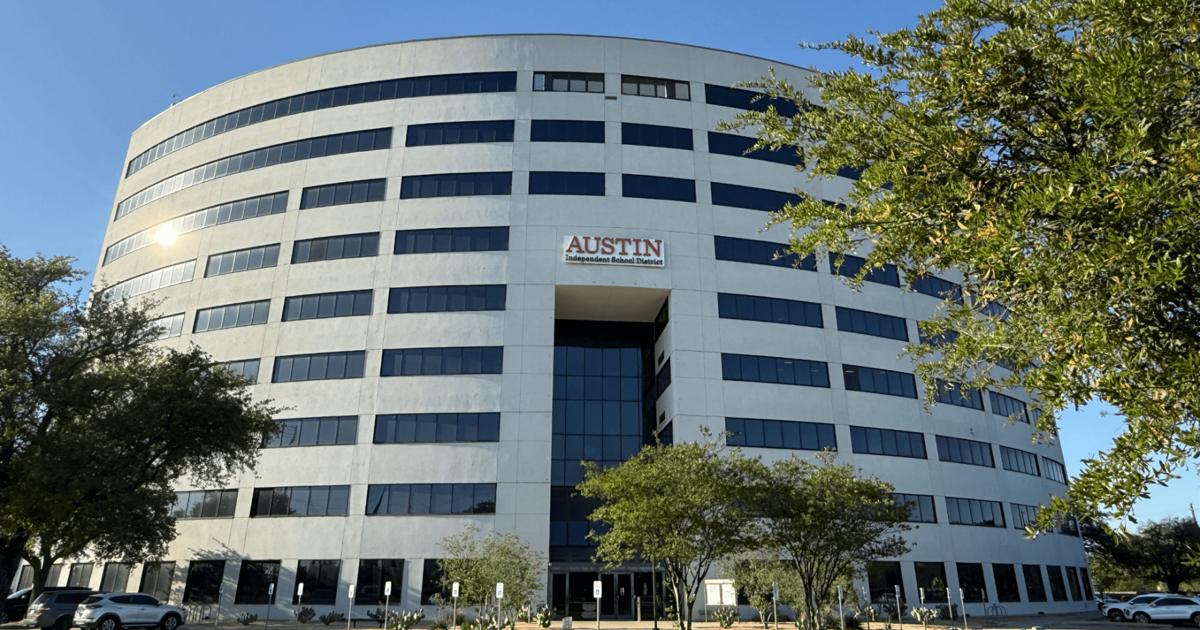
Two middle schools in Austin Independent School District (ISD) received their fifth failing A–F accountability rating from the Texas Education Agency (TEA) last week.
Under the Texas Education Code (TEC), “If a campus is considered to have an unacceptable performance rating for five consecutive school years, the commissioner shall order: (1) appointment of a board of managers to govern the school district; or (2) closure of the campus.”
The district originally had three middle schools with four consecutive failing ratings: Burnet, Dobie, and Webb. While Burnet and Webb earned F ratings, Dobie earned a D rating for this year.
According to TEA, a D rating does not break a consecutive failing streak — only an A, B, or C rating will stop the count. A D rating instead pauses the count until there are three D ratings in the chain, at which point the failing streak resumes.
Over the past school year, Austin ISD has made headlines for numerous challenges. In November, the district approved 10 school closures and 24 state-mandated turnaround plans for struggling campuses. After a projected $181 million budget deficit, the district was forced to make $205 million in cuts.
The district also announced the last-minute closure of Paredes Middle School on July 30, shortly before the start of the school year.
Austin ISD applied for Senate Bill 1882 partnerships for Burnet, Dobie, and Webb, which would have allowed the district to partner with an open-enrollment charter school or institutions of higher education approved by the TEA. These partnerships can receive increases in state funding and are exempt from certain accountability measures for two years.
Segura told KXAN News that the accountability pause was “not the driving factor” for the partnership, but rather the resources the partnership made available.
The TEA denied Austin ISD’s request in May, but said that the district could continue the partnerships, just without the state incentives. Austin ISD announced the dissolution of the partnerships for the three middle schools in July.
In an August 13 letter to parents, Austin ISD Superintendent Matias Segura addressed the possible state takeover, saying that “challenges remain.”
“In the weeks ahead, Austin ISD may be at the center of public conversations, speculation, and news headlines,” he wrote, adding that the district will “face these realities head-on.”
Segura celebrated the district’s overall B rating, saying it is “starting the year with momentum” — an improvement over three consecutive C ratings.
The Texan asked TEA Commissioner Mike Morath about the potential state takeover during an August 14 press conference.
“Ratings today are what we refer to as preliminary ratings,” he said. “There’s a 30-day window to apply for appeal, then there’s about 60 days where we have a third-party panel review and just check all the work, make sure it’s accurate.”
Morath emphasized that ratings can change, which is why it is “way preliminary to discuss what actually might happen in Austin as a result of that.”
Districts must submit rating appeals by September 11, and final rating decisions will be issued prior to December 11, when final ratings are released to the public.
Currently, seven districts are under the control of a state-appointed superintendent and board of managers, and Shepherd ISD is under mixed governance as it returns to its elected board of trustees.
Houston ISD came under state control in 2023, with the takeover extended until 2027; La Joya ISD in February 2024; and South San Antonio ISD in February 2025. Fort Worth ISD has been under a state takeover since October 2025, and the TEA announced the takeovers of Beaumont, Lake Worth, and Connally ISDs in December 2025.