
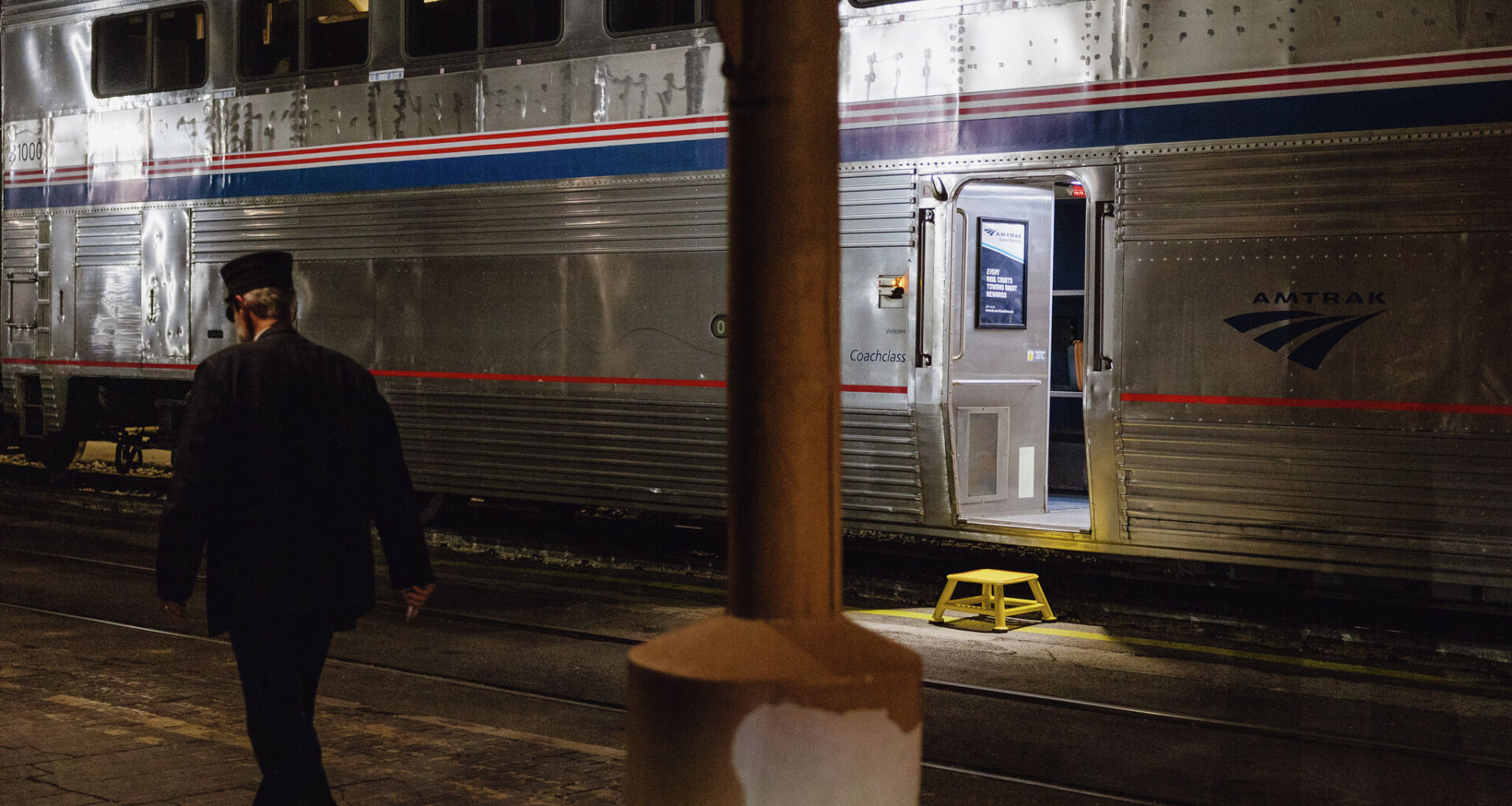
Amtrak employees wait outside to greet passengers for the Texas Eagle train linking San Antonio and Austin. A newly-released study commissioned by Travis County considers the possibility of building a new passenger rail line between the two cities along Texas 130 and Interstate 10.
Christopher Lee Staff Photographer
A newly-released study commissioned by Travis County concludes that it is possible, from an engineering perspective, to build a new passenger rail line linking San Antonio and Austin, running not along Interstate 35 but the Texas 130 toll road and a stretch of Interstate 10.

The problem: It could cost up to $13.5 billion — meaning it would rank among the most expensive infrastructure projects in Texas history, on par with the ongoing $13 billion revamp of Houston’s downtown freeway system. The cost would dwarf that of the multi-year expansions of Interstate 35 and Loop 1604 in San Antonio which — with budgets of $3 billion and $1.4 billion, respectively — are considered mega-projects in their own right.
Article continues below this ad
ALSO READ: TxDOT again pushes S.A. to Austin rail, but will Union Pacific play ball?
Most of the rail line — 53.7 out of a total of roughly 90 miles — would have to be elevated on columns within the medians of I-10 and Texas 130, according to the study, prepared by the engineering firm HNTB. Each mile of elevated line would cost an estimated $80 million, while the line at ground level would cost $40 million per mile.
Travis County Judge Andy Brown is undeterred. He took issue with that cost estimate, pointing out that a large portion, 45%, is marked as contingency — in other words, intended to represent unforeseen costs. On a mile-by-mile basis, it costs more to expand a highway than lay new rail, he said in an interview.
He believes that a new rail route following Texas 130 and I-10 could be the solution to the problem which has confounded South Texas leaders for more than 20 years, of how to establish decent commuter service between the two growing metropolises. But rather than carry passengers, the route should be built as a new freight line for Union Pacific, he said — the national company that owns the only active rail line linking the cities, parallel to Interstate 35.
Article continues below this ad
Union Pacific could then hand over its existing line for use by commuter trains, Brown suggested. Without having to share the tracks with freight cars, the trains could speed passengers between San Antonio and Austin and perhaps as far north as Taylor, stopping in cities such as New Braunfels and San Marcos along the way.
The idea isn’t new. It was the plan pursued by a prior effort for commuter rail known as the Lone Star Rail District. Launched in 2003, it met with some success, securing a memorandum of understanding and deal points with Union Pacific, with the company agreeing to consider relocating its freight line. But it floundered in 2016, when a Union Pacific executive declared that the goal of increasing passenger service was “unattainable.”
The argument for an alternate freight route is “even stronger today” than it was during the Lone Star Rail District’s push, Brown said.
“Even though TxDOT is expanding I-35, that’s not going to cut it for these two fast-growing areas to become a mega-region,” he said. Establishing rail service “is more expensive today than it was when Lone Star Rail first looked at this. That’s my argument, is that we need to do this now, otherwise it’s just going to get more and more expensive, and we’re going to end up with people who can’t get back and forth between Taylor, Austin and San Antonio quickly enough.”
Article continues below this ad
The Travis County Commissioners Court commissioned the study in October of last year, at a cost of $125,000.
Difficulties presented by report
As of now, those commuting along the I-35 corridor have few options apart from getting behind the wheel. Amtrak’s Texas Eagle service linking San Antonio and Austin, which shares Union Pacific’s line, is not an option for most commuters.
The northbound Texas Eagle departs San Antonio at 6:48 a.m., while the southbound train arrives at 10:46 p.m. — hardly ideal times for someone commuting to work or making a one-day business trip to Austin.
Article continues below this ad
ALSO READ: VIA board mulls bus fare increase as costs escalate for planned rapid lines
In the Travis County study, a path was sought keeping the rail line within the public right-of-way as much as possible. It would be mostly contained within the existing medians of Texas 130 and I-10. The state owns Texas 130, with a private company, SH 130 Concession Company, operating the highway under a 50-year agreement with the state.
The proposed route would be about 90 miles long, depending on its end points in San Antonio and Austin. If trains capable of a maximum speed of 125 miles per hour were run on the line, they could zoom between the two cities in travel times ranging from 55 minutes to an hour and five minutes, the study found.
One problem with the proposed route is where the trains would arrive in San Antonio and Austin. The study proposes an Austin terminus at Austin-Bergstrom International Airport, seven miles east of downtown Austin — meaning that commuters headed downtown would have to find another form of transportation there.
Article continues below this ad
A terminus in downtown San Antonio would be difficult because of a lack of right-of-way and sharp curves around the I-10 and I-37 interchange, the study notes.
The study presents two feasible landing points in San Antonio: at Roosevelt Avenue on the South Side, or at the East Side’s Frost Bank Center.
The study finds that the new line would require an operations and maintenance facility costing an estimated $300 million, and commuter trains costing $360 million. The new passenger line would cost between $140 million and $190 million per year to operate.
While he called the study “encouraging,” Brown said the ideal situation would be for a passenger route “that goes through all these downtowns, from Taylor to Austin to New Braunfels to San Antonio.”
Article continues below this ad
Getting freight away from the cities
Diverting Union Pacific’s freight route would have the benefit of keeping freight trains, which sometimes carry hazardous chemicals, out of densely-populated areas, Brown said, pointing to the derailment of a Union Pacific train in downtown Austin last month. A report from the Federal Railroad Administration found that 12 of the train’s cars were carrying hazardous materials, though none of those cars derailed, according to the Austin American-Statesman.
The derailment occurred where the rail track curves sharply after crossing Austin’s Colorado River. A straighter, more level route would be better for Union Pacific, Brown said. “I would like to work with them to get that,” he said.
Yet Union Pacific has made no indication that it’s interested in either sharing its existing rail track or moving its freight traffic elsewhere. In 2024, after Brown and Bexar County Judge Peter Sakai launched the latest campaign for better passenger rail between San Antonio and Austin, a Union Pacific executive sent Brown a letter saying new passenger service “would likely put freight back on I-35 — increasing gridlock, accidents and greenhouse gas emissions.”
Article continues below this ad
ALSO READ: Two new roadways planned for the South Side. Here’s what to know.
The company didn’t respond to a request for comment for this story.
Union Pacific’s line serves as a crucial link in the U.S. supply chain, ferrying produce and manufactured goods north from the booming Port of Laredo on the U.S.-Mexico border.
Several large businesses have located along Union Pacific’s line so as to use its freight capacity, including cement plants and quarries. Their presence would likely increase Union Pacific’s reluctance to give up the line.
Article continues below this ad
Brown’s hope is that Union Pacific would “come to the table” if TxDOT lent its support to a proposal and federal funding was lined up. He said there is a fresh opportunity for federal funding after the Federal Railroad Administration last year withdrew more than $3 billion for intercity rail from the California High Speed Rail Authority, making it available to other recipients.
Interest at state level
TxDOT has recently shown increasing interest in the possibility of boosting commuter rail service in the San Antonio-Austin corridor. This year, the agency commissioned its own study which concluded that passenger trains could make up to eight round trips between the two cities each day on Union Pacific’s existing line, without hampering freight traffic. Certain improvements would be needed, such as the construction of side-tracks onto which slower trains could pull over to let faster trains pass by.
Those improvements would cost an estimated $810 million to $1.9 billion, according to the study.
Article continues below this ad
Caroline Mays, who manages the agency’s rail division as its senior director of planning and modal programs, gave a presentation last fall at a conference of the Rail Passengers Association in downtown San Antonio. She described how Texas’s passenger rail network has withered over the past century and posed the question, “How can we re-rail Texas?”
ALSO READ: TxDOT to rebuild ramps along Loop 410 and U.S. 281. Here’s what to know.
Before his death in August, J. Bruce Bugg Jr., a close ally of Gov. Greg Abbott who oversaw TxDOT as chairman of the Texas Transportation Commission, had created a working group to study how to improve passenger rail service between San Antonio and Austin.
Brown helped launch the current push for inter-city passenger rail in 2024, when he and Sakai launched the Texas Passenger Rail Advisory Committee. The committee has continued meeting, Brown said; most recently, it gathered for a presentation on TxDOT’s study.
Article continues below this ad
He suggested that a next step could be to commission studies looking at the economic impact of inter-city passenger service and its potential ridership.
“The longer we wait to do this — this thing that is absolutely necessary to our continued economic growth — the more expensive it will become,” Brown said. “I’m very happy that we put the resources toward this, that TxDOT put the resources toward this, and we’re making progress.”