
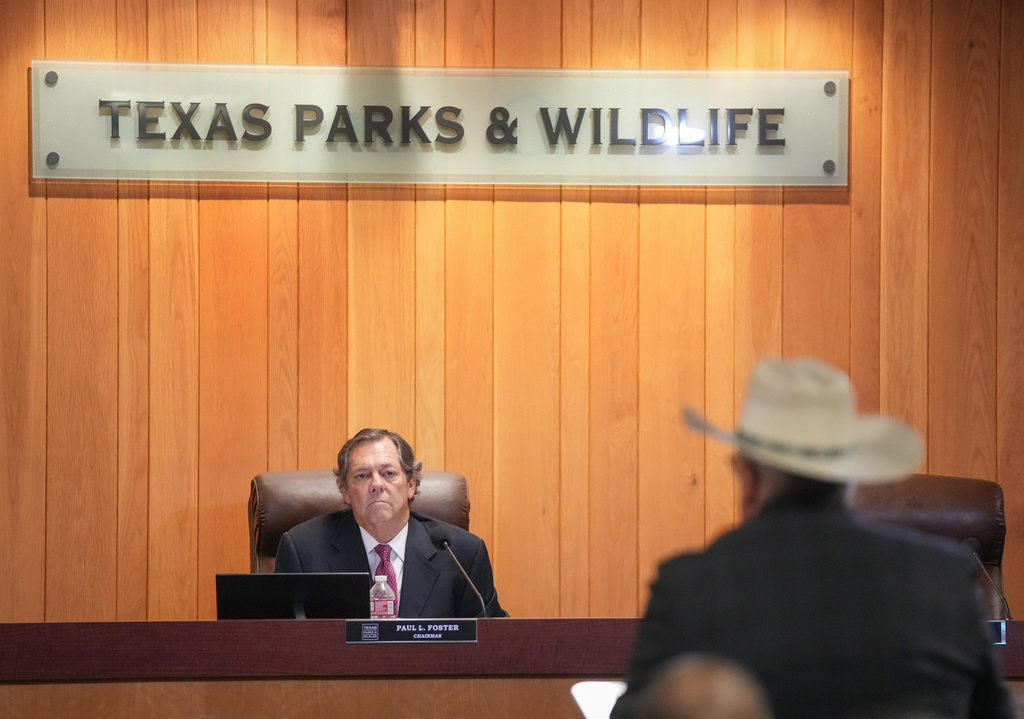
Paul Foster, chairman of the Texas Parks and Wildlife Commission, listens to a man speak against border wall construction in the Big Bend region during the commission’s annual public hearing at Texas Parks and Wildlife Department headquarters in Austin on Aug. 19, 2026. Opponents urged the commission to intervene in proposed border barrier construction inside Texas state parks.
Jay Janner/Austin American-Statesman
Emily and Michael Roberts, of Austin, protest border wall construction in the Big Bend region outside Texas Parks and Wildlife Department headquarters in Austin on Aug. 19, 2026. The demonstrators gathered ahead of the Texas Parks and Wildlife Commission’s annual public hearing, where advocates planned to urge the commission to intervene in proposed border barrier construction inside Texas state parks.
Jay Janner/Austin American-Statesman
Billy Bartko, of Terlingua, waits in line to enter Texas Parks and Wildlife Department headquarters during a protest of border wall construction in the Big Bend region in Austin on Aug. 19, 2026. The demonstrators gathered ahead of the Texas Parks and Wildlife Commission’s annual public hearing, where advocates planned to urge the commission to intervene in proposed border barrier construction inside Texas state parks.
Jay Janner/Austin American-Statesman
The future of controversial border barrier projects in the Big Bend region remains uncertain after nearly 100 people urged Texas wildlife officials Wednesday to oppose further construction, just days after federal officials announced a pause on some work.

Of the 101 registered speakers at the Texas Parks and Wildlife Commission meeting, only about 10 spoke on another matter. The rest opposed the border projects amid uncertainty over what exactly has stopped — and whether the pause will last.
Article continues below this ad
U.S. Customs and Border Protection Commissioner Rodney Scott said earlier this week that “survey and design work” had been paused in the park following bipartisan pushback. But residents and advocates told commissioners Wednesday they fear the halt could be temporary and want state officials to prevent construction from moving forward.
Speakers raised concerns about potential effects on the region’s communities, environment and businesses while calling for greater transparency about plans they said “seem to change every day.”
Here’s where the projects stand and what could happen next.
What did Texas parks officials say?
Texas Parks and Wildlife Commission Chairman Paul L. Foster said commissioners generally agreed with speakers’ concerns and were working with Gov. Greg Abbott’s office, CBP and the federal government.
Article continues below this ad
“Our objective is to minimize damage to the ecosystem out there, to the beauty of not only the parks but the whole area, and so we generally agree,” Foster said.
“I doubt we’re going to have a lot of speakers that stand up for a border,” he said.
Is Big Bend border construction actually paused?
Some work is paused, according to CBP, but the status of the broader projects is less clear.
Article continues below this ad
Scott said earlier this week that “survey and design work” had been paused in the park. His announcement came after residents and advocates spotted bulldozers and excavators in the region and after bipartisan opposition to the projects intensified.
The description also followed an early August statement from a CBP spokesperson that “early construction activities such as clearing and digging have begun.”
Before Scott announced the pause, CBP said earlier this month that installation of border barrier panels for the Big Bend 1, 2 and 3 wall projects in Hudspeth, Jeff Davis and Presidio counties was expected to begin “in the coming weeks.”
CBP has said work has not begun on Project 4, which is tied to a $1.7 billion contract and includes areas within Big Bend sector. The agency said crews at that site were regrading storm-damaged roads so workers could access the area and conduct surveys.
Article continues below this ad
The road work is part of the preparation needed before construction can begin.
Project 4 includes roughly 17 miles of vehicle barrier systems — including barriers, patrol roads and surveillance technology — along with another 205 miles of patrol roads, cameras, sensors or a combination of those features, depending on location.
CBP has said it does not plan to build 30-foot-high barriers in Big Bend National Park, Big Bend Ranch State Park or the Black Gap Wildlife Management Area.
Why do opponents say the pause isn’t enough?
Speakers repeatedly told commissioners Wednesday that they don’t trust the pause to last without more concrete action.
Article continues below this ad
“The positive signs from the past few days are not the win we are fighting for. We’ve all seen too many changes with no transparency to trust that this is anything but temporary,” Grant Appleton, a private landowner in the region and founder of ¡Chinga Tu Muro!, told the American-Statesman.
“As far as I can tell, this is all a PR blitz because the powers that be are afraid of getting destroyed in the midterms as people from all sides come together against this,” Appleton said.
Appleton added he wants contracts canceled and broader changes to federal authority over border construction.
People traveled from San Antonio, El Paso, Laredo, Marfa and elsewhere for Wednesday’s meeting.
Article continues below this ad
Susan Hays, an attorney and incoming Democratic Presidio County commissioner, urged the commission, whose members are appointed by Abbott, to use that connection to protect the region from current and future construction.
“Help this state stay strong against the federal overreach and with the destruction of the border of Greater Big Bend,” Hays said.
Before the nearly-five-hour meeting, roughly 200 people gathered for a “tailgate,” holding “Don’t Mess With Texas Public Lands,” “Save Big Bend” and “Stop the Wall” signs as folk music played and attendees traded stories about the region.
Hillary Pierce, an organizer and founding member of No Big Bend Wall, said it was the first opportunity for members of the public to go on the record before officials opposing the construction.
Article continues below this ad
Opposition crosses party lines
The pushback Wednesday wasn’t confined to environmental organizations or Democrats.
Former Republican Land Commissioner Jerry Patterson told commissioners opposition to construction in Big Bend transcended party politics.
“This is not a partisan deal — it is universal,” Patterson said.
Article continues below this ad
“This is a very expensive remedy to a problem that doesn’t exist. I am not asking y’all to say no; I am asking y’all to say hell no,” he said, drawing cheers and applause.
Dave Cortez, a director with the Lone Star Chapter of the Sierra Club, pointed to the unusual political coalition.
“When’s the last time you saw a Republican Land Commissioner like Patterson and the director of the Sierra Club come before you on the same issue aligned together?” Cortez said, drawing laughter.
Republican U.S. Sen. John Cornyn and congressional candidate Brandon Herrera have also opposed the work, along with U.S. Senate hopeful James Talarico and Democratic gubernatorial candidate state Rep. Gina Hinojosa.
Article continues below this ad
Abbott also said this week that there are other places along the Texas-Mexico border where barriers are needed more.
“When it comes to building walls, there are other border areas in the state where there are more crossings where a wall is more needed than in places like Big Bend,” Abbott said.
Abbott said CBP could secure the park “through technology, through personnel, through other means.”
Could Texas law become the next battleground?
Jaxon Welchman, an Austin-based attorney with No Big Bend Wall’s legal team, pointed commissioners to a section of the Texas Parks and Wildlife Code governing projects that use or take dedicated parkland.
Article continues below this ad
The requirements include three weeks of published notice, a public hearing and findings that there is “no feasible and prudent alternative” to a project and that planning minimizes harm.
“This process isn’t a formality; it’s the authority itself,” Welchman said. “And sure, there have been numerous federal waivers, but none have waived the Texas statute.”
“The day that Washington claims it can, that’s not a border policy question anymore; that’s a question about whether Texas law means anything on Texas protected land,” he said.
Welchman is an eighth-generation Texan who said he took annual family trips to Big Bend from age 5 through his sophomore year of college.
Article continues below this ad
“I grew up as that being a special place,” he told the Statesman.
For residents and advocates who packed Wednesday’s meeting, the federal announcement hasn’t resolved whether the projects have been stopped or merely delayed.
Appleton said opponents are looking for more definitive action, including canceled contracts.
Article continues below this ad
“Until contracts are canceled, until Congress acts on DHS’s ability to sign away every law in their way without oversight or approval, and until the people responsible for the damage that’s already been done are held accountable, we don’t let off the gas,” Appleton said.