

AUSTIN, Texas — Governor Greg Abbott has requested an investigation into how Texas public school districts are spending their money.
In his request to Texas Comptroller Don Huffines, Abbott asked the Comptroller’s office to investigate up to four independent school districts (ISDs) to determine whether sufficient taxpayer money is being allotted to students and teachers.
Abbott’s request says he wants to prevent money from “being absorbed by central-office growth, administrative bloat, consultants, and the web of noninstructional bureaucracy.”
In a press conference in El Paso, Abbott singled out Austin ISD (AISD).
“If you look at the decade from 2015 to 2025, in the Austin ISD, enrollment declined; It went down by 14%. But during that same time, administrative spending per student increased 75%,” Abbott said.
ALSO | Austin ISD superintendent answers questions on state intervention, school closures
Using student enrollment data from the Texas Education Agency’s (TEA) Texas Academic Performance Reports (TAPR), student enrollment in Austin ISD declined from 83,270 students during the 2015-16 school year to 72,272 students in 2024-25, a decrease of approximately 13.2%.
However, Dr. Rachel White, an associate professor in UT Austin’s College of Education, says spending per pupil does not always decrease alongside to student enrollment.
‘A really important thing to remember is that fixed costs don’t shrink proportionally with declining enrollment,” White said. “And so, when enrollment declines by 14%, you can’t only hire 14% less of a superintendent. No matter what, you have a cost for a superintendent and a lot of the district level positions that are in place… These are sort of fixed costs that no matter how big or small your district is, or how quickly it’s growing or shrinking, you can’t really cut those positions, at least at the very top level.”
KEYE
But she also says that declining enrollment can warrant changes to a district’s administrative needs over time.
“As a district leader and as a school board, you should always be sort of auditing yourself, to say, ‘Are we making sure that we’re sort of ‘right-sized,'” she said. “And sometimes as your district enrollment declines, you do have to do some right-sizing every five years, every ten years.”
Governor Abbott has asked the Comptroller to deliver results of the investigation by Dec. 31, 2026, ahead of the 2027 legislative session in January.
“The legislation I’m proposing today will ensure that school districts will spend at least 70% of their funds in the classroom, not on administrative expenses, staff or bureaucracy,” said Abbott.
When asked if it is feasible to allot 70% of district funds directly to students and teachers, White says she would want to know more information about how that threshold was determined.
“Where did 70% come from? Is there any sort of research that says 70% is this magic number that, if we have 70% going in this direction, that that’s going to ensure that all students have equitable access to high-quality learning opportunities?” she asked. “If there is research, great. If not, I think we want to think critically about where that number comes from.”
White says ISDs undergo several financial accountability audits at the local, state and federal levels. At the state level, the TEA releases yearly assessments of districts via its Financial Integrity Rating System of Texas (FIRST) reports.
“The majority of districts get A’s on these. Austin had a B last year,” White said.
One of the indicators measured by the FIRST reads “Did the school district not have a 15 percent decline in the students to staff ratio over 3 years (total enrollment to total staff)? If the student enrollment did not decrease, the school district will automatically pass this indicator.”
AISD scored a 0, or No, on this indicator in last year’s report.
Austin ISD provided CBS Austin a graphic detailing the district’s administrative spending compared to the TEA recommended administrative spending ratio.
AISD’s administrative spending ratio has declined every year since the 2022-23 school year.
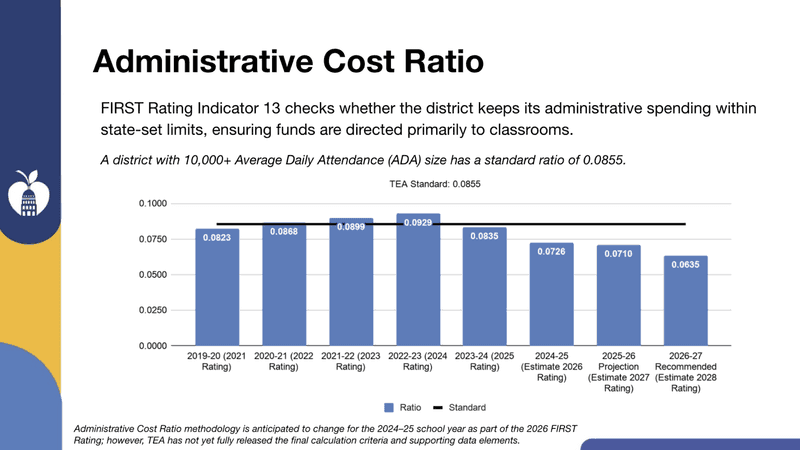
A graphic provided by Austin ISD details the district’s administrative spending compared to the TEA’s recommended administrative spending ratio (Photo: Austin ISD)
White said that an investigation by the Comptroller could ask districts for more information than is provided via FIRST.
“The FIRST reports, those have no connection necessarily to student supports and student learning explicitly,” she said. “So I could imagine maybe a deeper investigation is really trying to understand, ‘this money is going to this function.’ And if the local district can sort of provide a compelling rationale that that is going directly to support student learning, then that could be additional information.
The Comptroller’s Office plans to announce the school districts that will be investigated in the coming weeks.