
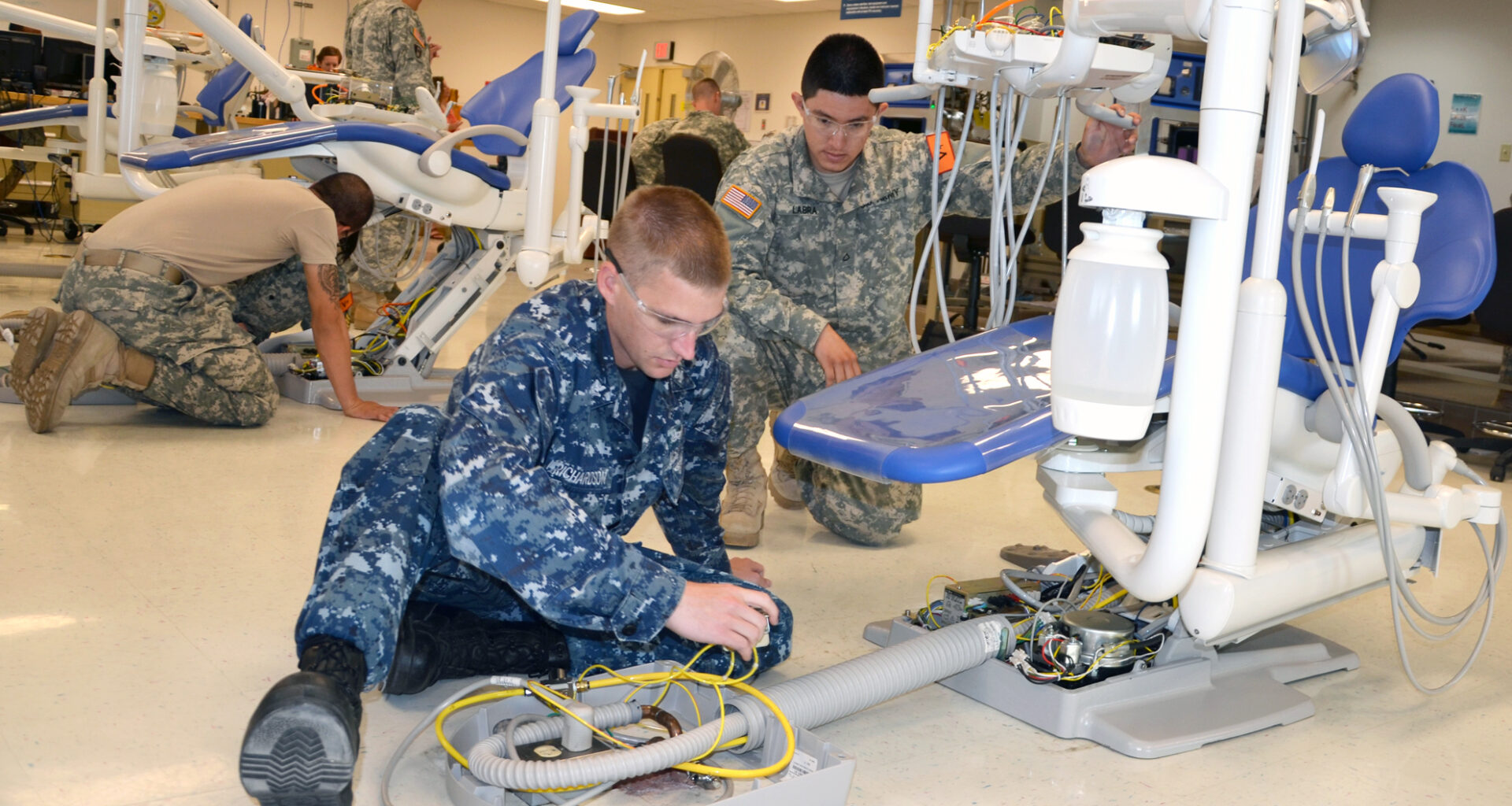
Petty Officer 2nd Class Brandon Richardson, left, and Pfc. Miguel Labra inspect the air supply on a dental treatment unit at the Medical Education and Training Campus at Fort Sam Houston in San Antonio.
Lori Newman/Joint Base San Antonio
Spurs player Zach Collins, left, visits the Medical Education and Training Campus at Fort Sam Houston, where he learned how to apply a tourniquet and observed a mock surgery on Jan. 25, 2024.
Sam Owens/San Antonio Express-News
Students and instructors in the respiratory therapist program at the Defense Department’s Medical Education and Training Campus in San Antonio practice using mechanical ventilators.
Defense Department
The Air Force has picked a contractor to build a massive new dormitory complex for military medical trainees at Fort Sam Houston. It will replace dorms that were so badly deteriorated the occupants had to be hurriedly evacuated a month ago.

Layton/Gensler has been selected to build five 400,000-square-foot dormitories to house 6,000 trainees at the Medical Education and Training Campus, the Air Force announced this week.
Article continues below this ad
Layton/Gensler is a joint venture between Layton, a Utah-based construction company, and Gensler, an architectural and design firm with headquarters in San Francisco. The companies will start preliminary design and demolition work immediately and will begin construction by the end of 2026, the Air Force said.
The service did not offer a cost estimate for the work, but an official familiar with the project told the San Antonio Express-News last month that the price tag is expected to be more than $1.4 billion.
METC trains enlisted personnel to fill medical support roles. Its students become combat medics, respiratory therapists, pharmacy technicians, dental assistants and other allied health professionals for the service branches. Although it is based at Fort Sam, an Army post, the institution also trains Air Force, Navy and Coast Guard personnel.
In July, the Defense Department relocated 5,200 METC trainees, nearly the entire student population, from their dormitories because of what it called “climate control” problems and “foundational defects.” Rep. Joaquin Castro, D-San Antonio, said at the time that he understood faulty construction was to blame, and that the buildings were infested with mold. The trainees were moved to hotels on Joint Base San Antonio.
Article continues below this ad
In tearing down and replacing the old dorms, Layton/Gensler will work under an Other Transaction Authority (OTA) agreement, a legal tool that allows the government to purchase goods and services outside normal federal procurement processes. OTAs are intended for projects where speed and flexibility are of the essence.
“Our people deserve quality living quarters that are clean, safe and comfortable, delivered at speed, so they can focus on their work,” said Dale Marks, assistant secretary of defense for energy, installations and environment.
An Air Force statement said the joint venture will use “proven industrial offsite manufacturing technology” — an apparent reference to prefabricated building techniques — “to accelerate the previously planned construction timeline by approximately 70 percent.” The work will cost 20% less than if it were built using standard construction methods, the statement said. The Air Force said it is “targeting completion within 24 months.”
METC grew out of military base closures and consolidations in the mid-2000s. The legislation that created the 2005 Defense Base Closure and Realignment Commission required the service branches to consolidate medical training for enlisted personnel at Fort Sam Houston, where the Army already did such instruction.
Article continues below this ad
The campus opened in 2010 after a crash building program that relied on prefabricated construction, which was touted as a way to get the work done faster. The complex includes dormitories, a headquarters/administration building, an 80-square-foot dining hall and other facilities.
A ribbon-cutting on June 30, 2010, was attended by 300 people and was marked by inspirational rhetoric.
“As you look at the buildings behind us, I want you to not just see bricks and stones and mortar and glass. I’d like you to see the people whose lives have been made better for what will transpire in those buildings,” said Rear Adm. Bob Kiser, METC’s first commandant.
“I want you to look 15 years into the future,” he said, “and see the Marine corporal who will survive his injury to stand and give his daughter away in marriage because there was a hospital corpsman armed with the skills learned here, to apply those skills in a difficult place and difficult circumstance for our country.”
Article continues below this ad
Decrepit living conditions for enlisted personnel have been a chronic problem for the U.S. military.
The Government Accountability Office surveyed 10 barracks across the country, including at JBSA, and reported in 2023 that the facilities were rife with mold, bed bugs, gas leaks and even squatters. Soldiers told auditors they felt unsafe and depressed in their surroundings.
In 2019, inspectors found mold or mildew in 30 percent of all dorm rooms at three San Antonio military installations and the Camp Bullis training range in northern Bexar County. During a cold snap in January 2024, buildings in parts of JBSA lost heat for a week.
Article continues below this ad