
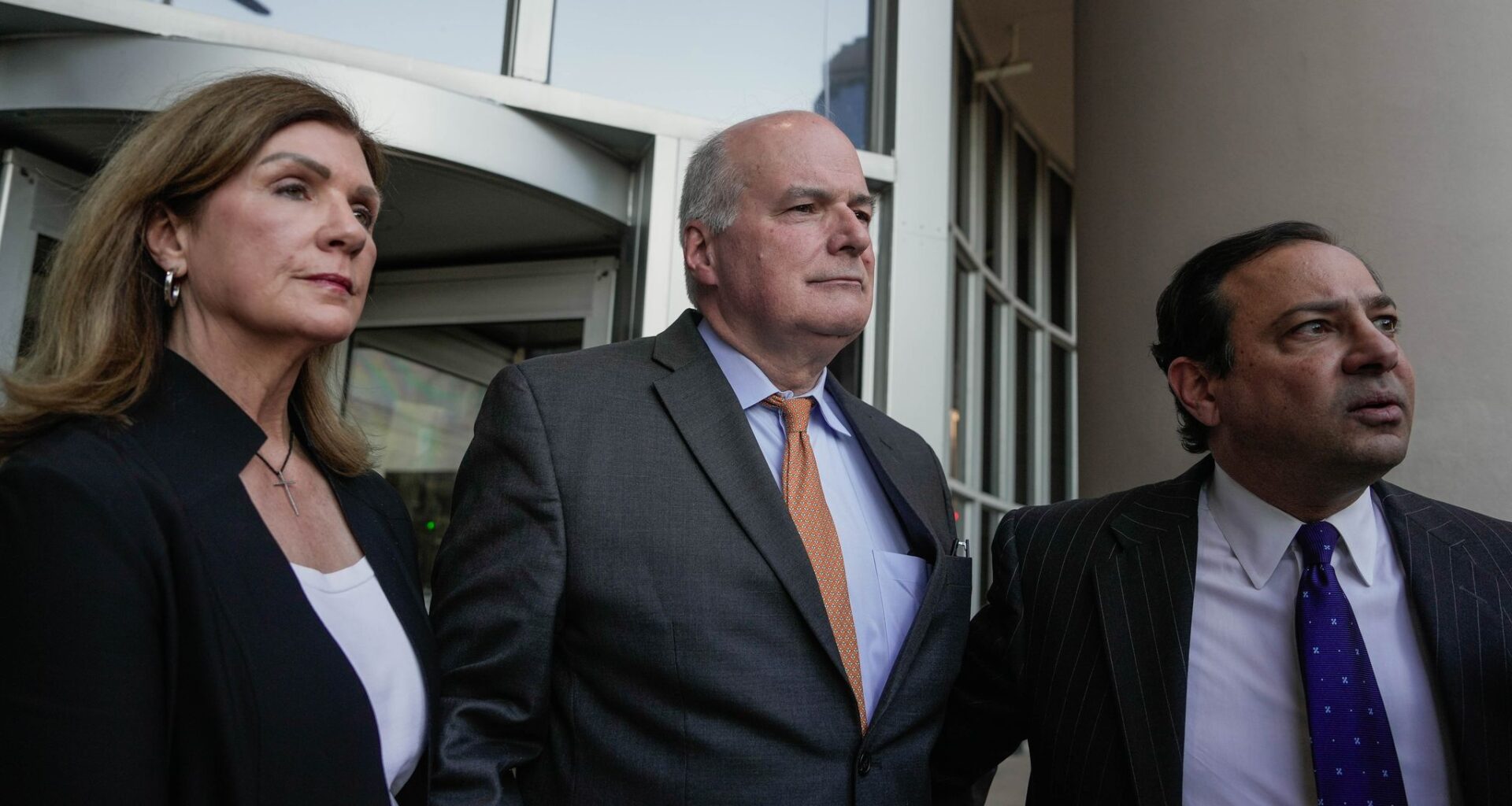
Dr. John Stevenson Bynon Jr., flanked by his attorney, Samy Khalil, exits federal court after his arraignment on charges alleging he falsified medical records that made patients ineligible for liver transplants, in Houston on Thursday, Feb. 5, 2026.
Raquel Natalicchio/Houston Chronicle
Federal prosecutors accuse a Houston transplant surgeon of blocking patients from getting donated livers they needed to survive. But this week, a federal judge said their case against him is on a knife’s edge.
“This case has always struck me as, shall we say, an aggressive prosecution,” U.S. District Judge Lee Rosenthal said Tuesday as prosecutors and attorneys for Dr. John Stevenson Bynon Jr. wrangled over the details of his federal criminal trial, which could take place this fall in Houston’s downtown federal courthouse.
MORE ON HOUSTONCHRONICLE.COM: Houston police respond to body found on grounds of HISD’s Attucks Middle School
Article continues below this ad
In May, the Justice Department indicted Bynon and charged him with five counts of making false statements relating to health care matters. Bynon, the director of abdominal organ transplantation at Memorial Hermann, was accused of improperly preventing five patients from receiving organ transplants.
The charges were the culmination of two years of controversy surrounding Bynon and Memorial Hermann’s transplant program. In 2024, the hospital announced that Bynon made “inappropriate changes” in a liver transplant database and temporarily suspended the program. Bynon later admitted to using his own process to effectively remove patients from the organ waiting list. Bynon told federal regulators his goal was to ensure that sick patients were “safely transplanted.”
Organ transplant guidelines typically require patients who are too sick for surgery to be temporarily inactivated from the waiting list. Bynon’s lawyers have argued that following the guidelines could have negatively affected his patients’ chances of receiving a transplant in the future. Liver transplant candidates do not accrue time on the waiting list while they are inactivated.
Two of the five patients at the center of the criminal case died before they could receive transplants, according to the indictment.
Article continues below this ad
The Justice Department said Bynon’s actions amounted to a crime. In a statement, former Assistant U.S. Attorney Nicholas Ganjei said Bynon “stole years and hope from those who trusted him most.” Bynon, 66, faces the possibility of up to 25 years in prison if he is convicted by a jury and given the maximum sentence by a judge.
To get that far, however, the trial still must reach the jury stage. In pretrial hearings this week, Rosenthal admitted she had reservations about the Justice Department’s strategy. For months, Bynon’s lawyers have argued that prosecutors weren’t explicit enough in their indictment about which false statements Bynon made — a fact they said they needed to know to provide a defense.
Rosenthal questions whether the allegations amount to a crime
Bynon’s defense team has asked Rosenthal to dismiss the case.
Rosenthal pushed prosecutors to be specific about their accusations.
Article continues below this ad
“The question is in all of this: it may be bad medicine, it may be contrary to hospital policy and procedure,” Rosenthal said. “Where’s the crime?”
Assistant U.S. Attorney Suzanne Elmilady said Bynon’s entries into UNet – an organ transplant web platform – misrepresented decisions made by Memorial Hermann’s transplant review board. The board comprised of multiple experts determines eligibility for liver transplantation, and the government said Bynon took it upon himself to make a decision.
Bynon’s lawyers said the entries he made to the web system were meant to be exclusionary.
When Bynon set one patient’s maximum donor age at 8, for instance, his lawyers said he wasn’t literally looking for a child’s liver. Rather, he was indicating he did not want any possible liver and did it by setting criteria to accept only a very unlikely match.
“Contextually he’s saying he didn’t want a liver,” attorney Samy Khalil said. “Our client has admitted it on the record that he did not want a liver.”
Article continues below this ad
The attorneys characterized the act as a medical decision and said the proper venue to dispute such decisions is a civil lawsuit, not a criminal indictment.
Rosenthal again appeared to agree and stressed to the prosecutors their case needed to be about Bynon’s alleged misrepresentations, and not about health care decisions.
“We cannot allow this case to be tried as a medical malpractice case, as a bad manager case … because none of that is criminal,” Rosenthal said.
Restrictions on how prosecutors can describe Bynon and his patients
The warning was just one of the limits placed on the prosecutors.
Article continues below this ad
Rosenthal also said attorneys won’t be allowed to refer to the people who were under Bynon’s care as “victims” or to his acts as “lies” or “deceptions.” While some of Bynon’s former colleagues at Memorial Hermann may be called to testify, they may be limited to telling the jury about the organ donation system, and not his management or personal behavior. Elmilady in court said that Bynon operated with “unchecked power” at the hospital
Bynon’s attorneys have also challenged other expert witnesses who analyzed Bynon’s actions on behalf of the government. One of the experts, transplant surgeon Matthew Cooper, wrote in his report that Bynon lacked a clinical basis for making changes to the UNet entries.
Cooper’s report also called Bynon’s actions “reprehensible,” according to court filings.
Rosenthal has already said that Cooper’s comments on morality won’t be presented to a jury. In coming hearings, attorneys will question Cooper and other experts about their qualifications and conclusions before they’re allowed to participate in the trial.
On Thursday, Rosenthal agreed to set a trial date for October. Attorneys said a trial could take up to three weeks to complete.