
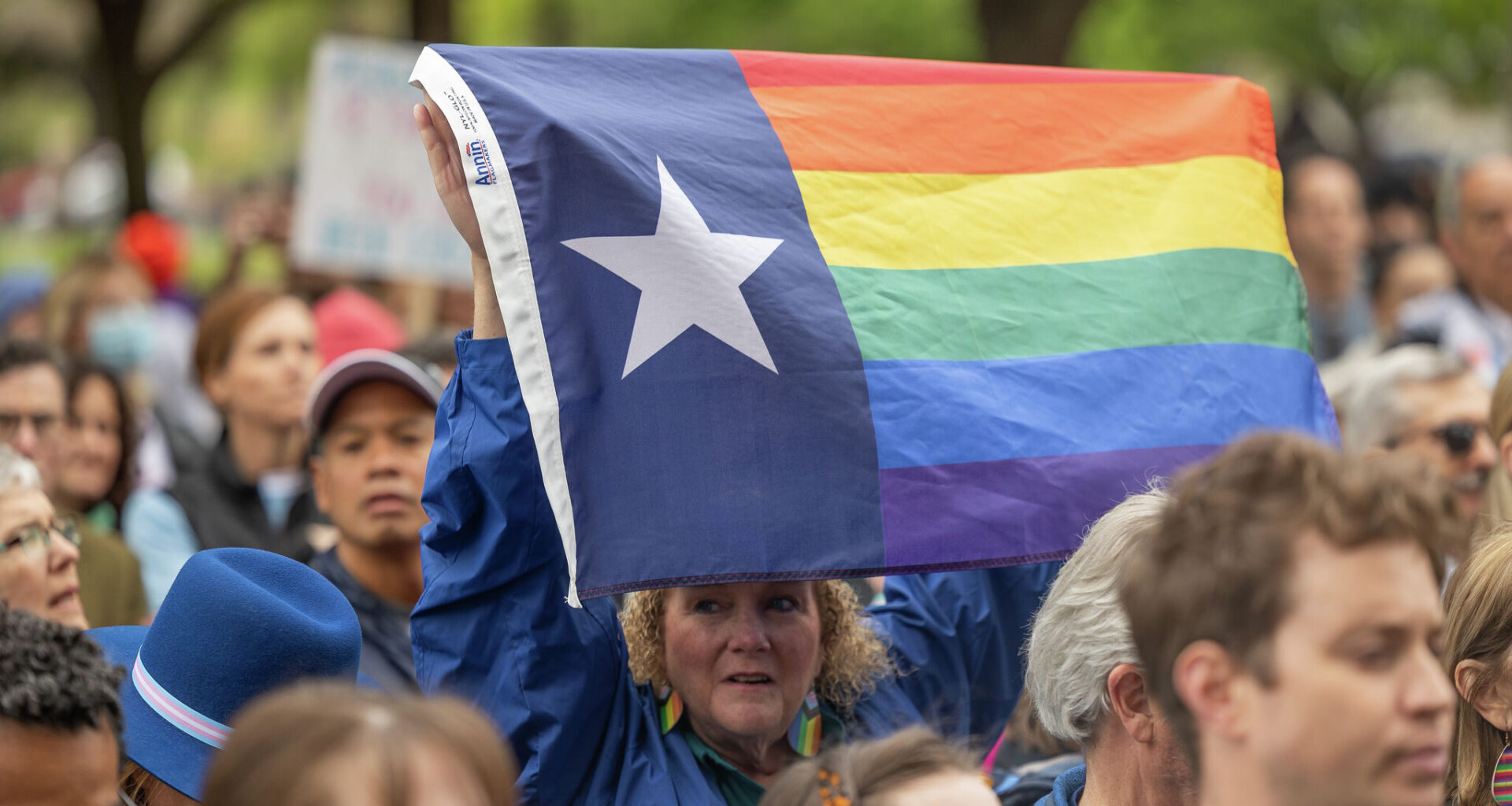
Supporters of trans rights rally on the steps of the Texas Capitol ahead of an advocacy day of meetings with state representatives. Amber Briggle, husband Adam, their son and daughter drove more than 200 miles from their home to attend a rally and trans awareness day at the Texas Capitol in Austin, Texas on March 20, 2023.
The Washington Post/The Washington Post via Getty Im
It’s cliché to say at this point, but everything really is bigger in Texas. According to a new report, that includes the number of Texans who identify as LGBTQ+.

According to a new report from the LGBTQ-rights advocacy organization Human Rights Campaign, 12 percent of U.S. adults, or about 25.6 million people, identify as lesbian, gay, bisexual, transgender or gender diverse. The report found that 12.54 percent of Texans, about 2,243,590 people, identify as LGBTQ+, meaning the Lone Star State has one of the largest LGBTQ+ populations in the country. By identity, the report found that:
Article continues below this ad
3 percent of Americans identify as lesbian or gay
7 percent identify as bisexual
2 percent identify as transgender or gender expansive
The Human Rights Campaign’s report looked at 2.4 million responses to the U.S. Census Bureau’s Household Pulse Survey, an online national survey of households that ran from 2021 to 2024. While HRC’s methodology documents note that the Household Pulse Survey was experimental, it was “one of the largest federal data collection efforts” to have collected information about Americans’ sexuality and gender identities. Notably, that survey was one of the last major efforts to poll Americans about their sexual orientation or gender identities before the Trump administration stopped collecting such data.
Texas ranks among the top 15 states in terms of pure percentage of LGBTQ+ adults and is second behind only California among raw numbers of LGBTQ+ adults. That tracks with earlier estimates of LGBTQ+ populations throughout the country. A 2023 report from the Williams Institute at UCLA found that around 5 percent of Texans identified as LGBTQ+, mirroring the national percentage in that survey of 5.5 percent.
More recent surveys of LGBTQ+ adult populations have found that the number of Americans identifying as something other than straight or cisgender has grown in recent years. Earlier this year, Gallup reported that 9 percent of Americans identify as “lesbian, gay, bisexual, transgender or something other than heterosexual.” While that figure remained essentially the same as a 2025 poll, it was double what Gallup found when it first began measuring LGBTQ+ populations in 2012. In 2012, 3.5 percent of Americans identified as LGBTQ+.
Article continues below this ad
HRC said that its finding of 12 percent is higher than Gallup’s due to different sources of information. Gallup primarily surveyed Americans by phone, while HRC used an online survey, a method the group says “may offer greater privacy on sensitive questions, which can contribute to higher disclosure.”
The Austin Pride Parade proceeds down Congress Avenue in Austin, Texas, Saturday, Aug. 23, 2025.
Austin American-Statesman/Hearst/The Austin American-Statesman vi
Unsurprisingly, most of Texas’ LGBTQ+ population is clustered in the state’s cities and surrounding suburbs. Thirteen percent of adults in the Dallas-Fort Worth-Arlington metro area identify as LGBTQ+, or 632,947 people. In the Houston-Woodlands-Sugar Land area, just over 12 percent of adults identified as LGBTQ+, or about 565,912 people. Few studies have looked at Houston’s LGBTQ+ population, though an in-progress survey by Rice University’s Kinder Institute for Urban Research in partnership with local LGBTQ+ groups may give more insight.
Before now, there have been few comprehensive looks at Texas’ LGBTQ+ population as a whole. In 2022, the Williams Institute estimated about 1.42 percent of Texas youth identify as transgender. A 2025 update found that less than one percent of adults identified as transgender, while 3.5 percent of youth did. One 2023 look at Texas found that 93 percent of Texas counties had less than the national average in same-sex couples and four had none at all, which researchers and advocates attributed to a hostile environment and problems with the U.S. Census.
Article continues below this ad
According to HRC’s report, Texas has the largest LGBTQ+ adult population in the South. The South’s LGBTQ+ population as a whole is estimated at about 36 percent of all adults in the new survey.
‘We’re not a niche constituency’
In a statement, HRC said its report underscored the importance of treating LGBTQ+ Americans as an important bloc of voters as some Democrats consider how much emphasis they should put on LGBTQ+ rights. The new figures also come as the Trump administration has directed federal agencies to stop collecting information on gender, sexuality and other data on LGBTQ+ Americans.
Smart, funny and sometimes unhinged look at the week that was.
By signing up, you agree to our Terms Of Use and acknowledge that your information will be used as described in our Privacy Policy.
“LGBTQ+ Americans are everywhere,” Human Rights Campaign president Kelley Robinson said in a statement. “There are 25 million of us across the country, and we now have critical mass in almost every state in the nation. We’re not a niche constituency, and no campaign, brand, or employer can afford to treat us like one.”
Article continues below this ad
But the new state-level data also shows that Texas conservative lawmakers, who have focused on laws targeting queer and trans Texans in recent years, are legislating issues impacting more Texans than previously thought. In recent legislative sessions, Republicans in Austin have passed laws curbing gender affirming care for trans youth, bathroom usage for trans Texans in public buildings, and the sports teams trans athletes may play on. The legislature has also aimed at public displays of LGBTQ+ Pride and how educators in state schools may teach about queer people.
That’s resulted in some LGBTQ+ Texans leaving the state entirely for more supportive states. A survey from gender affirming care clinic Plume in 2025 found that Texas had the highest percentage of transgender people leaving the state. That’s led many to seek shelter in large, Democratic led cities like Seattle.