
Is there another opera as much about ideas as Dialogues of the Carmelites?
Suffused with Christian themes, it’s about religion versus tyranny, fear versus faith, self versus sacrifice, about one person’s death sometimes saving another. In the wake of his midlife re-embrace of Roman Catholicism, composer Francis Poulenc crafted his own libretto from a play by Georges Bernanos. The story’s ultimate source was an account of the French Revolution by a nun who barely survived it.
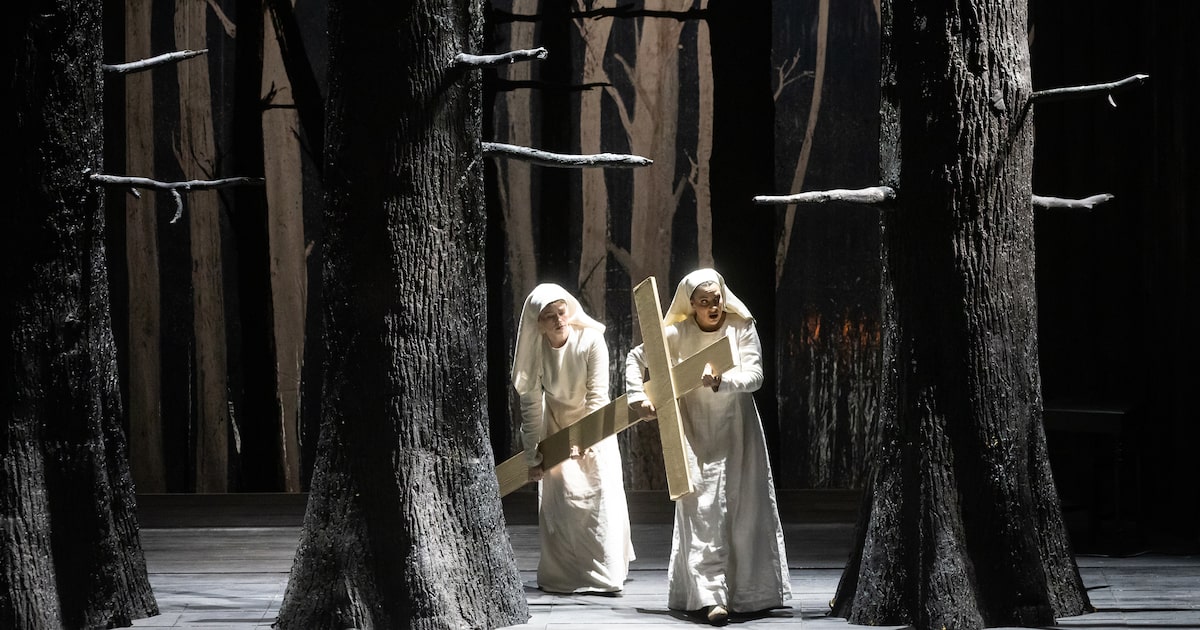
You might think an opera mainly about nuns would by shy on personalities, on drama, but Carmelites has no lack of either. And personalities and drama were vividly realized in the Dallas Opera production that opened Friday night at the Winspear Opera House.
Surprisingly, one of the most important 20th century operas, premiered in 1957, had never before been done by The Dallas Opera, although Fort Worth Opera staged it in 2006. It’s being sung in the original French, with English supertitles.
News Roundups
Poulenc and Bernanos set the action during the French Revolution’s bloody anti-Catholic Terror, but men’s costumes here suggest the mid-19th century — maybe the 1870-71 Franco-Prussian War? The production, originally staged by Olivier Py for the Théâtre des Champs-Elysées in Paris and Théâtre Royal de la Monnaie in Brussels, is revived here by Daniel Izzo.
Sets and costumes by Pierre-André Weitz, dramatically lighted by Bertrand Killy, stick to a stark black-white-and-gray color scheme. Eschewing specific settings, walls of rough boards slide in and out, sometimes opening on wintry forest scenes.
No composer’s musical language is more distinctive than Poulenc’s. There’s a directness, and a certain singsongy quality, to the tangy wind harmonies, soft lappings of strings and scorching blazes of brass. You’ll walk out humming no tunes, but motifs will stick in your head. Led with sure and sympathetic hand by music director Emmanuel Villaume, the Dallas Opera Orchestra supplied every thrill and subtlety.
The cast was less consistently convincing. As the ironically named Blanche de la Force, who’s always running from something, soprano Joyce El-Khoury took a while to warm up vocally. Patricia Racette supplied plenty of drama as the old prioress Madame de Croissy. But on an upturned upstage bed her dying agonies, in one of the most gripping scenes in all of opera, couldn’t exert the visceral impact of a closer presence. And Racette’s soprano sounded too healthy for a woman, in and out of delirium, railing against her death.
The successor prioress, Madame Lidoine, sees herself as a humble servant, but you wouldn’t have known that from Leah Hawkins’ stentorian portrayal. The vocalism was impressive, but it didn’t fit, and she was rhythmically unsteady. On the other hand, Stéphanie d’Oustrac — a great grand-niece of Poulenc, no less — was the aptly sturdy Mother Marie, with a well appointed and beautifully expressive mezzo. Deanna Breiwick was appropriately bright-toned as Sister Constance, gradually taming the character’s initial superficiality.
Raymond Aceto’s well-seasoned bass boomed imposingly for the pompous Marquis de la Force, father of Blanche and the Chevalier de la Force. The latter was vividly portrayed by Martin Luther Clark, with quite a handsome tenor. In this production, at least, was I alone in sensing something less than a healthy relationship between the siblings?
Aaron-Casey Gould gave the convent’s Chaplain the appropriate high baritone, but I wanted a smoother tone, and more gravitas to the portrayal. Andrew Potter supplied a potent, well focused baritone for the roles of Thierry and the Jailer. Samuel PJ Lopez was appropriately oily as the First Commissioner, but the role could have used more vocal oomph.
Excellent contributions from the assembled nuns and crowds betokened fine preparation by chorus director Paolo Bressan.
The opera ends with the nuns marching off one by one to the offstage guillotine, singing the Marian hymn “Salve regina.” At least that’s how it’s usually done. You can decide whether this production’s novel realization of the scene works. I found it more confusing than convincing.
Details
Repeats at 2 p.m. Nov. 9 and 7:30 p.m. Nov. 12 and 15 at Winspear Opera House, 2403 Flora St. $15 to $412. 214-443-1000, dallasopera.org.