
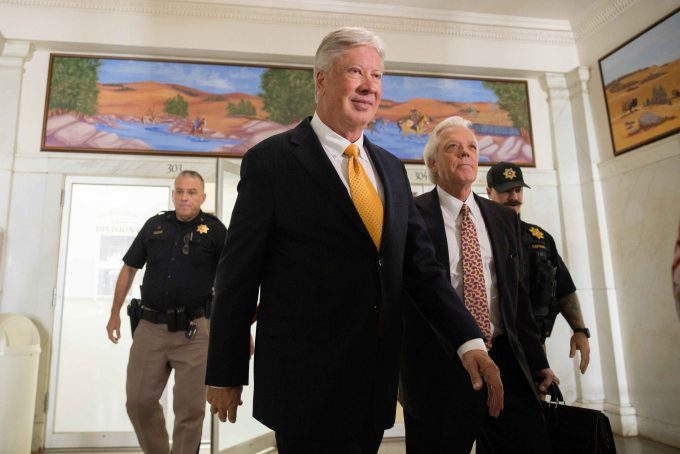
DALLAS — A Texas court has ruled in favor of Gateway Church in a defamation case brought against the church and its former pastor, East Texas native Robert Morris, by the woman who accused Morris of sexually abusing her as a child in the 1980s.
Morris eventually pleaded guilty to multiple child sex abuse charges. The court ruling is a significant setback for Cindy Clemishire, who accused Gateway, its leadership and Morris of conspiring to cover up her abuse and defaming her in statements after the abuse became public.
Based on the ecclesiastical abstention doctrine, the Fifth Court of Appeals in Dallas ruled Wednesday that a lower court should dismiss the case against Gateway and three of its elders within 30 days. In a separate opinion, the court also dismissed all claims, except for one, against Morris.
“Because we find that real parties’ claims are inextricably intertwined with the church’s investigation of Morris’ misconduct, the doctrine deprives the trial court of jurisdiction,” the opinion said.
In a statement, Clemishire’s attorney Jeff Leach said the ruling has “deeply troubling consequences” for survivors of childhood sexual abuse. A spokesperson for Clemishire said her legal team is considering next steps.
Ronald Breaux, an attorney with Haynes Boone law firm, which represents Gateway and the three elders, said the court’s opinion vindicates Gateway’s “foundational first liberty” and that “we continue to pray for healing and peace for Cindy and her family.”
Email newsletter signup

“While Gateway grieves and laments Robert’s child sexual abuse of Cindy, that abuse happened 20 years before Gateway was founded,” Breaux said in a statement.
Morris’ attorney Bill Mateja said in a written statement that Morris will continue fighting the “sliver that’s left.”
“Robert has never shied away from what he did to Cindy decades ago — he pled guilty, and he served the sentence for it. But this civil suit was never really about that,” Mateja said. “It was an attempt to pull a church’s internal reckoning into a courtroom where it doesn’t belong, and the Court of Appeals confirmed that the First Amendment doesn’t allow it.”
The lawsuit is centered on statements made in the days after Clemishire went public with her story in 2024 in an interview with the Wartburg Watch, a religious watchdog blog.
A statement from the church to its staff included a quote from Morris, when he said he had been involved in “inappropriate sexual behavior” with a “young lady” early in his ministry. Another statement from Gateway referred to the abuse as an “inappropriate relationship.”
Gateway leaders later apologized to the congregation for describing Clemishire as a young lady, saying instead that she was a “12-year-old child.”
Clemishire has argued these statements downplayed and incorrectly characterized rape and child sex abuse.
Morris pleaded guilty to five counts of child sex abuse charges in October and served six months of a suspended 10-year sentence. He was released from Oklahoma jail in March. Under his plea agreement, he was required to register as a sex offender for life and is serving the remainder of his sentence on probation. Clemishire has said she was consulted on the plea deal.
Morris was born in Marshall and graduated from Pine Tree High School in Longview.
He founded the megachurch in Southlake in 2000, and it grew to be one of the largest churches in Texas with over 100,000 members and multiple campuses. He resigned as senior pastor in June 2024, after Clemishire publicly accused him of sexually abusing her from the ages of 12 to 17 during the 1980s.
Clemishire and her father filed the lawsuit against Morris, his wife Deborah, the Robert Morris Evangelistic Association, Gateway Church and several current or former church elders and staff in June 2025.
Court said ecclesiastical abstention doctrine applies
The court wrote that the case should be dismissed not on whether statements were defamatory, but because it found religious liberty protections apply. A Dallas district judge Emily Tobolowsky had previously denied petitions from the Morris and Gateway parties to dismiss the case.
The Fifth Court of Appeals ruled Wednesday that the Dallas trial court erred in that decision.
When invoked, the ecclesiastical abstention doctrine, grounded in the First Amendment, prevents courts from adjudicating the internal matters of religious organizations – particularly in civil cases. Critics of the doctrine have said it improperly protects churches from consequences related to sex abuse.
In his statement, Clemishire’s attorney Leach, who is also a Republican state lawmaker, said religious liberty was never intended to become a “shield” for concealing child sex abuse.
Leach said churches should not receive greater accountability protections than secular institutions in cases of child sex abuse.
“The effect of this ruling is to create precisely that double standard,” Leach said. “It permits bad actors within religious institutions to invoke the ecclesiastical abstention doctrine as a barrier to claims arising from the concealment and enabling of child sexual abuse.”
The court said that the doctrine does not bar all claims against a religious organization, and that a civil court may exercise jurisdiction over non-ecclesiastical issues.
However, the court found that “claims relating to the publication and communication of the results of the investigation cannot be severed from a church’s policy to investigate its clergy and fall within the ecclesiastical abstention doctrine.”
The court found that Gateway’s investigation into Morris was “inherently ecclesiastical,” and therefore Clemishire’s claims would require probing ecclesiastical matters. The court wrote that the June 14, 2024 communication from Gateway was made to its staff for a religious purpose, “shepherding” the congregation.
“Even where statements reach nonmembers, ecclesiastical abstention applies if resolving the claims would require probing a church’s internal processes,” the opinion said.
Between two court filings related to Gateway and Morris’ arguments, the court ordered the claims against Gateway, three elders, Morris’ wife and most of the claims against Morris to also be dismissed.
One claim against Morris remains standing, which is tied to statements he made in a May 2025 court filing in a separate case.
In June, a federal court dismissed a different lawsuit against Morris and Gateway by former members of the church based on the ecclesiastical abstention doctrine. The lawsuit had accused Morris and the church of misusing money donated to the church through tithes.
In May, Gateway and Morris agreed to arbitrate their dispute over a multi-million dollar retirement package outside of court, dismissing an ongoing civil case.