
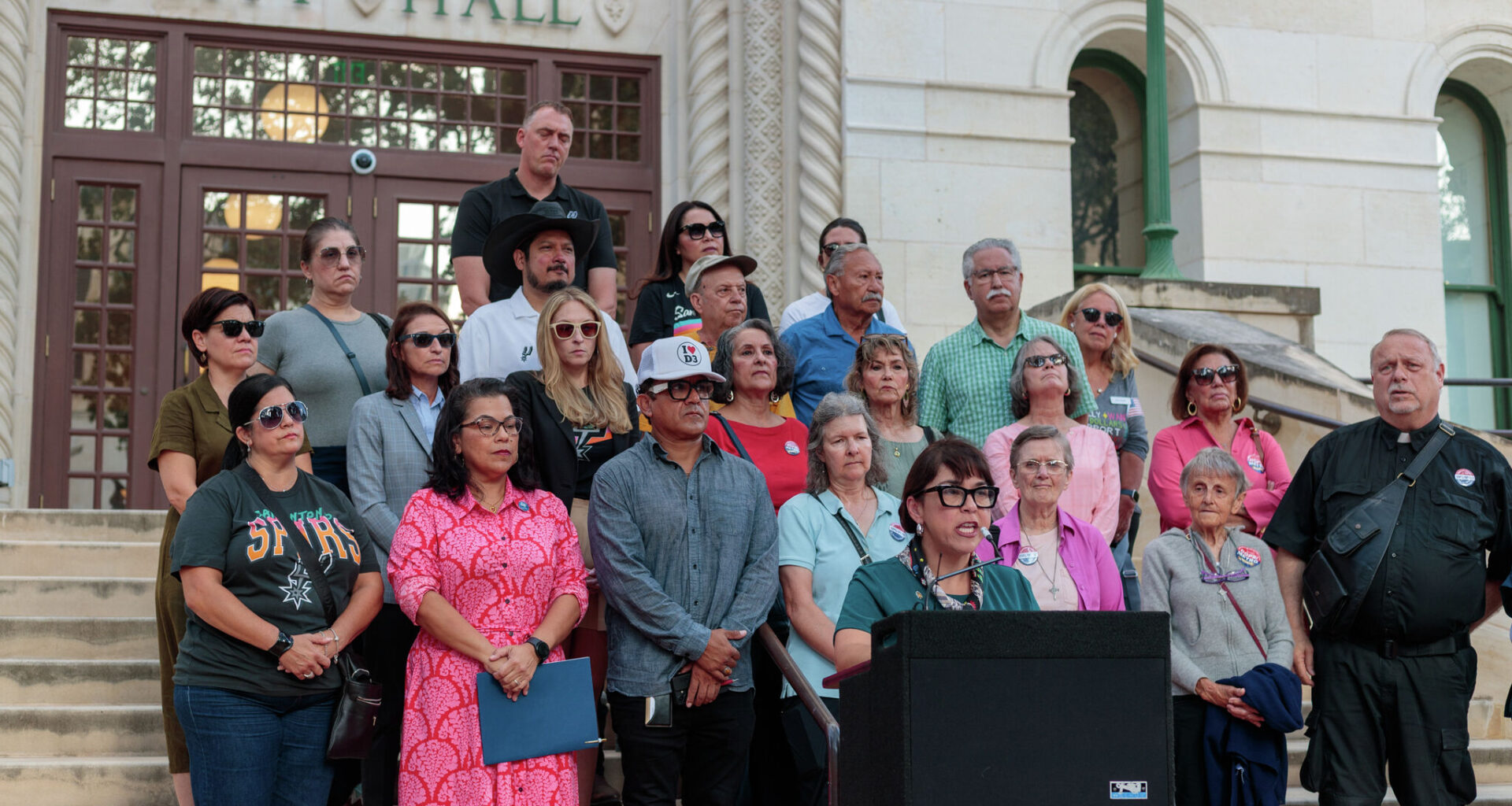
District 3 City Council Member Phyllis Viagran speaks on Aug. 7 during a press conference in front of City Hall in opposition to another vote on the Spurs arena and the city’s Ready to Work program. She is joined by business and community leaders.
Blaine Young/For the Express-News
Mayor Gina Ortiz Jones gives her first state of the city address in April during the Greater San Antonio Chamber’s annual event at the Tobin Center for the Performing Arts.
Katina Zentz/San Antonio Express-News
It may be surprising to some given the closeness of the recent San Antonio City Council vote, but a second election on the downtown Spurs arena was never in play.

Mayor Gina Ortiz Jones never had six votes to advance a city-specific arena election, which in a sense made Monday’s 5-6 vote much ado about nothing — but hardly as amusing as Shakespeare’s play.
Article continues below this ad
This doesn’t, however, mean the vote was inconsequential.
In politics and governance, the symbolism and theater of votes can be almost as meaningful as the policies enacted. As the city of San Antonio lurches forward to address a budget gap of $158 million over the next two years, the potential deregulation of its electric utility market and the need to see this downtown Spurs arena to fruition, there are enduring consequences of Monday’s vote for the mayor, the city as an institution and the broader community. Not one is positive.
A weakened mayor
It’s hard not to see how Jones doesn’t emerge from this vote as a weaker mayor.
Article continues below this ad
While Jones gave voice to the fierce opposition among many residents to the downtown arena and has a legion of vocal supporters who see her as an inspiring fighter challenging an ineffectual establishment, she also alienated key stakeholders with her pressure campaign. She fired up her base in pushing for a second arena election, but she has emerged more isolated in the community and on council.
At the 10,000-foot level, there is something unsettling about an elected official seeking to erase a recent election outcome. It was not quite a year ago that a majority of Bexar County voters, including a majority of city voters, approved county funding for the Spurs arena.
It was understood the city funding was contingent on voters approving the county funds. Voters approved a vision for the community — right or wrong — and that should be respected, not diminished or manipulated.
Jones also made a tactical mistake by briefly pushing for a new vote to unwind the city’s Ready to Work program, which 77% of voters approved in 2020. While that program got off to a painfully slow start, it has made a huge difference for thousands of people, mostly women and minorities.
Article continues below this ad
Again, this was another political dead end for the mayor.
Not only was it unlikely the remaining Ready to Work funds could be applied to the city’s budget gap, as Jones wanted, but it is the signature program for former Mayor Ron Nirenberg and COPS/Metro Alliance.
Nirenberg is on the ballot in November as the Democratic nominee for Bexar County judge. As for COPS/Metro, the storied community organizing group, which opposed the arena last year, came out against new elections for the arena and the jobs training program.
Loss of trust
In pushing for a second arena vote, Jones sowed doubt about the city government she leads.
Article continues below this ad
Her statements about how the city’s arena funds could be used to mitigate the city’s deficit, or how the broader downtown sports and entertainment district had changed, or how city residents would be paying twice for the arena were misleading enough that they prompted unusual responses, if not outright blowback.
City Manager Erik Walsh issued a memo to address “misinformation” from “several statements and reports that have recently circulated in the media concerning aspects of the Sports and Entertainment District.”
Left unsaid was how some of those statements had been made by the mayor.
District 3 City Council Member Phyllis Viagran was blunt, accusing the mayor earlier this month of lying about a nonbinding term sheet.
Article continues below this ad
“No one’s lying,” Jones said.
“You are being more than inaccurate,” Viagran responded.
It can be easy to get caught up in the drama at City Hall — the thousand paper cuts that accumulate over time — but the larger repercussions deserve greater attention. Not only has the council become fractious in a way we haven’t seen with past mayors, but arena opponents now see their civic voice denied.
The doubt around arena funding, as well as Ready to Work funding, may prove infectious and costly, be it in the loss of community trust or in outside economic opportunity.
Article continues below this ad
No civic vision
Jones was the only mayoral candidate in 2025 who never articulated a vision for the downtown Spurs arena.
As a candidate, she never told voters, at least in general terms, how much public funding, if any, was appropriate for the arena. While she raised questions about arena funding and called for an independent economic study, she never outlined parameters of a deal she would support.
Through such a lens, Jones’ opposition to this voter-approved arena plan is hardly surprising, just as her relentless push to redo past votes is telling. It is, after all, easier to look backward than to embrace the challenges ahead, just as it is easier to poke holes in someone else’s vision than craft one of your own.
Article continues below this ad
This isn’t to say elected officials shouldn’t be critical or demand more — from the Spurs or Ready to Work or staff at City Hall. Nor is it to say elected officials should champion a project or cause they don’t believe in.
But the best elected officials, and especially the best mayors (looking at you, Phil Hardberger), rally the community and their council colleagues around a civic vision, whether that is embracing Hurricane Katrina evacuees, building the Museum Reach River Walk extension, spurring downtown development or investing in workforce development and public transit at a time of crisis.
Jones’ best moment as mayor came last fall when she rallied the community to support families who were on the verge of losing food stamps. It was positive, compassionate and brought people together for common cause.
Article continues below this ad
Those are essential ingredients to meaningful governance, but too often they have been missing at City Hall. After this past week, that is unlikely to change.
jbrodesky@express-news.net