
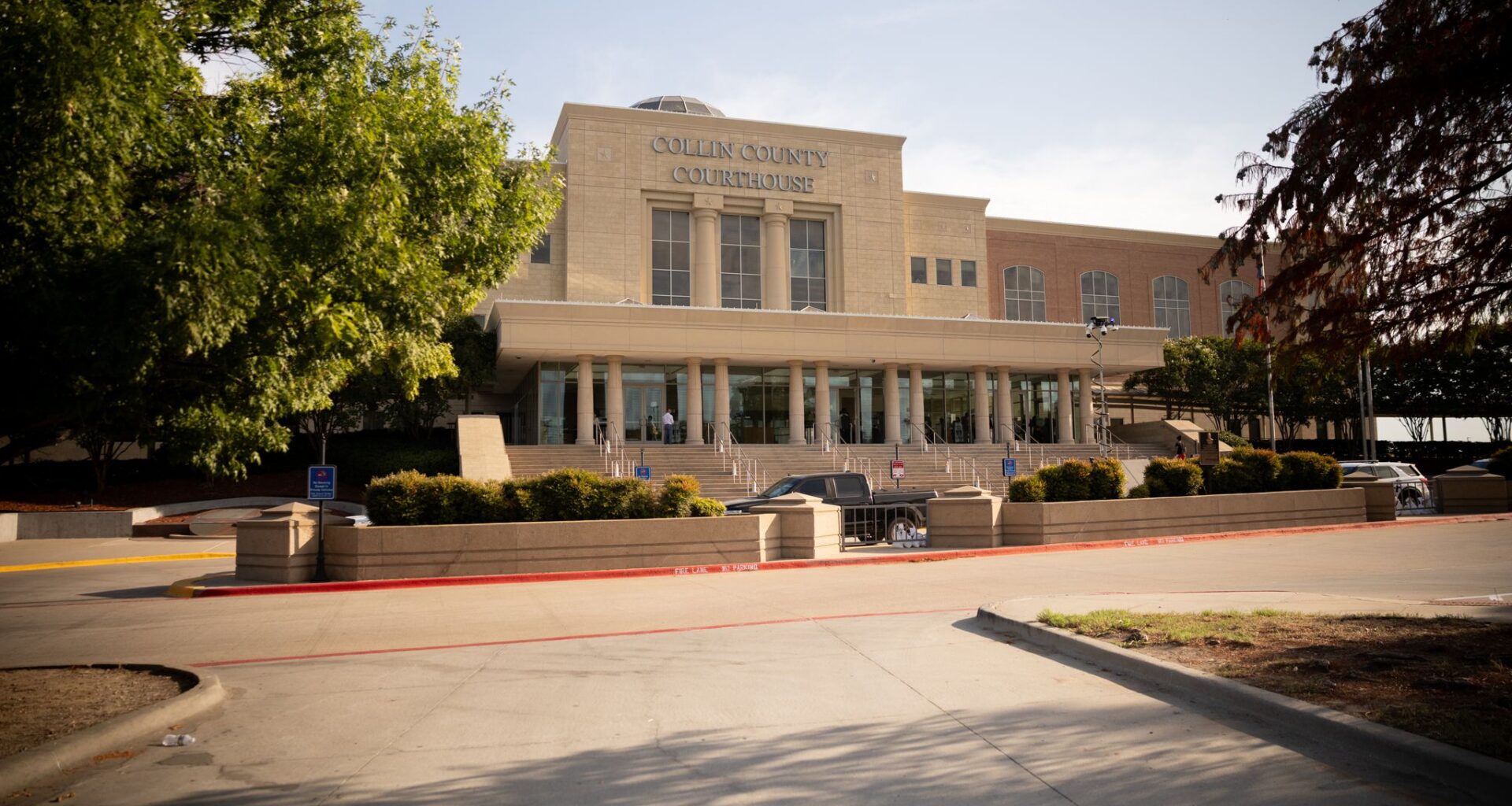
The exterior of the Collin County Courthouse before a hearing on Karmelo Anthony’s motion for a new trial in McKinney, Texas, Friday, Aug. 21, 2026. Anthony was convicted of murder in June and sentenced to 35 years in prison for the fatal stabbing of Austin Metcalf at a high school track meet in Frisco.
Juan Figueroa/The Dallas Morning News
McKINNEY — A “shadow docket.” Or, an “old school approach.”

These differing characterizations of off-the-record proceedings in Karmelo Anthony’s June murder trial took center stage at a Friday hearing in Collin County to determine whether the Frisco teen should get a new trial.
Anthony, 19, was sentenced to 35 years in prison in June after a Collin County jury found him guilty of murdering 17-year-old Austin Metcalf at a Frisco track meet. Anthony’s appellate team has spent the past two days arguing the teen’s constitutional rights were compromised at his trial by an off-the-record “gentleman’s agreement.” The prosecution and defense said they arrived at the deal so troubling accusations against both teens would be kept away from the jury.
Article continues below this ad
Toby Shook, one of Anthony’s trial attorneys, and Collin County prosecutor Bill Wirskye took the stand on Friday and offered contrasting views of the agreement. Wirskye argued both sides agreed to the deal to protect all parties from “unprecedented” threats, including doxxing, swattings and death threats.
The case has attracted intense national attention and has sparked misinformation and racism on social media.
“It would have given fuel to the fire,” Wirskye testified, “which was fully lit in Collin County.”
The prosecution on Friday detailed allegations against Anthony that previously remained undisclosed under the terms of the agreement. Attorneys showed dozens of messages that they argued demonstrated Anthony’s desire to engage in and instigate fights, with some messages referencing alleged plans to incite violence.
Article continues below this ad
“Imma shoot the school up tmr,” prosecutors said Anthony wrote in April 2023, followed by “With my blick.” “Blick” is slang for gun.
As the texts were read aloud in court, Anthony vacillated between jotting down notes and leaning into the side of one of his lawyers, whispering in his ear.
Wirskye testified that had these records been public during the June trial, Anthony likely would have gotten a much harsher sentence.
“It would have been death by a thousand cuts,” he said.
With allegations of violent behavior against both Anthony and Metcalf, Wirskye said he proposed the “gentleman’s agreement” to keep both teens’ pasts from clouding the already complex case. He testified that officials took several steps to limit exposure of sensitive case information, including keeping a physical case file in the judge’s chamber rather than relying on a publicly updated docket online.
Article continues below this ad
“The less that gets out, the better,” he said of his mindset during the trial.
Related: How a quiet deal derailed Karmelo Anthony’s defense
But Shook challenged Wirskye’s characterization of the agreement, setting the two former law partners squarely against each other.
Shook testified the agreement “detrimentally impacted” Anthony’s rights at trial because of confusion over its terms.
During his testimony, Shook detailed how Wirskye told him the defense “opened the door” to introducing details about Anthony’s character in his cross-examination. The prosecutor said this opening came from the defense’s nod to Anthony’s involvement in chess club on the first day of the trial.
Article continues below this ad
The last-minute change, Shook testified, was stunning. He said it not only destroyed confidence in the state honoring the agreement — it instilled a resolute fear in Anthony.
“Bill’s just going to find a reason to open the door, no matter what I say,” Shook recalled Anthony saying, moments before he decided not to take the stand.
As a result, Shook said his team’s ability to effectively defend their client was “gutted.” He explained Anthony’s own testimony was crucial to establishing the state of mind necessary for a compelling self-defense argument.
Related: New court records challenge Karmelo Anthony retrial motion
Shook’s testimony is the latest addition to the defense’s argument that the trial judge, District Judge John Roach Jr., ran a “shadow docket” with extensive off-the-record proceedings. Since the terms of the “gentleman’s agreement” were never written on the record, Roach told both parties that he was unable to enforce the deal.
Article continues below this ad
“Both sides know it is not up to the Court to enforce this,” Roach told both attorneys during a recess in the June trial, according to court transcripts. “The Court is not bound by it.”
Roach was recused from the case following a separate Wednesday hearing.
The handful of supporters who waited outside the courthouse during Friday’s proceedings will have to wait a bit longer to get a decision — Judge Michael Chitty concluded the hearing without delivering a verdict. He now has only a few days to review the record and come to a decision.
The judge said he’s “bumping up against a deadline” imposed by Texas law, which states the court has 75 days after sentencing to determine if a new trial will be granted. Sunday marks 75 days after Anthony’s sentencing.
Article continues below this ad
Staff writer Nicole Asbury contributed to this report.