
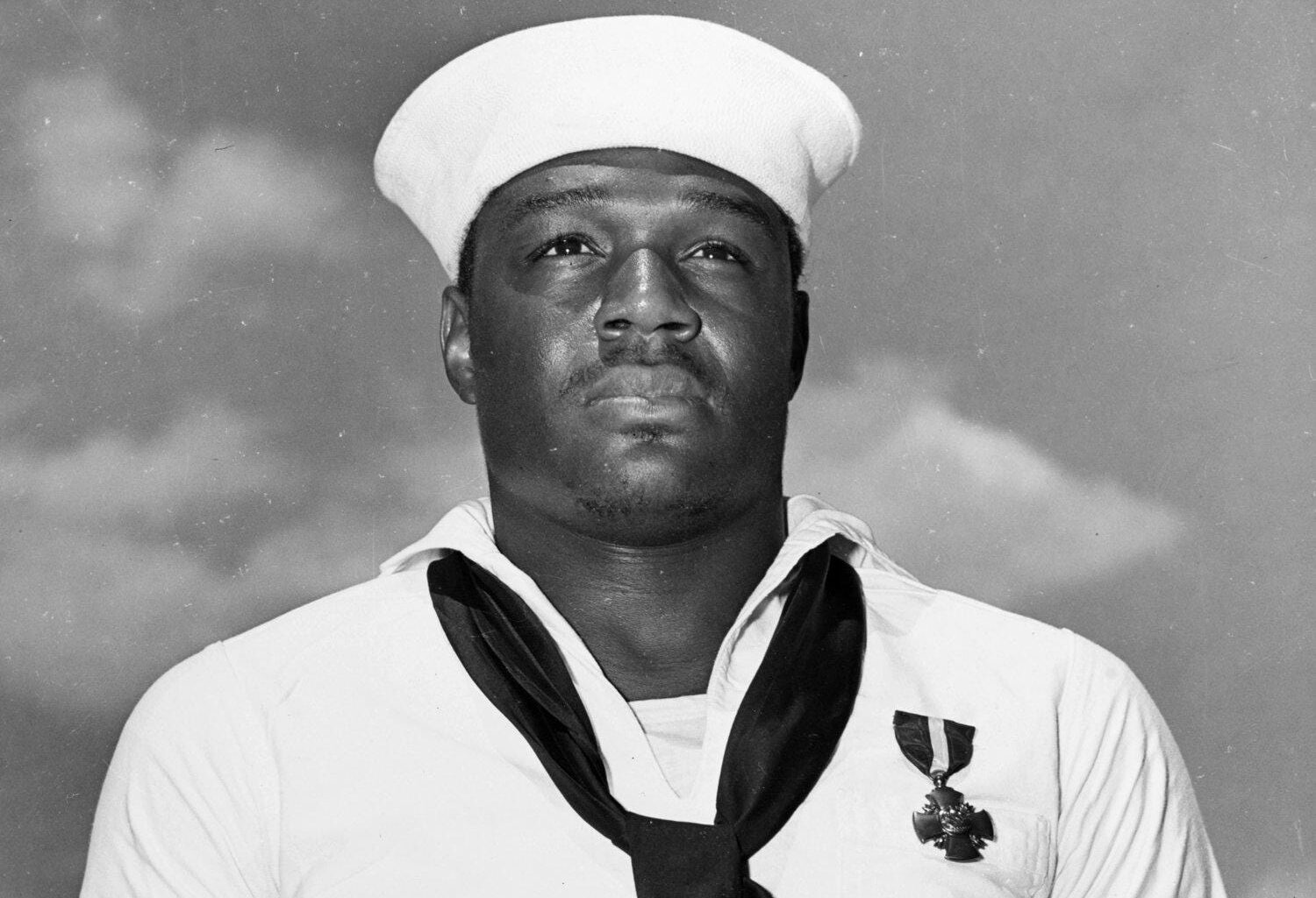
U.S. Navy Mess Attendant Doris Miller was the first African American awarded the Navy Cross for his heroism during the Pearl Harbor attack in 1941.
Austin American-Statesman
CNN was first to report that the U.S. Navy might remove the name of sailor and Pearl Harbor hero Doris Miller from an aircraft carrier under construction and replace it with President Donald Trump’s name. To christen a carrier after a sitting president would be unprecendented.

Here’s what we know about the Navy carrier that was to be named after the Texan war hero and namesake for the Doris Miller Auditorium in East Austin.
Article continues below this ad
Which ship is to be named for Doris Miller?
During Trump’s first term, the Navy announced that the Gerald R. Ford-class carrier under construction would be called the USS Doris Miller. The name recognized an enlisted sailor who helped defend U.S. forces from Japan’s attack.
In the event of a name change, Miller’s honor might transfer to another ship under construction.
Recently, Trump has made several suggestions about the redesign of such carriers, such as reinstating steam catapults to launch planes and changing the position of the island control tower.
Article continues below this ad
Who was Doris “Dorie” Miller?
Miller was a figure who bolstered both patriotic fervor during the war and potential social progress after it. Doris “Dorie” Miller, the first Black recipient of the Navy Cross and a nominee for the Medal of Honor, performed heroically during the attack on Pearl Harbor.
Without training and despite bans on African Americans serving in combat roles, he manned antiaircraft guns and downed as many as four Japanese planes. He also protected fellow crew members during the waves of attacks.
A native of Waco, Miller was hailed as a hero in Texas. Adm. Chester Nimitz, a native of Texas and commander in chief of the Pacific Fleet, pinned the Navy Cross on him.
Article continues below this ad
Miller returned to the United States to bolster war bond tours, but on Nov. 24, 1943, he was serving on the escort carrier Liscome Bay when it was torpedoed. His parents learned that he was considered missing in action on Dec. 7, 1943, two years after the Pearl Harbor attack.
Congress would have to authorize a Medal of Honor for Miller, with the president making the award.
What are the Doris Miller links to Austin?
Austin’s link with Miller is a slim but sturdy one.
Article continues below this ad
After his death, schools, roads, military assets, veterans groups and community centers were named after him. In 1944, the city started construction on Doris Miller Auditorium in Rosewood Park. Considering the politics of the time, U.S. Rep. Lyndon Johnson and Austin Mayor Tom Miller probably had a hand in the naming.
Decades later, Austin educator, businesswoman, community leader and school namesake Bertha Sadler Means recalled the rush of events in 1941, the year she married James H. Means Sr., a professor of mathematics at what is now Huston-Tillotson University, where she was a student.
“A lot of things happened in 1941,” she told the American-Statesman in a 2015 profile of her distinguished family. “The war started. I had a high school friend who was killed — Doris Miller. He was a student in Waco. We always teased him for having a girl’s name. After he was killed, Mayor Tom Miller named an auditorium after him: ‘Dorie’ Miller. I called the mayor and said: ‘His name is Doris. Would you change it?’ And he did.”
How do Texans respond to the possible name change from Doris Miller to Donald Trump?
Thomas Bledsoe, Miller’s great-nephew, told CNN that Miller’s family had not been informed of the possible change or the renewed effort to award his great-uncle the Medal of Honor.
Article continues below this ad
The family worked for him to receive the Medal of Honor “for years,” Bledsoe said, and called the Navy’s move to recommend the honor “very positive.”
Responses from Austin to the possible ship name change have so far been livid.
“Any attempt to diminish the role of Doris Miller in history is beyond a travesty,” said community advocate and former American-Statesman columnist Roxanne Evans. “Miller was a mess attendant/cook in the U.S. Navy, one of the few positions open to African Americans. He could have just stayed in his lane and cooked.
“However, while serving during World War II, with no weapon experience, he stepped up to save his fellow seamen on the U.S.S. Virginia and manned the weapons and shot down at least one Japanese plane,” Evans continued. “He also carried men to safety. He became the first African American to be awarded the Navy Cross for a reason.
Article continues below this ad
“His place in history should be elevated, not eliminated. That this is even being discussed is deplorable.”
“The Doris Miller Auditorium in Austin which bears his name has been a source of pride and determination to Austinites of all backgrounds,” preservationist and community leader Alta Y. Alexander said. “To move to replace his name anywhere now is to undermine that hard-won progress. My hope is that that U.S. Navy and any governmental entity does not tear down the monuments of our progress, and opts to preserve them.”
This is a breaking news story. Please check here for updates from Austin.
Article continues below this ad