
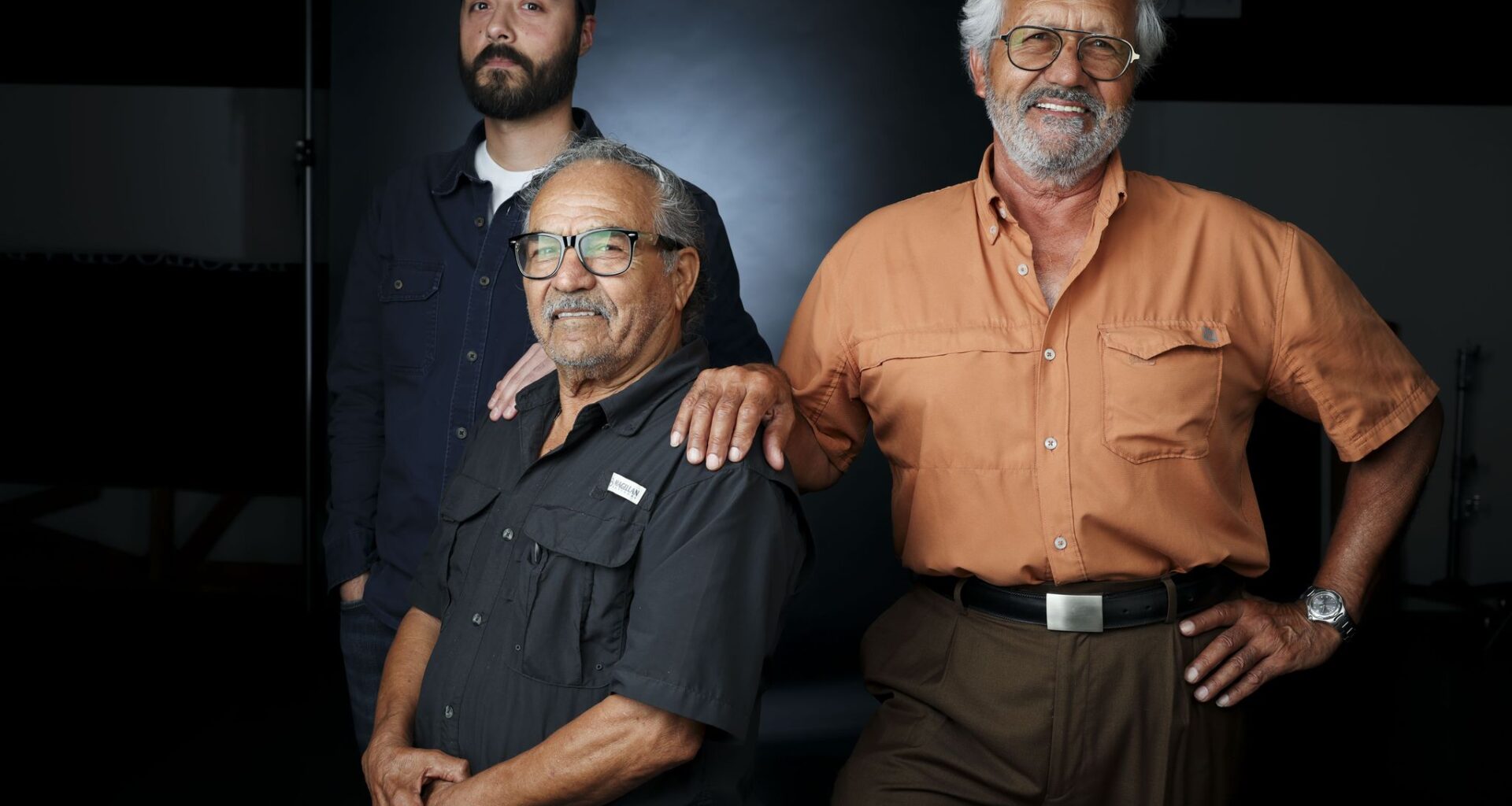
From left, Merced Elizondo poses with his grandfather’s brothers Juan Merced Elizondo, 81, and Sergio Manuel Elizondo, 72, at the Dallas Morning News studio, on Wednesday, July 29, 2026 in Dallas.
Shafkat Anowar/The Dallas Morning News
Every time Juan Merced Elizondo drives through downtown Dallas, he points to the massive concrete building nestled against the city’s skyline.

“Nomás cuando paso les digo ‘Mira, yo hice esto.’” “When I pass by, I tell them, ‘Look, I built this,’” he said.
Nearly six decades ago, a teenage Elizondo and his brothers hauled lumber under the Texas sun to build the seven-story Dallas City Hall. They worked for a year, pouring concrete on the foundations of the inverted pyramid the architect I.M. Pei designed.
Article continues below this ad
The brothers have watched as city officials debate spending hundreds of millions repairing City Hall or replacing it altogether.
Engineering reports have documented aging infrastructure and outdated systems inside the nearly 50-year-old building that, according to the Elizondos, put Dallas on the map.
The Dallas City Council still hasn’t voted on leaving the building but rejected a repair plan for the facility in June.
For 81-year-old Juan Merced Elizondo and his brother, 72-year-old Sergio Manuel Elizondo, City Hall represents hundreds of hours of labor and sacrifices that brought their family from Mexico to Dallas. The building transformed the city from a regional town into an international destination.
Their grandnephew, filmmaker Merced Elizondo, is preparing to release a movie shot inside the building.
Article continues below this ad
“My family helped build it and I might be the last filmmaker to capture its beauty,” he said.
Merced Elizondo poses for a portrait at the Dallas Morning News studio, on Wednesday, July 29, 2026 in Dallas.
Shafkat Anowar/The Dallas Morning News
‘We went through so much’
Developers and city leaders have said removing City Hall unlocks prime real estate that could save downtown. Merced Elizondo, 31, was surprised when he first heard the city was considering leaving the building.
“Surely people who are way smarter than us will know better,” he said during a July conversation with his great uncles about the building.
Article continues below this ad
Juan Merced Elizondo arrived in Dallas in 1963, just two weeks before President John F. Kennedy’s assassination.
“Tanto que sufrimos para hacerlo.” “We went through so much to get it done,” he said.
Dallas City Hall under construction in 1974.
1974 FIle Photo/Dallas Morning News
Francisco, his older brother, arrived first. Then Juan followed. Eventually, all six Elizondo brothers were working construction across North Texas.
The youngest, Sergio, was only 15.
Article continues below this ad
The city wasn’t welcoming at first. Juan remembers when he would have to go to a private corner for “Blacks and Hispanics only” in restaurants.
But all that changed after Kennedy’s assassination. President Lyndon B. Johnson signed the Civil Rights Act. And city leaders threw themselves into civic efforts to undo Dallas’ identity as a “city of hate.”
City Hall opened to the public in 1978 after nearly a decade of planning and two years of construction.
“Era un avance aquí para Dallas, para dar más a conocer esta ciudad.” “It was a step forward for Dallas, to raise the city’s profile,” Juan said.
The Elizondos helped build pieces of modern Dallas over the next four decades. Parkland Hospital. The Reunion Tower parking garage. Downtown office towers.
Article continues below this ad
Barren land
Building City Hall was different.
The brothers spent about a year building the concrete forms that would support the massive structure. The Lee Roy Westbrook construction company had about 20 workers assigned to that portion of the project.
When they started, 1500 Marilla St. was just rocks and barren land.
Construction site of I. M. Pei’s City Hall. Shot June 1, 1974 – Construction continues on Dallas City Hall. 1974×1974 ORG XMIT: DMN1006171144356215
LEE LANGUM – staff photographer/Dallas Morning News
The brothers recalled working long hours in a time before hydraulic lifts and modern equipment. Everything was carried by hand. There was no shade. No cooling stations.
Article continues below this ad
The clock on the Mercantile building across the street served as the daily reminder of lunch time. Their packed tacos were sometimes cold when they dug in because there was no place to heat their food.
The brothers remember details hidden beneath today’s City Hall that few Dallas residents know exist. While excavating the foundation, groundwater seeped through the limestone.
They also built a tunnel beneath the structure. Engineers told them it was intended for a future streetcar.
It never came. The tunnel was buried beneath the building.
City Hall’s future
After spending decades in construction, the brothers understand that buildings age. That’s just the wheel of time.
They said the city needed to take care of City Hall before it was too late, to take advantage of the new construction technology to avoid being in this pivotal moment for Dallas.
Modern waterproofing systems simply didn’t exist when City Hall was built. Could it be repaired? Maybe, they said.
Their grandnephew was a little less understanding.
To him, there’s never been a better time to be in Dallas. He has seen the arts grow, bubble and blossom. He has experienced New York City and worked in Los Angeles. But Dallas was a place to watch.
“I feel like anytime Dallas is close to establishing a culture, we rip it out because of corporate interests,” he said.
He filmed “And Then Everything Turned Itself Inside Out” at City Hall. It’s a story of an imagined future where people’s birthmarks are investigated by social services to probe their past whereabouts.
A still from Merced Elizondo’s “And Then Everything Turned Itself Inside Out”. The film is expected to have its world premiere in 2027.
Merced Elizondo
A still from Merced Elizondo’s “And Then Everything Turned Itself Inside Out”. The film is expected to have its world premiere in 2027.
Merced Elizondo
Elizondo was selected for the Latino Film Institute fellowship, which is supported by Netflix. His movie — starring Raúl Castillo, Julio César Cedillo and Moira Kelly — is expected to have its world premiere next year.
He worries City Hall will be demolished but hopes the city will keep the building alive as a museum or a school.
“Look, there’s a lot of millionaires, there’s a lot of billionaires in Dallas,” he said. “I don’t know why we can’t either scrape some kind of money together to fix it.”
His great uncles understand that the decision may ultimately come down to dollars. They also understand that cities change. After all, they helped build much of the one Dallas residents know today.
“Si van a hacer algo ahí, que hagan algo bueno, que sea reconocido mundialmente.” “If they’re going to do something there, at least it should be something good — something that will be recognized worldwide,” Juan said.