Late last month, the United Football League (UFL) made a couple of major announcements. They officially moved out of Birmingham, Alabama – along with Houston, Texas. While the plan is to expand to two more cities in 2028, Mike Repole and the executive team made the business decision to pivot for 2027 as well.
When Mike Repole bought into the UFL in late July of 2025, it was clear that the league was going to see serious shakeups under his leadership. Almost immediately, the league moved three teams – expanding into Columbus, Louisville, and Orlando. Those efforts proved to be quite fruitful, culminating in a Louisville Kings Championship.
Now, the UFL has the opportunity to jump into another two new markets in 2027. Austin, Texas stands out as a location with loads of potential – and it may already be on the UFL’s radar.
In this piece, we’ll be taking a closer look into Austin, and why it might be the perfect place for the United Football League in 2027, and beyond.
Market Size
Austin is, without a doubt, one of the fastest growing communities in the entire country. It is now recognized as the 12th largest city in the United States, with a population of 1.002 million people within the city limits alone. Expand into the Austin-Round Rock metro, and you’re looking at an audience of 2,550,000.
Comparing Austin to a place like Louisville, you can see where the excitement lies. The Kings averaged over 11,000 fans per game (in a venue that seats 15,000) – with a population of just 642,000 in city limits. Expand out to the metro, and Louisville is still dwarfed by Austin, at 1.39M.
Since the 2020 census, Austin’s metro has added 337,000 residents – a 14% increase across a six year span. The city is consistently ranked as the #1 or #2 fastest-growing major metro area in the U.S. by percentage growth over the past decade. On top of that, Austin is outpacing Dallas, Houston, and San Antonio as the fastest-growing major region in Texas. For a league that has always had 2-3 teams in the state of Texas, that’s important to note.
Demographic
Aside from the size of the market itself, Austin presents some incredibly enticing qualities. The city is the sixth youngest metro in the country, with large numbers of young people moving there annually. Austin’s metro median age is 35.9 years old, three years younger than the United State’s national median.
Why does this matter? In addition to the young overall median age in the city, Austin has a higher-than-average median household income – at around $90,000. Because the market has a younger than usual demographic, paired with a higher than usual income, it poises a golden opportunity for the UFL – if they can capitalize on it.
Younger demographics are statistically proven to embrace new sports teams/branding at a more consistent sell-through rate than older generations. Compared to most minor league markets, Austin has a higher percentage of young people who actually have disposable income. If executed upon correctly, that’s a potential cash cow for the UFL right there.
Venue: Q2 Stadium
We hear Mike Repole say it all the time: Right market, right venue, right branding. You need all of those things in order for spring football to thrive – and not just survive.
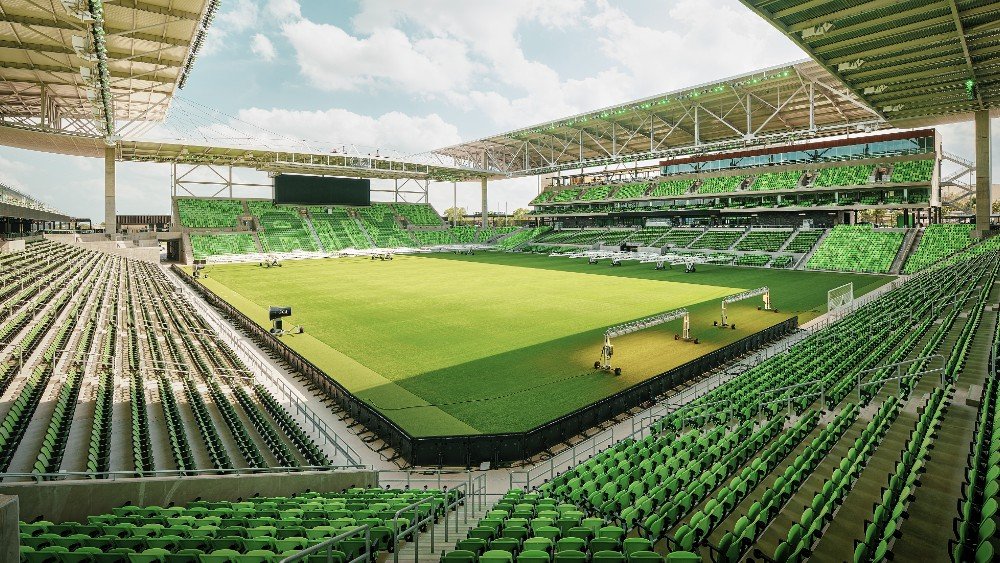
Enter Q2 Stadium, sitting in North Austin. Opened in 2021, it is the home to Austin FC, a soccer club which is a member of Major League Soccer (MLS). In years past, the UFL had a tough time getting into these smaller, soccer-sized venues – but Mike Repole changed that dynamic entirely in 2026.
This opens the door for Q2 to be the perfect landing spot for the UFL moving forward. With a capacity of 20,500, it mimics the size and atmosphere of similar venues where the league is already a tenant, such as Audi Field in DC, or Historic Crew Stadium in Columbus.
Of course, the UFL would have to work around Austin FC, who would have priority at Q2. That said, seeing that the league landed a whopping five new venue deals in 2026 alone, it shouldn’t be too difficult. With Repole at the helm, there is more financial leverage than there was in the past, making it easier to ink contracts with these soccer-centric stadiums.
Wide Open Competition
Another angle which makes Austin intriguing: the lack of professional sports in the area. Aside from Austin FC, Austin features no pro teams whatsoever. There are a few minor league organizations, such as the Texas Stars (AHL Hockey), and the Austin Spurs (NBA G-League). Of course, the Texas Longhorns are based out of Austin – with a raucous fanbase that has existed for decades.
Speaking of said fanbase, the hunger for professional sports in Austin is certainly there. Austin FC regularly sells out Q2 for their home matches, with a ridiculous 96-game streak sellouts. It speaks volumes to the potential for the UFL in this city – if marketed right, to the proper demographic, the possibilities are endless.
Tonight’s attendance of 20,738 marked the 71st consecutive MLS home sellout for Austin FC, extending the league’s longest active streak. pic.twitter.com/qoZlmi9Ucz
— Austin FC Communications (@AustinFC_PR) February 23, 2025
Promising Television Numbers
While Mike Repole’s main focus is getting butts in seats, there’s no denying the television aspect to the league as well. Spring football is long past the golden days of Vince McMahon’s XFL in 2020, when telecasts would regularly get millions of viewers – but the market is still there. The UFL consistently sees several hundred thousand viewers per game, competing with other similar sports in the spring at an efficient rate. This is largely due to their strong partnerships with FOX and ESPN.
Austin, in particular, will only add to that depth. It is currently the 34th largest Nielsen TV market in the U.S. with over 1.03 million TV households. In tune with the growth of the population itself, the Neilsen uptick has been noted the last several years.
Despite being the 34th largest media market overall, Austin loves their football, at least when it comes to college broadcasts. For major college football windows, Austin consistently performs as a top-five market in total viewing weight, even if Texas isn’t playing. For example, it is a common occurrence for the city to see upwards of a 20.0 share (20% of all TV’s in Austin) tuned into a major national game, via Neilsen’s records.
While losing markets such as Birmingham and Houston leaves a void from a ratings perspective, Austin can fill that hole without question.
Houston ➔ Austin
With six teams staying put in 2027, it would not make much sense for the United Football League to do an entire redraft and re-allocation, like they did in 2026. It served its purpose well last year. But, this go-around for general team chemistry and camaraderie, keeping things stationary will benefit the play on the field.
With that in mind: Houston should be placed in Austin. It would be a seamless transition, one that leaves the door open for Kevin Sumlin to retain his team and staff. Sumlin is an accomplished coach in Texas, and made it clear that he planned to return to Houston in 2027. Placing him in Austin is a bit outside of his comfort zones in Houston and College Station, but it’s close enough. Realistically, the UFL probably wouldn’t be able to find a “Chris Redman”-esque hire for Austin, anyway.
See also

Is It A Possibility?
Before we get ahead of ourselves here: let’s be clear – the UFL has not made any announcements in regard to relocation in Austin.
Our league sources have not confirmed a move to Austin, although they have indicated that a mutual relationship could certainly be brewing between the two. It almost makes too much sense for it not to.
Between the size of the market, the impressive growth and TV performance – and the golden venue – Austin would be ideal. Even if the UFL doesn’t head there in 2027, it’s an excellent location to move into at some point.
#UFL Co-Owner Mike Repole was on @PatMcAfeeShow this afternoon, and mentioned these cities as potential expansion locations:
– Austin, TX
– Salt Lake City, UT
– Omaha, NE
– Albuquerque, NM
– NYC
Thoughts on where the United Football League should go next? pic.twitter.com/uxdVZx2DIQ
— James Larsen (@JamesLarsenPFN) April 27, 2026
It’s also worth noting: back in April, on the Pat McAfee Show, Mike Repole mentioned Austin in a list of potential expansion cities. That list also included Salt Lake City, New England/Rhode Island, Omaha, New York City, and Albuquerque.
USFL Enterprises LLC, a subsidiary of the UFL, renewed their trademark for the “Austin Wranglers” in May of this year. The Wranglers are formerly an indoor football brand from the Arena Football League in the 2000’s. Unless the UFL comes up with their own new branding and name, the Wranglers could be an option since the league owns that trademark. It’s expected that the Gamblers brand will not be maintained, but that’s a detail that remains to be seen depending on where they land, whether in Austin or elsewhere.
Final Thoughts
The bottom line: Austin checks all the boxes. Across the board, the numbers are all there in order for success to be had. If the UFL makes their way to the city, it’s on the league to market – and broadcast this new brand – the right way. If they execute the same way they did in Columbus and Louisville, Austin will be a smashing success.
On August 14th, UFL Co-Owner Mike Repole stated in a post on X:
“Two new markets for 2027 should be announced in the near future. Also, two more markets are coming in 2028 as we grow from 8 teams to 10.”
With that in mind, we should expect to hear some developments on this front sooner than later. Hopefully, Austin is truly on the league’s radar. It certainly should be.
Do you think that the UFL should expand to Austin? If so, what would you name the team? Let us know down in the comments below, or join the conversation on Discord!