
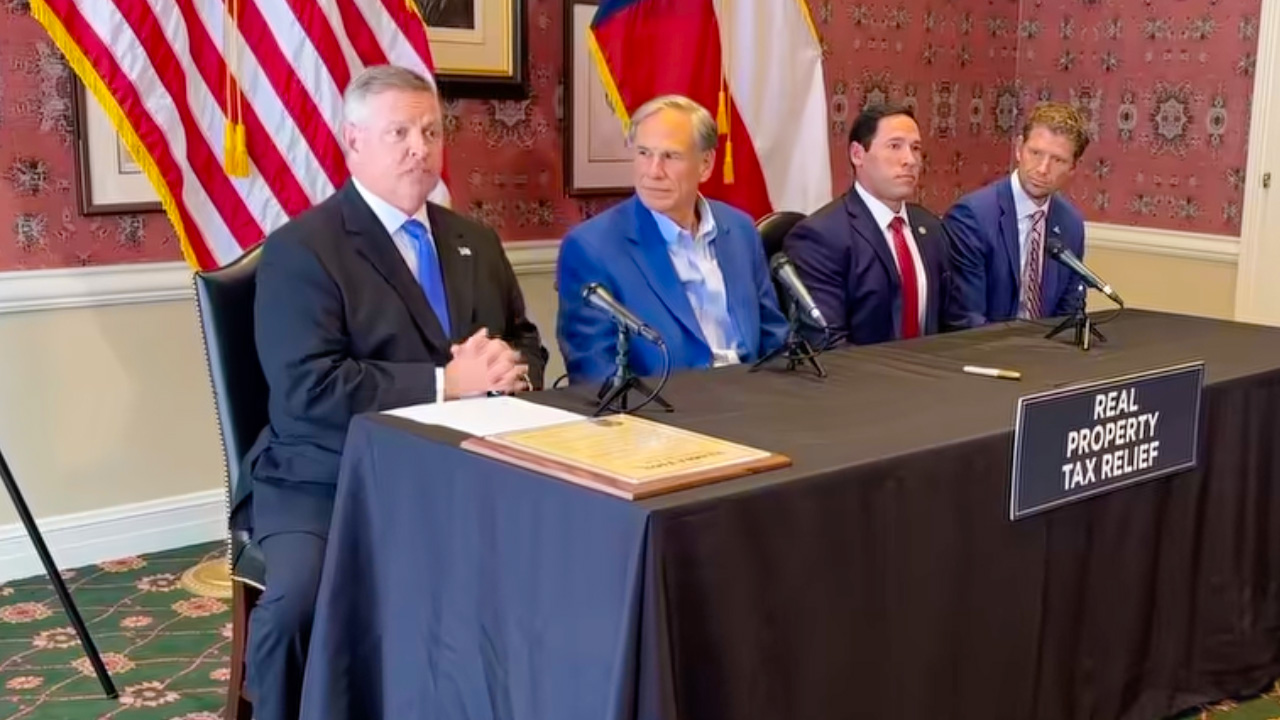
Tarrant County Judge Tim O’Hare speaks alongside Gov. Greg Abbott and Commissioners Manny Ramirez and Matt Krause during a property tax relief event in Fort Worth. | Tim O’Hare/Facebook
Tarrant County Judge Tim O’Hare (R-Tarrant County) says the county’s tax and spending reforms have saved families and businesses more than $1.1 billion over four years, a record Gov. Greg Abbott (R-Texas) highlighted in Fort Worth on Aug. 20 while pressing for statewide property tax relief.
Abbott appeared with O’Hare, Tarrant County Commissioner Manny Ramirez (R-Precinct 4) and Tarrant County Commissioner Matt Krause (R-Precinct 3) to promote his statewide property tax reform program. Tarrant County adopted an Aug. 13 resolution endorsing the plan, according to an Aug. 20 release from the governor’s office.
“It is very achievable for jurisdictions across the entire state to do exactly what Tarrant County has done,” Abbott said. “And that is to cut property taxes while fully funding operations in a robust, growing city like Fort Worth and county like Tarrant County.”
O’Hare details four-year record
“Thank you, Governor Abbott, for highlighting the work we’ve done reducing property taxes in Tarrant County,” O’Hare wrote in an Aug. 20 post.
O’Hare credited three adopted rounds of county and JPS Health Network tax rates below the no-new-revenue level and a proposed fourth, 20% homestead exemptions for both entities and more than $70 million in county operating-budget reductions. He said the combined policies saved families and businesses more than $1.1 billion over four years.
Official county records show that Tarrant County and JPS each offer the maximum 20% general homestead exemption. Commissioners increased both exemptions from 10% to 20% in June 2024, as The Dallas Express reported.
Commissioners cut the fiscal year 2025 budget by more than $50 million after an $8.1 million reduction the previous year, as The Dallas Express documented. O’Hare’s latest post places the four-year operating-budget reduction above $70 million.
“So we set about to go change that and to provide actual property tax relief for Tarrant County residents and businesses,” O’Hare said during the Aug. 20 appearance.
“In the last four years, we have cut both entities’ property tax rates each year below the no-new-revenue rate,” O’Hare said.
“Not one service has been cut. We’ve done it with good fiscal management,” O’Hare said.
Fourth rate cut still awaits final vote
Commissioners adopted a third consecutive round of lower county and hospital district tax rates in September 2025, as The Dallas Express reported. The county’s fiscal year 2027 budget recommends a county rate of 18.6 cents per $100 of valuation, down from 18.62 cents, and projects $6.4 million less property tax revenue than the prior budget.
Commissioners still must formally approve the proposed county and hospital district rates. Texas taxing entities must set their rates by the September 30 deadline.
The no-new-revenue benchmark estimates the rate that would generate the same revenue from properties appearing on both the current- and previous-year tax rolls after required adjustments. A lower rate does not guarantee that every owner’s total tax bill will fall because appraisals, exemptions and rates that cities, school districts and other taxing entities impose also affect the final bill.
Abbott lays out statewide proposal
Abbott’s program would empower voters to roll back tax increases, require local spending limits, create more predictable appraisals, require two-thirds voter approval for tax increases and curb appraisal growth for all property owners. Abbott intends to pursue the program during the next legislative session.
“There’s only so much one county can do,” O’Hare wrote. “The Governor has a five-point plan to help lower taxes across the state, which Commissioner Ramirez, Commissioner Krause and I fully support!” He added, “It will be a game-changer for Texans.”
Abbott said other local governments can follow Tarrant County’s approach while continuing to fund operations. The appearance placed O’Hare’s local tax and spending record at the center of Abbott’s statewide property tax push as Tarrant County moves toward final rate adoption.