
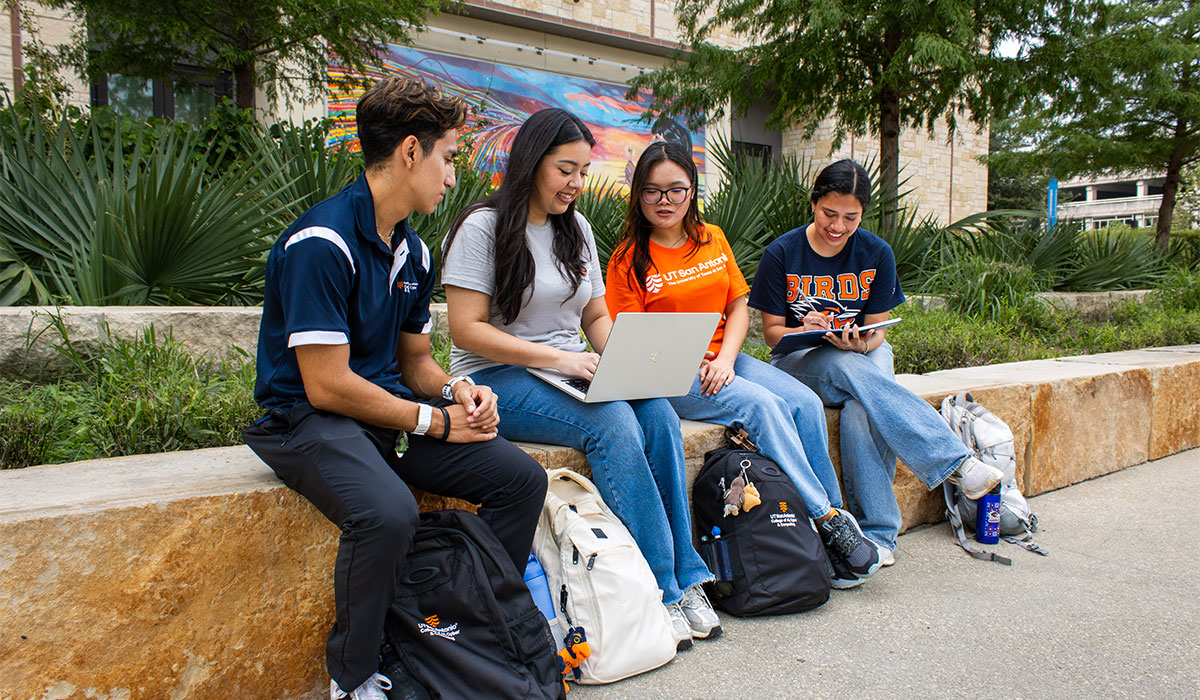
Thousands of UT San Antonio students will begin the fall semester at the Downtown Campus, part of a broader effort to align select academic programs with the city-centered opportunities that enrich learning and career preparation.
August 24 marked the first day of UT San Antonio’s new school year. The university’s College of AI, Cyber and Computing (CAICC) opened its doors at San Pedro II, a new campus building in the heart of San Antonio’s downtown technology corridor. With a projected 8,000 students enrolled in programs housed downtown this fall, which doubles the more than 4,000 taking classes there just a year ago, the university is rapidly turning an ambitious vision into an everyday reality.
For Jinjun Xiong, founding dean of the new college, the moment is equal parts exciting and clarifying.
“Everything is new, and we can no longer say we are still planning,” Xiong said. “Whatever we envisioned, now can be tested. We will work with our students to co-envision our futures and put some of our ideas into practice.”
Situated downtown and surrounded by the employers, nonprofits and government agencies forming San Antonio’s economy, UT San Antonio plans to work directly with community partners to shape its curriculum in real time.
“Education should never be like an ivory tower,” Xiong said. “We need to make sure we are grounded with our community’s needs.”
Listen to how UT San Antonio is expanding into San Antonio’s urban core.
Zander Brysch, a senior studying computer science, has spent the past year taking classes downtown. This summer, he joined the H-E-B Innovation Scholars Program, which pairs students with local nonprofits. Brysch worked with United Way on data analysis and discovered a passion for data analytics he hadn’t expected.
“With everything being downtown, it helps with being able to connect with nonprofit partners around here,” Brysch said. “That’s a valid sector to go into, other than just the private and the government sector.”
Beyond the career opportunities, Brysch is most excited about community.
“After classes, it’s no longer just I’m going to go straight home,” he said. “I’m going to stay on campus, hang out with my friends, experience what else is here downtown. The fact that I can spend my final year being able to see where the college is going — that’s really exciting. I’m very fortunate.”
The downtown expansion extends beyond the College of AI, Cyber and Computing. This fall, the College of Education and Human Development, the Margie and Bill Klesse College of Engineering and Integrated Design and the College for Health, Community and Policy all have several programs located downtown, pushing UT San Antonio closer to President Taylor Eighmy‘s goal of 10,000 students learning in the city’s urban core by 2028.
Heather Shipley, provost and senior executive vice president for Academic Affairs, sees the location as central to that vision.
“Downtown creates new opportunities for our students to connect their learning to the people, organizations and industries shaping San Antonio’s future,” Shipley said. “By engaging with partners across these various sectors, students can apply what they’re learning in meaningful ways, build professional relationships and gain valuable real-world experience. It’s an important part of how we’re creating transformative educational experiences that prepare students to make an impact wherever their careers take them.”