
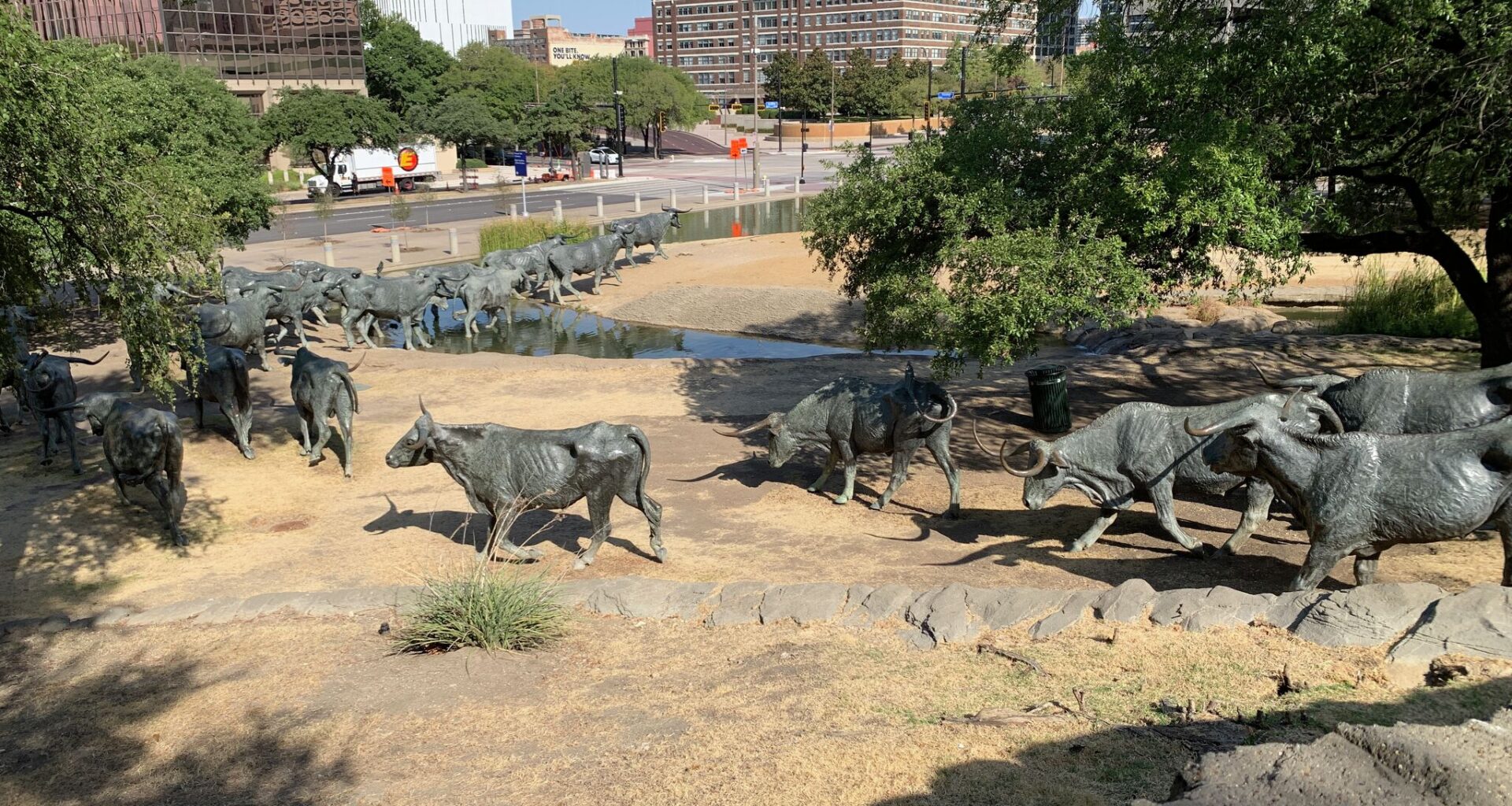
The southeast corner of Young and Griffin streets in downtown Dallas is 4.2 acres of history, mythmaking and dealmaking in the shadow of what will be the most expensive do-over in this city’s history. A PR man reminded me Monday that tourists from Sweden, Japan and Switzerland love that hillside full of sculpted steers and trail drivers, probably for the same reason they used to come to town and wonder where J.R. lives.
I’d heard in recent days from preservationists concerned that workers were scanning, surveying and kicking up dirt in the adjacent Pioneer Cemetery, where, from the 1850s until 1921, many of Dallas’ founding families were buried. Historians, used to seeing history erased in this town, feared the footprint of the $3.8-billion convention center would stomp all over the cemetery and require disinterring men and women for whom streets and neighborhoods are named.
So I asked the city what’s up. Eleven minutes later, I got a response. With an exclamation mark, even: “That’s not true!”
Which is what happens when you’re the last in line to ask what’s up with the primordial cemetery where four early mayors are buried, and where a faux pasture is grazed by 32-year-old bronze Longhorns conceived by developer Trammell Crow, who, critics said back when, just wanted to kill a hotel.
Article continues below this ad
I received that extremely prompt nuh-uh, along with links to a statement (with a bold-faced “There are no plans to disturb any burial sites or remains at Pioneer Cemetery”) and vague plans (“a vibrant, welcoming destination that connects history, art and community”) for the park’s proposed makeover. If and when it happens, city officials say, it will encompass all of Pioneer Park — the cemetery and the bronze sculptures created by Glen Rose artist Robert Summers in the 1990s.
Numerous Pioneer Cemetery headstones have disappeared over the year. Some are in the basement of Dallas City Hall, others stored at Hensley Field. But many are missing, making it difficult to tell who’s buried where, in part due to conflicting plot maps.
Robert Wilonsky/Staff writer
“We were out [laser-mapping] because the Texas Historical Commission wanted us to confirm where the bodies are and where the coffins may have shifted under the dirt,” Rosa Fleming, director of Convention and Event Services, said Monday morning as we stood in the parking lot off Griffin. Enough folks freaked out over the sight of workers wandering the boneyard that Fleming and reps from public relations firm Allyn Media, hired by the city to sell the makeover, invited me for a chat.
“This is part of the overall convention center master plan,” Fleming said. “This was always meant to stay here. It’s the second most visited site in Dallas. Why would we move it?”
By the way, Dealey Plaza is the most visited site in Dallas, because of course it is.
Article continues below this ad
Fleming said $10 million has been allotted for design, construction and restoration, while another $5 million has been earmarked for the just-in-case. Said Fleming, “As with any historic restoration project of this scale, we anticipate cost adjustments as work progresses, and have built in contingency funding and outside partnerships to keep the project on track.”
She envisions a far more walkable (and ADA-compliant) site that would actually combine the steers and the cemetery into a cohesive, coherent site with signage that provides more Dallas history than some headstones with familiar names on them (Harwood, Browder, Peak, Young, Marilla). There’s also a tunnel buried some 20 feet beneath this dried-out, deeply eroded hill, dating back to the days when this land was a railyard.
“You had a railroad that went through here, you had a cattle drive, you’ve got the founders,” Fleming said. “There will be the storytelling of how Dallas became Dallas.”
Louis Frisbie, founder and CEO of Metropolitan Infrastructure, has been at Pioneer Cemetery in recent months trying to determine how many people are buried in the founders’ graveyard — and exactly where they were interred.
Robert Wilonsky/Staff writer
It’s not exactly clear how many people are buried in the cemetery, a local and state landmark that fell into disrepair a couple of times in recent years despite being under the care of the Dallas Park and Recreation Department. Convention center expansions, among other issues, required archeological surveys and reinterment as recently as 1999.
Article continues below this ad
Louis Frisbie, founder and CEO of Metropolitan Infrastructure and the project leader, said Monday that “there are two different burial plot layouts that contradict each other.”
And even a quick walk through the boneyard reveals dozens of missing and indecipherable headstones — some, just snapped off; others, merely worn down by time. Some headstones are locked behind a gate in a City Hall parking garage, while others were taken to Hensley Field, the old Naval Air Station where the city winds up stashing everything sooner than later.
“That’s why we’ve had boots on the ground, to see what’s really here, then reconcile it against the documents we have,” Frisbie said. “Then, hopefully, with that information, if the broken pieces are still legible, we can figure out where they went. So, it’s a process.”
Kind of like finishing Pioneer Park itself.
Somewhere beneath the hill featuring the cattle driver is a train tunnel that used to cross this land, which was a railyard before the convention center’s expansion.
Robert Wilonsky/Staff writer
Allyn Media’s been meeting with folks, including Summers, who worked with Crow on the project, which was supposed to feature 70 Longhorn steers running down that hill. But as Summers told the Dallas Observer in 1999, only 49 were ever installed, alongside three trail riders, when money and momentum ran out. But not before Crow and supporters raised $5 million to sink the steers into city-owned land once set aside for Griffin Square, which was supposed to feature a 75-story office tower and a convention center hotel. Crow, developer and owner of what was then called the Loews Anatole Hotel, didn’t love that.
Article continues below this ad
Today, 14 of the sculptures are grazing at Hensley Field, Fleming said, including 10 removed in 2018 because they’d grown too “wobbly”; others were later damaged when a driver steered a car into the steers. City staffers said at the time that restoration of the 10 would cost $250,000, though Fleming said Monday they are “still working on the cost estimate.” Nonetheless, she said she would like to see all 70 roam the intersection at some point.
Decorating that corner with Summers’ cattle drive was done over the objection of the city’s Public Art Committee, which included artists who sued to stop it, insisting, among other things, they weren’t historically accurate. The Shawnee Trail cut through Dallas, but in 1993, Dallas City Council member Paul Fielding, yet to become the first council member to be indicted while in office, told this newspaper that “Dallas has never been a cattle town” and accused Crow of “trying to turn the city into something it’s not.”
Texas Monthly wrote that the Dallas Parks Foundation “would have done better to sponsor a sculpture with … 70 shopping bags from Neiman Marcus,” because “at least they have something to do with Dallas.” But Crow told The New York Times in 1994 those “bovine bronzes … would someday be what the Eiffel Tower is to Paris and the Colosseum is to Rome.”
Pioneer Cemetery’s final burial occurred in 1921. Which looks to be the last time its grass received any water.
Robert Wilonsky/Staff writer
For better or worse, he wasn’t wrong.
Article continues below this ad
Who knows when this will happen. The convention center’s delayed until at least 2030, and the city still has to issue a request for qualifications to find a landscape architect. But if and when it’s done, there should be signs and paths enough to tie the site together.
Monday morning, Allyn Media’s Shawn Williams said that according to a survey, 61% of the visitors who pull over to photograph those steers don’t know there’s a cemetery on site. About half an hour later, 71-year-old Jose Trevino came over to ask if he could walk on the grass to take photos of the sculptures from atop the hill.
Trevino just retired from the Dallas Police Department, three years after being honored as the Northwest Patrol Bureau’s Non-Sworn Employee of the Year. He said he finally had the time to take photos of the Longhorns. I asked if he knew what was beyond the sculptures, up the hill. Sure, he said – City Hall. We explained that there was a cemetery up there filled with founders of the city for which he once worked.
“Wow,” he said, his eyes wide. “You live in Dallas, you don’t really take the time to explore it.”
Article continues below this ad
Yup, a lot of good stories here, some of them even true.