
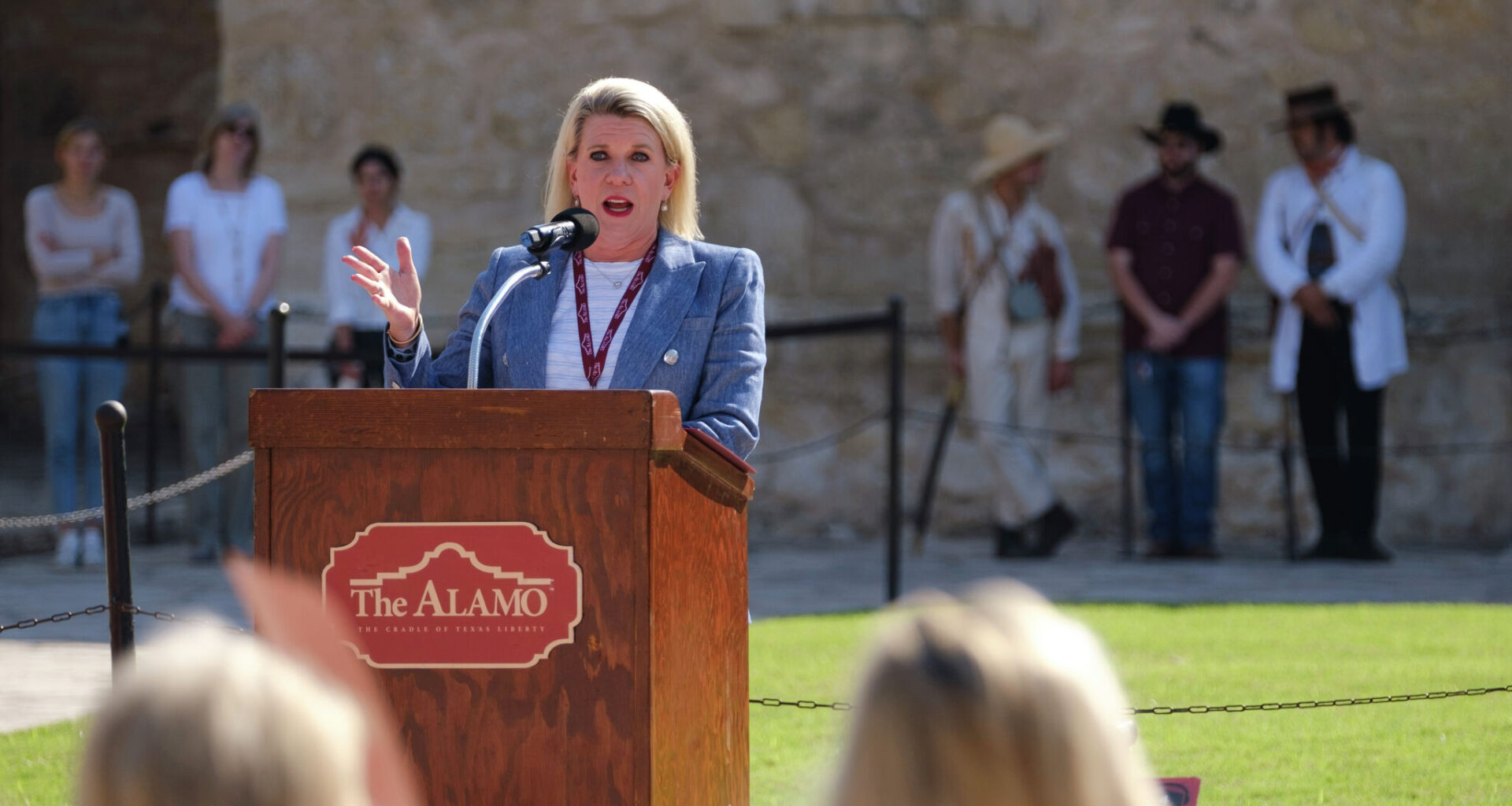
Former Alamo Trust CEO Kate Rogers speaks at a news conference at Alamo Plaza on Oct. 2, 2025. Rogers sued Lt. Gov. Dan Patrick, Land Commissioner Dawn Buckingham, the trust, its leaders and a foundation affiliated with the trust last year, alleging they violated her First Amendment rights.
Clint Datchuk/Clint Datchuk for San Antonio Ex
Ex-Alamo Trust CEO Kate Rogers has won a procedural victory in her battle against Texas leaders and her former employer over her ouster for academic writings they viewed as conflicting with how they believe the history of the Alamo should be told.

U.S. District Judge Xavier Rodriguez ruled Tuesday that most of Rogers’ claims in a federal lawsuit she filed last year can proceed, including her allegations that Lt. Gov. Dan Patrick and Land Commissioner Dawn Buckingham violated her First Amendment rights by pushing for her resignation from the trust.
Article continues below this ad
Rodriguez rejected most of state officials’ and the trust’s motions to have Rogers’ allegations tossed. The federal judge said Rogers plausibly contends that Buckingham and Patrick wield significant influence over the nonprofit trust and a major public-private makeover of the Alamo — and used that power to go after her.
Attorney Lawrence Morales II said he and Rogers are “very pleased” by Rodriguez’s decision and “look forward to discovery and trial.” A lawyer for the trust and its affiliate Remember the Alamo Foundation declined to comment, and attorneys for Patrick and Buckingham did not immediately respond to inquiries.
RELATED: Ousted Alamo CEO Kate Rogers lands a new job in San Antonio
The court order is the latest twist in the fight between Rogers, Patrick, Buckingham and the trust’s board, which erupted last year.
Article continues below this ad
It came about four years after Rogers was hired to lead the trust, which oversees daily operations at the Alamo, and help spearhead a $700 million overhaul aimed at more fully telling the story of the state-owned site. The state is footing most of the bill for the makeover and buying two nearby hotels, while the city of San Antonio and Bexar County are contributing $63 million and the nonprofit trust has pledged to raise $150 million from private sources.
The tension was sparked by an Indigenous People’s Day post on Oct. 13 on the Alamo’s social media accounts. The Alamo said it was “recognizing their history” at the site and noted that the future Alamo Visitor Center and Museum, the centerpiece of the makeover, will feature an Indigenous Peoples gallery.
On X, conservative activist Michael Quinn Sullivan said, “Who thought this was a good idea?” and added that Buckingham should address it. Buckingham responded that the Alamo’s post was “unacceptable” and “woke has no place at the Alamo.”
She also sent a letter to the trust’s board describing the post as part of a pattern of “blatant disregard of the battle-centric focus of The Alamo, that most Texans expect — the liberty or death history.” She noted that the museum’s script included more references to “slavery” and “enslaved” than “freedom” and “liberty.”
Article continues below this ad
RELATED: Kate Rogers out, Hope Andrade in at Alamo Trust after call for resignation
In the suit she would later file, Rogers said she was told at a subsequent trust board meeting that “the state is too upset” and “someone is going to have to pay.” Rogers said she offered to resign but the board refused to accept that and instead fired the trust’s communications director.
On Oct. 22, Patrick called Rogers about a dissertation, titled “Role of the Researcher,” that she penned in 2023 for a doctorate in global education from the University of Southern California. The trust did not pay for the degree.
Rogers wrote in the document about lawmakers’ “conservative agenda,” including a ban on Critical Race Theory, voter suppression and women’s reproductive rights, and said educators should be able to teach free from political pressure. She referenced “Forget the Alamo,” a controversial book that posited the Texas Revolution was fought primarily against Mexico to expand slavery.
Article continues below this ad
Rogers also wrote that General Land Office staff were part of most decisions she made about the Alamo, especially those with “political implications,” which meant she “had to be very careful with my study and its implications as it could have negative consequences” for her job and the Alamo redevelopment.
Patrick demanded Rogers resign based on what he called “troubling writings” that are “incompatible with the telling of the history of the battle of the Alamo.”
“Of course the entire story of the Alamo will be told, but the overriding emphasis must be on the ‘13 Days of Glory,’ as nearly 200 men gave their lives to defend liberty and freedom for Texas,” Patrick wrote in a letter to the trust’s board.
Rogers resigned from the trust on Oct. 23.
Article continues below this ad
In November, she sued Patrick, Buckingham, the trust and affiliated foundation, trust board chair Welcome Wilson Jr. and trust CEO Hope Andrade, alleging that she was retaliated against for the opinions she expressed in her dissertation. After Rogers sat for an interview with Texas Monthly to discuss why she resigned, she said the trust and foundation yanked her severance pay.
In the petition, Rogers painted a picture of Patrick and Buckingham’s in-depth involvement in the Alamo’s redevelopment and what she described as the difficulties of trying to keep them and the trust’s board happy.
RELATED: Texas officials, Alamo Trust say ex-CEO Kate Rogers ‘sealed her own fate’
Patrick and Buckingham mandated changes to scripts for the museum and were at times in conflict with each other over who they viewed as in charge, Rogers alleged. Buckingham and her staff often criticized input from advisory committees on the project and meddled in the trust’s decisions, such as what materials should be used for a new roof for the Alamo Church, her lawsuit stated.
Article continues below this ad
State and trust leaders pushed back, callings Rogers’ suit a publicity stunt.
In court filings, they accused Rogers of “biting the hand” of lawmakers who provided a windfall for the Alamo’s makeover and said she “knew she was playing with fire” when she criticized their priorities.
They said she wrote her dissertation in her capacity as the trust’s leader. They did not force her to resign and she negotiated her severance in bad faith, refusing to agree not to make negative comments about them until after she had already given an interview doing so, they said. They also said they are protected from her claims by immunity.
“Rogers’ hubris eventually caught up with her,” Buckingham wrote, adding that Rogers “consistently placed her interests above the long-term interests of the Alamo” in part by undermining the General Land Office’s attempts to monitor her work.
Article continues below this ad
RELATED: Inside the ‘power struggle’ that led to former Alamo CEO Kate Rogers’ ouster
But Tuesday, Rodriguez said most of Rogers’ claims could advance.
Rogers successfully argued that she wrote her dissertation as a citizen protected by the First Amendment, Rodriguez said. Her assertions that the state exercises a lot of control over the trust and that Buckingham and Patrick pushed for her resignation can also move ahead, and the two elected officials are not immune from the suit, according to the judge’s order.
Rodriguez said Patrick wasn’t on the hook for injunctive relief — returning Rogers to the position of CEO at the trust — because he doesn’t have the authority to reinstate Rogers as its leader, but her claims for damages against Patrick can proceed. The trust, Andrade and Wilson will remain defendants because Rogers argued that they acted in tandem with state officials.
Article continues below this ad
Rodriguez tossed one of Rogers’ claims against the foundation because she hadn’t shown that it played a role in her resignation, but allowed her contention that leaders retaliated against her by revoking her severance offer to proceed.
The Tobin Center for the Performing Arts recently hired Rogers as its chief development officer.