
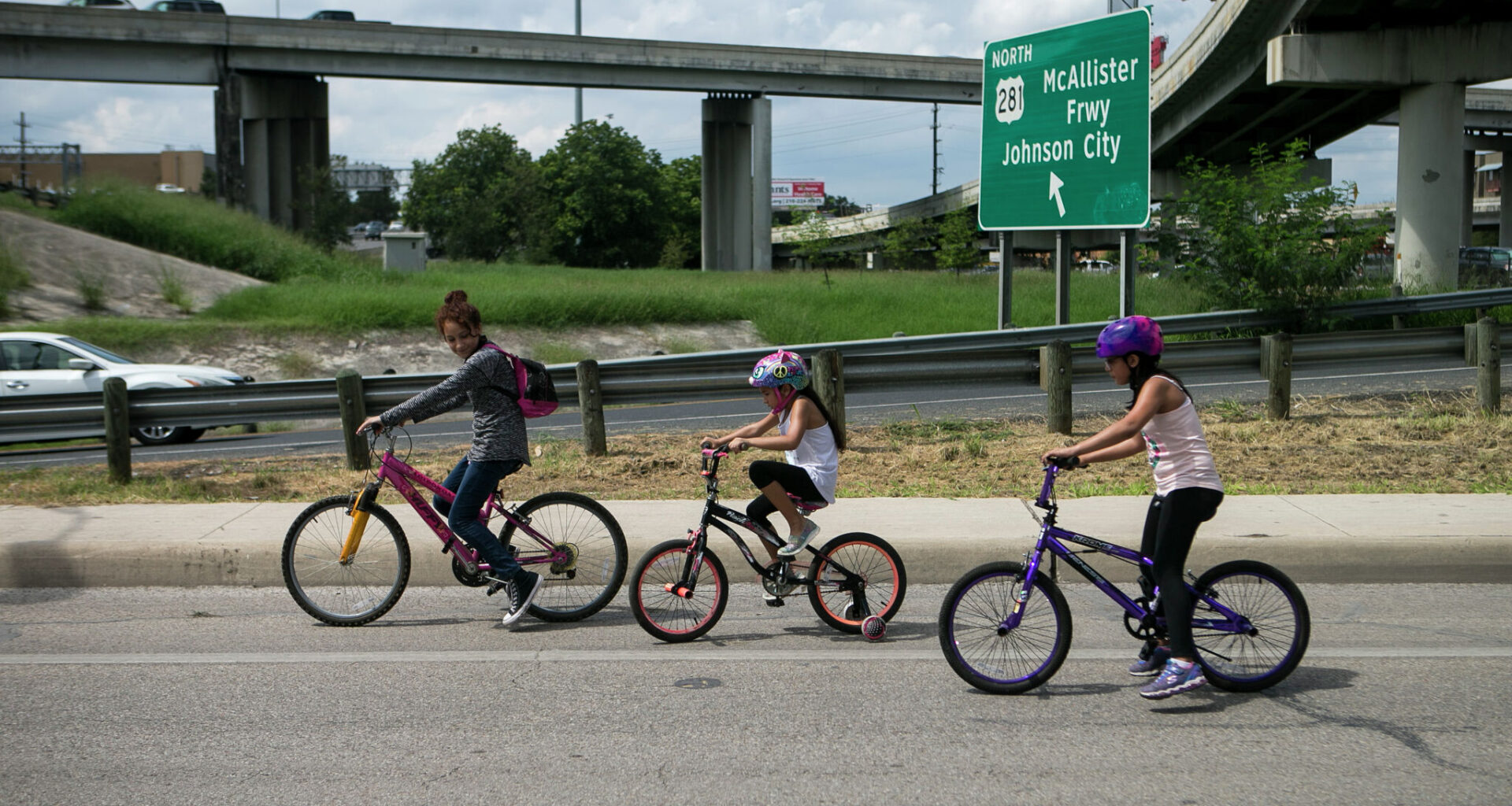
San Antonio has made progress on several bike projects outlined in its Bike Network Plan, says Catherine Hernandez, director of the city’s Transportation Department.
Josie Norris/San Antonio Express-News
Catherine Hernandez, director of the city of San Antonio’s Transportation Department, envisions remaking more than 2 miles of McCullough Avenue on the North Side with protected bike lanes — possibly replacing one of the thoroughfare’s four vehicle lanes.

Building the bike route, from Basse Road to north of Loop 410, would bring the city closer to realizing the sweeping Bike Network Plan it adopted early last year. The plan calls for the construction of 1,890 miles of bike routes by 2050, with an estimated cost of $3 billion to $8 billion.
Article continues below this ad
ALSO READ: Study finds passenger rail route between S.A., Austin could cost $13.5B
The city transportation department recently completed a feasibility study for the McCullough Avenue project, which would also improve the roadway’s sidewalks, currently non-existent in places. The aim is to include it in the city’s upcoming bond measure, Hernandez said.
That bond measure, set to go before voters next year, will likely be much smaller than previous one in the city’s five-year cycle — posing a potential problem for the ambitious bike plan.
Unless the city raises new revenue, the bond will supply $625 million for local projects, about half the $1.2 billion program voters approved in 2022. Prior bonds included a long list of projects with bike components, including $10 million for bike projects citywide in the 2022-2027 bond.
Article continues below this ad
The city is now figuring out how to tighten its belt as it faces a $158 million budget deficit — a situation that is not good news for bike projects.
The Bike Network Plan suggested that expanded the bike network could be paid for mostly by federal funding— $5.8 billion of the $8 billion maximum cost, according to a proposed cost breakdown — with the city supplying an estimated $540 million to $1.4 billion. Federal grants often require a local match. For example, when the city accepted $5.4 million in federal funds last year to build a bike route and improve sidewalks along North Frio Street west of downtown, it committed to providing $1.4 million in local funds.
The transportation department already has experience finding creative ways to make bike projects happen, Hernandez said.
“In previous years, our capacity was bigger. Right now we need to assess, what is our capacity? Have we leveraged all resources to grow that capacity?” Hernandez said. “In the meantime, what we’re doing is, assuming we do have a smaller capacity, we have our list of projects… We prioritize to say, OK, let’s submit these because this is one we have a lot of community input on. McCullough is one of those.”
Article continues below this ad
The city can point to bike infrastructure successes it has achieved in the year and a half since the City Council approved the Bike Network Plan. Last month, it celebrated the opening of a 0.4-mile stretch of protected bike lanes on Camden Street, near the Pearl. It has added bike lanes on Santa Rosa Street, Alamo Street and Avenue B downtown, and along the extension of Sonterra Road in Stone Oak.
Since the beginning of 2025, the city has installed more than 13 miles of bike infrastructure, including new lanes and shared-use paths – throughways that can be shared by cyclists and pedestrians, according to the transportation department.
The new lanes and paths bring San Antonio to a total of 518 miles of bike infrastructure, the department said. That’s still a far cry from the 1,890-mile network of bike lanes envisioned in the Bike Network Plan.
The city is aiming to complete another 19.3 miles of bike infrastructure next year, including shared-use paths spanning thoroughfares such as Zarzamora Street, Culebra Road and Huebner Road, according to the department.
Article continues below this ad
The scope of the McCullough project would be determined through a public input process, Hernandez said. It is expected to cost about $50 million.
She emphasized that the department operates with only 15 employees, including five on its project delivery team, working to implement not only the Bike Network Plan but the city’s Vision Zero traffic safety initiative. It often “piggybacks” onto road projects overseen by other departments, such as Public Works. For example, bike infrastructure was added as part of the city’s recently-completed $58.9 million reconstruction of Alamo Street downtown.
“I’m impressed with the work that they have done with the small amount that they have, pushing themselves and pushing the funds as far as they can,” she said. “We know that this last fiscal year and in the upcoming fiscal year, our resources are tight. We have to make lemonade, right? We’re doing everything we can to leverage everywhere we can.”
The department is preparing to gather public input on the possibility of revising two ordinances to make it easier to cycle in San Antonio. One change would give neighborhoods more flexibility in removing street parking for bike lanes; the other would relax a law prohibiting riding a bike on a sidewalk.
Article continues below this ad
In gathering input for the Bike Network Plan, the city heard from parents who would like for their children to be able to bike to school, she said. “But there’s no safe infrastructure, and they technically can’t ride on the sidewalk.”
While San Antonio has sometimes been wary of new bike infrastructure — in 2013, the city replaced one of four vehicle lanes on South Flores Street with a pair of bike lanes, only to remove the bike lanes a year later after complaints — Hernandez said she has seen support for residents, including at a recent community input meeting for the bond in District 4, on the Southwest Side.
“There were people that were talking to me about adding bike infrastructure, wanting to see the connections to the parks, to the trails,” she said. “We recognize that there are people who do not have access to a car, cannot afford a car. Cycling or taking transit are their options. If they can’t ride on a sidewalk because it’s illegal, where are they going to go?”
Article continues below this ad