
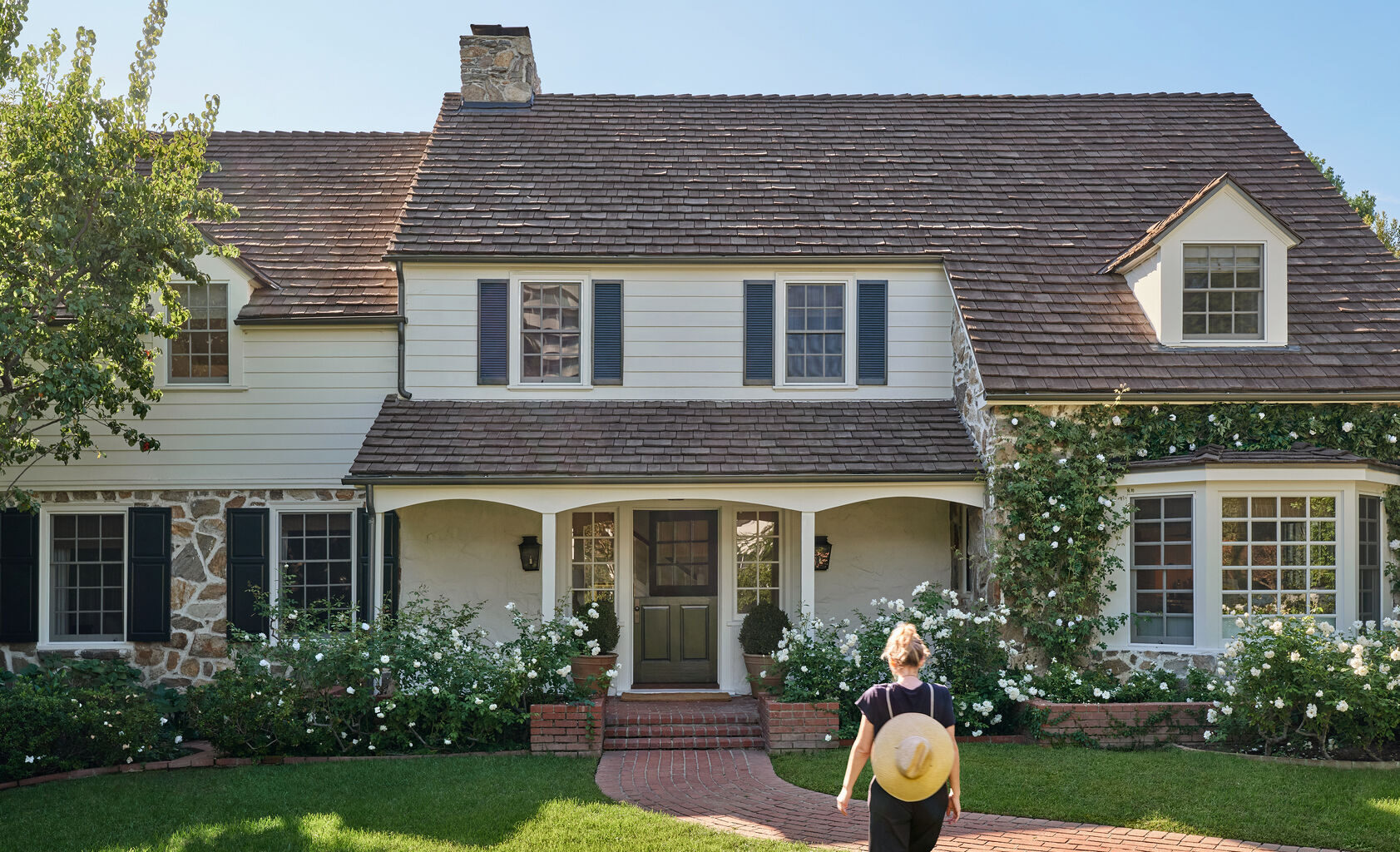
The 288-page tale details the myriad decisions the author made while renovating her 1940s house in Beverly Hills.
Roger Davies
Annie Meyers-Shyer never anticipated that documenting the renovation of her historic home would change her life — but it did. The account @thisoakhouse began as an Instagram chronicle of the decisions, discoveries and inevitable complications that came with restoring a 1940s home in Beverly Hills. It quickly grew into something much bigger. Her stories and meticulously researched recommendations resonated with hundreds of thousands of design enthusiasts.
And now she has compiled the full story of her family home into a 288-page book. This Oak House will be released Sept. 15; on Nov. 11, the author will make a stop at Dallas’ beloved Interabang Books for a signing.
This Oak House stems from Annie Meyers-Shyer’s Instagram chronicles of her home renovation.
Roger Davies
Meyers-Shyer honed her eye for design as an editor at Harper’s Bazaar and an executive at Chanel. But her education began much earlier: She grew up in beautifully curated homes and on movie sets, thanks to her filmmaker parents, Nancy Meyers and the late Charles Shyer. The pair’s joint credits include Private Benjamin, Father of the Bride and The Parent Trap.
Article continues below this ad
When the opportunity arose to move into a 1946 house by acclaimed California architect Gerard Colcord, Meyers-Shyer and her husband couldn’t say no. She immersed herself in the home’s design and architectural history as she developed a vision for its next chapter. Once the renovation began, Meyers-Shyer meticulously tracked each decision and how the home came together.
This Oak House is equal parts renovation guide and memoir. The book traces the process from its earliest planning stages down to the smallest (but still consequential) choices, like light switches.
Ahead of her Dallas visit, we asked Meyers-Shyer about the lessons she learned along the way, including how to update a historic home without erasing the character that makes it worth preserving.
Q&A with Annie Meyers-Shyer
Abode: When you launched @thisoakhouse, what did you hope the account would become? Did you ever imagine it would lead to a book?
Article continues below this ad
Annie Meyers-Shyer: I absolutely never imagined any of this coming from it. I started the account on a whim. I had a hunch that the renovation would be an interesting project to document, but I didn’t really understand what it was going to become for me until I sunk my teeth into it.
In the book, Meyers-Shyer shares everything from paint colors to millwork profiles.
Roger Davies
I was going incredibly deep into the research because I wanted to understand every decision I was making, and it became this enormous learning experience for me. And when I started sharing what I was learning, not just the finished rooms or the pretty things, that was when I really saw the account start to take off. People were interested in the process and the information behind the decisions.
I also think there has always been an authenticity to what I share, and that is something I never want to lose. I’ve shown the good, the bad, the ugly, the mistakes, the things that worked, the things that didn’t and obviously all the fun parts too. There was never a strategy behind it. I was genuinely figuring it out as I went along and bringing people with me. I thought I was renovating a house. I had no idea I was going to fall in love with interiors, architecture and craftsmanship, let alone that it would lead to a book and an entirely new chapter of my life.
Abode: You grew up on the famously well-designed sets of films made by your parents. How did the homes in their movies shape your ideas about what home can — and should — be?
Article continues below this ad
AMS: This is actually something I never really thought about until recently. I’ve been asked the question quite a bit, and it has made me think about the way my parents used houses in their films. The homes weren’t simply beautiful backdrops. They told you something about the people who lived inside them.
Think about the house in Father of the Bride. Before anyone tells you who the Banks family is, that house has already told you so much about them. It’s warm and welcoming. It feels like a family has actually lived a life there. Then think about Bryan MacKenzie’s parents’ house. It’s enormous and grand, but it’s also cold and imposing. The contrast between those two homes is telling you something about those two families and those characters without anyone having to say it.
I think I absorbed that idea without ever consciously realizing it: A home can be an extension of the people who live there. It can tell their story. And when I think about what I ultimately wanted from my own house, I wanted it to feel deeply personal. I wanted you to walk in and understand something about us and the way we live.
Related: Dallas designers’ new book breaks down ‘the final 15%’ of decorating
Abode: Which design books inspired you and helped guide your vision for the renovation?
Article continues below this ad
AMS: I referred to Gil Schafer’s three books constantly during the design phase. They were probably the books I reached for most. I also referenced both of Rose Tarlow’s books and Rose Uniacke’s two books. They’re all very different designers, but I learned so much from studying the way they think about proportion, materials and architecture. Sometimes I would ask myself WWGD? What would Gil do?
Abode: What elements are worth splurging on in a renovation?
AMS: I would splurge on the things that are hardest to change and that can potentially outlive you in the house. For me, that means the hard finishes: faucets, hardware, lighting, stone and paint. Those are the things you see and touch every single day, and they have such an enormous impact on how a house feels.
Lighting in particular is hugely important to me. Cheap lighting feels like cheap lighting. And I think the same is true of hardware and plumbing fixtures. These are things you interact with constantly. A beautiful faucet or door handle is a small thing, but you’re going to touch it thousands of times. If you can invest in quality there, I think it’s worth it.
Meyers-Shyer touts the importance of investing in quality elements that impact your everyday enjoyment of your home. She also embraces the hunt for antique finds that add character — like the library stool in her “snug,” a cozy living space.
Roger Davies
Abode: On the flip side, where do you think homeowners can save?
Article continues below this ad
AMS: This one is tricky for me because I approached our renovation as a forever house, and one of the lessons I learned over and over again was that, very often, you get what you pay for. That doesn’t mean everything in a house needs to be expensive. It means understanding where quality really matters.
I would spend on the things that are permanent or that you touch every day, and save on things that are easier to change. There are incredibly well-designed, well-made sofas and upholstered pieces available from larger retailers now. And some of my favorite things in my house are vintage pieces that I found at flea markets or antique shops. Saving money doesn’t have to mean compromising on character or design. Sometimes it just means being willing to look a little harder.
Abode: In Dallas, architecturally significant homes are sometimes razed to make way for new construction. What advice do you have for homeowners who want to work with the bones of an old house and update it for modern life?
AMS: The bones of our house are exactly what make it unique. They’re what keep it from feeling like a new or spec house. I wanted our house to function for the way our family lives today, but I never wanted to erase what made it special in the first place.
With almost every decision we made, I came back to the same guiding questions: Could this have been part of the original design? Would the original architect have liked this? We added modern conveniences and adapted the house for the way we live now, but always with respect for what was already there.
Article continues below this ad
Even utilitarian spaces, like this laundry room, were given careful aesthetic consideration.
Roger Davies
I feel very strongly about preservation. Part of what makes traveling through Europe so extraordinary is being surrounded by buildings that have been there for hundreds of years. You feel the history when you walk into them. There is a sense of place and continuity that simply can’t be recreated. And I think we sometimes forget that the buildings we choose to preserve today are what future generations will get to experience as their history.
Houses should evolve, and they need to work for the people living in them, but I think there’s something incredibly special about being the steward of an old house. Before you tear something down or remove an original detail, understand what it is and what you might be losing. Those proportions, materials, quirks and craftsmanship are often the very things that give a house its soul. My goal was always to make our house feel like an old house but function like a new one, and I think preservation and modern life can absolutely coexist.
Abode: Annie, your followers know you don’t embrace ceiling fans. But this is Texas! It’s hot. What should we do instead?
AMS: Okay, I need to clear this up once and for all: I am not against ceiling fans! I just don’t have a recommendation because they’re not something we really need in LA, so I’ve never had to become an expert on them. If I lived in Texas, I am quite sure I would have ceiling fans. Honestly, long live the ceiling fan.
This Oak House, from Chronicle Books, is out Sept. 15, 2026. It’s available for preorder now via Amazon and Bookshop. Interabang Books is hosting a signing with Meyers-Shyer on Nov. 11, 2026, at 4 p.m. Tickets cost $52 and are available for purchase through Eventbrite.
Love homes, gardens and design? Get more good stuff from Abode by following us on Instagram and Facebook.