
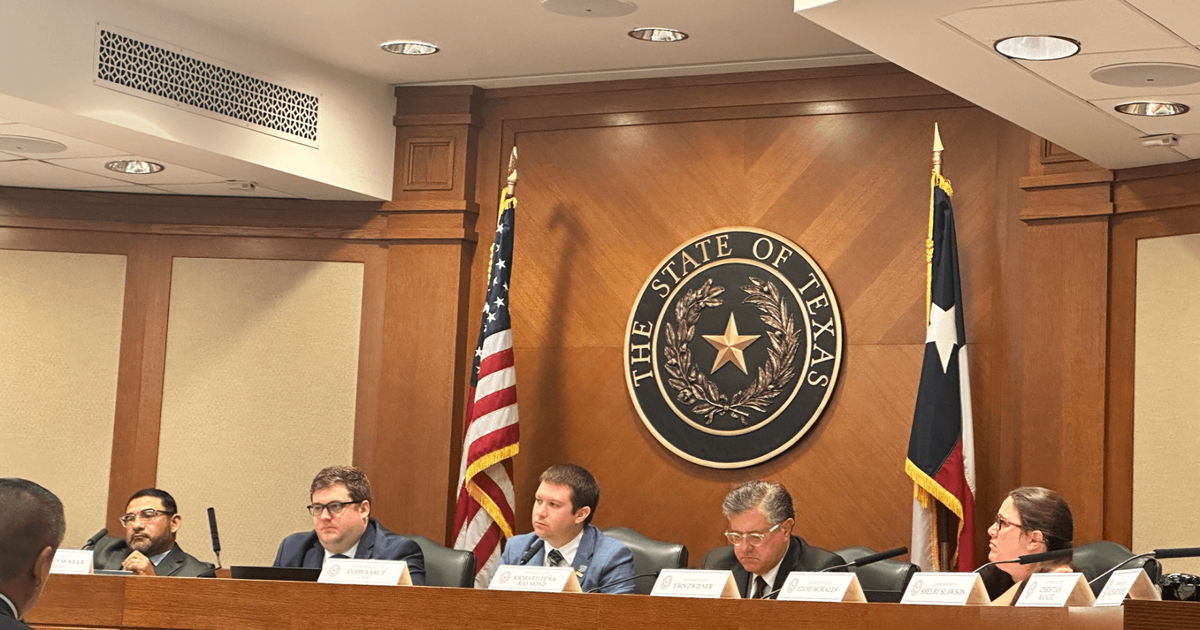
During hours of testimony on education foundations in Texas, state lawmakers grilled witnesses and at times expressed incredulity over the details of the nonprofit tax-exempt organizations designed to support public school districts.
The Texas House Select Committee on Governmental Oversight held an interim hearing Wednesday with particular focus on the Barbers Hill Education Foundation (BHEF), which reports the largest education foundation holdings in the nation.
Although Barbers Hill Independent School District (BHISD) educates fewer than 8,000 students and manages an annual budget of $151 million, it enjoys significant revenue from a since-reformed state tax abatement program known as Chapter 313, which it transfers to BHEF.
Mandy Drogin of the Texas Public Policy Foundation told the committee that BHISD’s 2024 audit reported approximately $133.7 million paid to the foundation, and that last year, BHEF had a fund balance of $200 million.
BHISD Superintendent Greg Poole, who is also the executive director of BHEF, has defended the payments in lieu of taxes to BHEF as a way to avoid recapture — the state redistribution of tax revenues from property-wealthy public school districts to poor ones.
BHEF’s board also drew scrutiny since three elected BHISD trustees also sit on the board, as does the ISD’s assistant superintendent of finance. Another board member, Nathan Watkins, is also a vice president of Americus Holdings, a company from which BHEF has purchased real estate.
Several lawmakers queried Poole about the makeup of the BHEF board and the firm handling its investments, Commerce Street Holdings.
State Rep. Ellen Troxclair (R-Lakeway) asked Poole how he had handled Watkins’ apparent conflict of interest.
“It was his responsibility to disclose a conflict of interest,” Poole said. “He did not disclose that. If he didn’t, then he doesn’t have one.”
Troxclair’s questions led to an awkward exchange after Poole claimed no one in his family worked for Commerce Street Holdings, which has handled $200 million in investments for BHEF.
After a long pause, Troxclair asked if he was related to Hillary Poole, who is listed as the vice president of institutional business development at Commerce Street Holdings.
“You’re asking if she did, but you asked if she does. She does not,” Poole answered. “If you’re asking, did she? Yes, ma’am. She did.”
Education foundations are not subject to the Texas Public Information Act or open meetings laws, leading state Rep. Mitch Little (R-Lewisville) to query Poole on the makeup of the board, which also includes persons whose companies make payments in lieu of taxes to BHEF.
Little called that arrangement “weird.”
“It is strange that members, duly elected members of a school board, are simultaneously fiduciaries of a nonprofit whose portfolio holdings are concealed and owe a fiduciary [duty] to that board, while also the taxpayers who are getting out of paying property tax are on the board and stakeholders of that same organization,” Little said.
Little also noted that what would have been a taxable value of $8.9 billion was taxed at $1.3 billion within BHISD.
Several witnesses noted that EFs raise private funds and can provide meaningful assistance to public school districts.
Sean Callaway, president, CEO, and owner of Foundation Innovation, told the committee that the foundations operate under “real, meaningful oversight.”
In response to a question from Committee Chair Cody Vasut (R-Angleton), Calloway admitted that while most education foundations have a memorandum of understanding that requires the district to receive more in benefits than it spends on the foundation, it is not “a legal requirement from the state of Texas, but it is the best practice.”
Vasut suggested that lawmakers explore options to codify the best practices for education foundations.
BHEF board member Watkins unsuccessfully ran against state Rep. Terri Leo Wilson (R-Galveston) in the 2026 Republican primary for Texas House District 23, and BHEF filed a defamation lawsuit against Wilson over comments she made during the campaign.
Wilson responded with an anti-Strategic Lawsuit Against Public Participation (SLAPP) motion, but the matter is still pending in a Texas appeals court. She told The Texan that she has incurred nearly $90,000 in legal fees, which she is seeking to recover through the court.
During the House hearing on Wednesday, Poole said he was unsure but did not think Watkins had participated in BHEF’s vote to file the lawsuit against Wilson.
Earlier this year, the Texas Education Agency launched an investigation into BHISD’s relationship with the BHEF, but the state agency does not have jurisdiction over education foundations.