



Construction management senior Kevin Valencia, left, and exercise science sophomore Pedro Contreras duck as water is poured over them during a Lambda Theta Phi fundraiser Aug. 24 at UTA. Valencia said staying hydrated is important during the heat
Students moved between buildings with sunglasses on, water bottles in hand and backpacks slung over sweaty shoulders. Between classes, students reached for whatever shade they could find, while the few patches of air conditioning offered temporary refuge from the suffocating conditions outside.
Events for the first week of school continued despite the intense heat, with water misters and large fans offering relief at some outdoor celebrations. By the middle of the week, the heat had settled over campus, making ordinary routines feel exhausting.
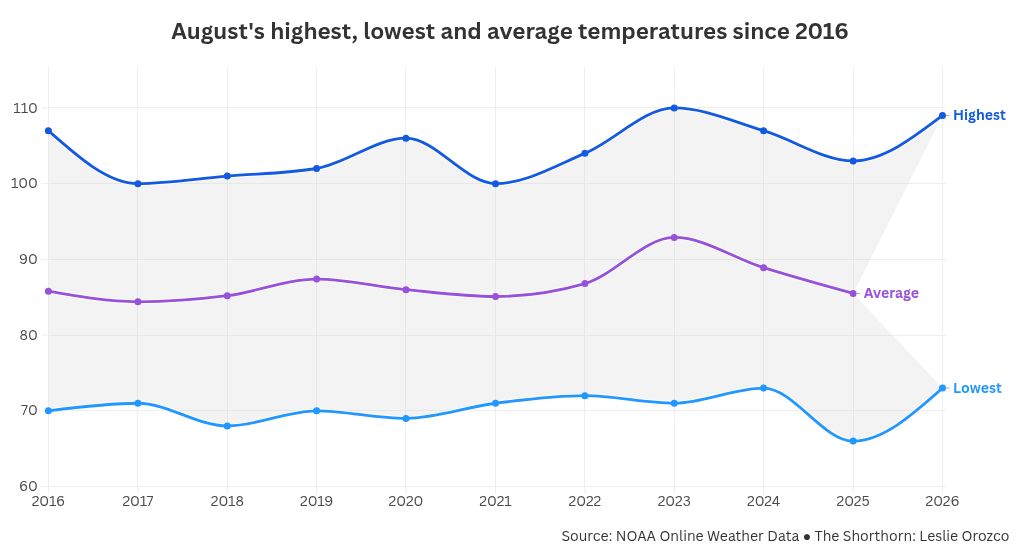
Allison Prater, National Weather Service meteorologist, said that while August is usually the hottest month of the year, temperatures have been between 104 and 106 degrees, about 10 degrees above normal.
On Aug. 23, temperatures reached 108 degrees in Dallas-Fort Worth, the highest since 2023’s 110 degrees. The following day, temperatures reached 109 degrees.
816
The weather service has criteria for ambient temperatures, the actual temperature of the air, and apparent temperatures, or heat index, Prater said.
Once the temperature hits 103, the heat index hits 105 or both, the criterion for a heat advisory is met. If the temperature hits 105 or the heat index hits 110, that meets the criterion for an extreme heat warning, she said.
“Those are normal during the summer,” Prater said about the heat advisories. “It’s more the safety aspect of, ‘Hey, it’s incredibly hot. It’s extremely hot.’ It was dangerous to be outside for extensive periods of time.”
For some students, staying cool became part of the daily routine, alongside getting to class, grabbing lunch and making it through the day. Prelaw junior Isabella Kuzhta said she decided to walk to her classes on the first day to see how bad the weather would be.
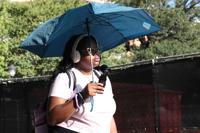
Theater arts junior Myriah Elam walks past the University Center with an umbrella and fan Aug. 21. Elam said she bought her fan on Amazon.
“Walking was miserable,” Kuzhta said. “It was 107 on that Monday, and it was horrible.”
She said apart from bringing a fan, she also carried mints to help cool her down.
Similarly, social work junior Sandy Atkinson said she carried a spray bottle of water and an umbrella and stopped at certain buildings to refresh when needed.
Both attended Waffleopolis, a long-standing UTA tradition filled with music, dancing and free waffles, and separated from their group to fan themselves and stand in front of the misting fans, as temperatures remained at 100 degrees even at 8 p.m.
Water bottles became a constant companion for students navigating the event, many taking a drinking break under the shade of trees before heading back into the heat.
Atkinson, who lives at Campus Edge, said she changed her normal route to cut through the Maverick Activities Center and walk in shaded areas.
Michelle Kelly, Division of Student Affairs assistant vice president for health and well-being, said that during all the major events on campus over the first couple of weeks, the university is trying to make sure bottled water is available for students.
Kelly said the heat can feel more intense if students are surrounded by a lot of cars or concrete, which reflects the heat off the ground onto people.

Psychology freshman Karen Fernandez takes a water from Julianne Benge, Fellowship of Christian University Students pastoral staff member, Aug. 21 outside the University Center. Fernandez said she is still trying to get used to the Texas heat.
Two ways she said students can stay cool are limiting their outdoor time or taking extra measures when going outside and staying hydrated with water.
“If I know that I’m going to be doing something physically strenuous outside in the heat, that’s when your sports drinks, your Gatorades, when stuff like that are helpful because they’re supplying some sugar, which is helping you with simple energy source, but they also have salt in it, and we tend to lose a lot of salt when we sweat,” Kelly said.
Students should begin hydrating a day before they plan to be outside or participate in physically demanding activities, not the day of, she said.
“What we fail to realize is, if I am outside, and that’s when I have started to hydrate, I am too late,” Kelly said.

Graham Spencer, Fellowship of Christian University Students assistant director, hands out fans and waters Aug. 21 outside the University Center. The group also gave out free iced coffee.
Something like snacking is also important because one’s body is working harder for basic moment-to-moment activities, and snacks can provide the fuel for that, she said.
“Snacking is particularly important during these extreme weather seasons, especially when it’s too hot, because sometimes that actually reduces our appetite and makes us think, ‘Well, I’m not very hungry,’” Kelly said.
Taking care of the skin by wearing sunscreen is also important. For those who may not usually wear sunscreen, Kelly suggested wearing thin, light-colored clothing for protection.
“The skin is our primary means of regulating our body temperature, and so if we damage our skin, then we have just made it even harder to then manage how our body responds to the outdoors,” she said.
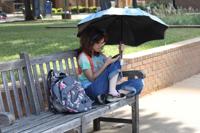
Psychology freshman Chloe Knight sits on a bench with an umbrella Aug. 21 outside the Central Library. Knight said that to beat the heat she has been staying inside more and drinking extra water.
Additionally, understanding when to seek medical help and how to recognize signs of heat exhaustion or heat-related illnesses is important.
“Normally, by the time you decide as a student, ‘Oh, I’m feeling so bad, I need to go to Health Services,’ that it is pretty bad,” Kelly said. “Oftentimes, when it comes to heat exhaustion, people don’t necessarily seek out medical care.”
Understanding how heat affects the body can also help explain why some students might struggle more than expected when they spend time outside.
“If I add the temperature with the relative humidity and I get a number over 150, that means I can be in the best shape in the world, everything’s still going to be harder for me outdoors,” she said.
Recognize the symptoms of heat exhaustion, according to the Centers for Disease Control and Prevention:HeadacheNauseaDizzinessWeaknessIrritabilityThirstHeavy sweatingElevated body temperature
@_.lexlie_