
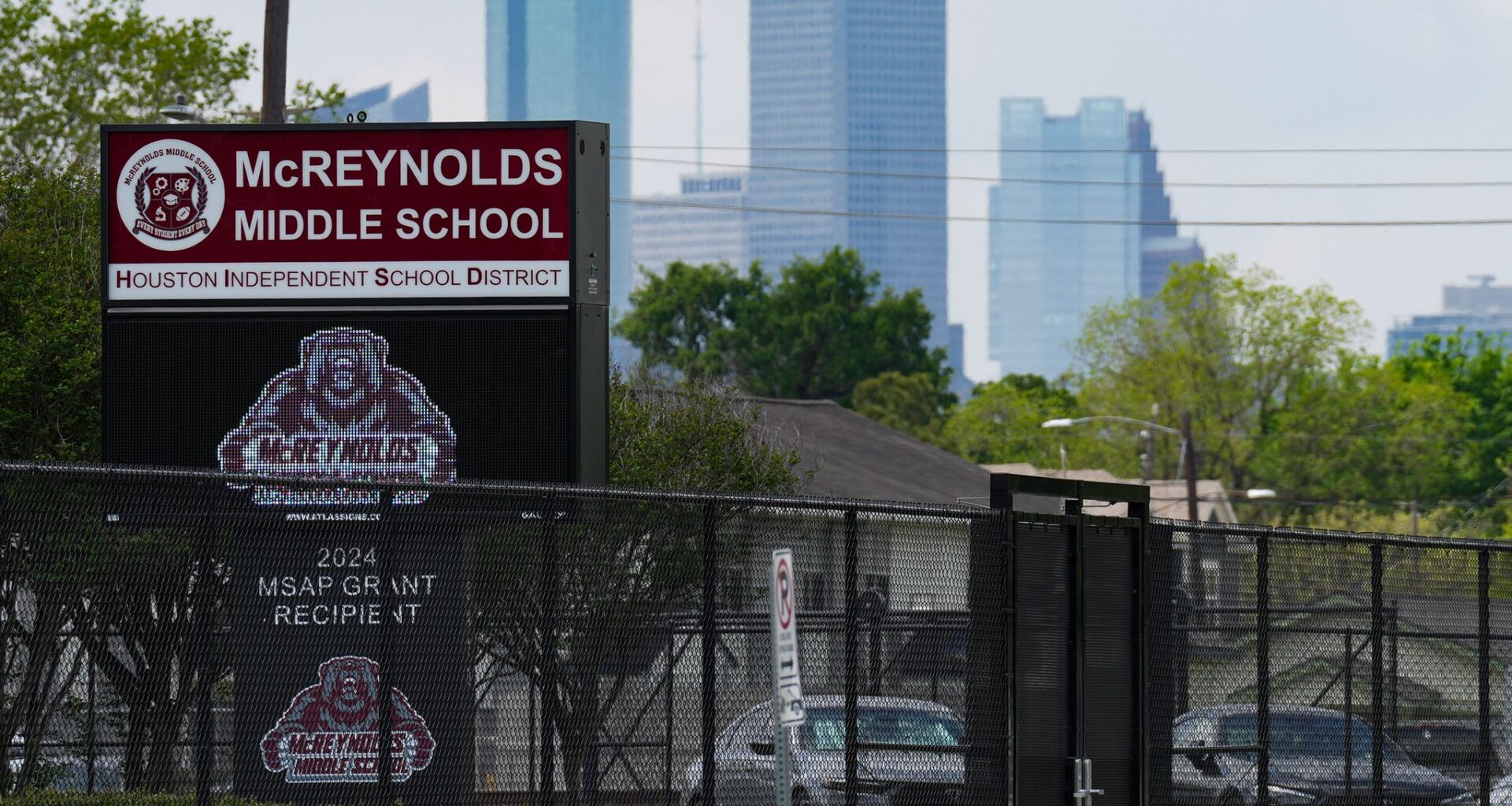
McReynolds Middle School is one of the HISD schools slated to closed in Houston on Tuesday, March 24, 2026.
Elizabeth Conley/Houston Chronicle
More than 100 Houston ISD schools are still operating far below capacity — even after the district closed a dozen campuses last school year, according to district data released this summer.
Last year, HISD closed or consolidated 12 campuses, citing larger-than-expected enrollment declines and aging facilities. But more than 100 schools that opened their doors this school year are operating under 60% capacity, according to 2025-26 district data.
State-appointed Superintendent Mike Miles has said HISD could lose $50 to $60 million in state funding every year due to enrollment declines “unless things drastically change.” He said in February the district also could have closed up to 40 campuses based on aging facility conditions alone, which often prove costly to repair and replace.
Article continues below this ad
HISD’s enrollment declines have accelerated since the state takeover began in 2023. But the declines started well before then and have been exacerbated by multiple factors, including charter school growth, Texas’ new private school voucher program, an immigration slowdown and declining birth rates nationwide, said Bill King, a fellow in public finance at Rice University’s Baker Institute for Public Policy.
King, who wrote an August report on HISD’s campus capacity, predicted more schools will likely close as the district continues to lose students.
“HISD is in a perfect storm,” King said. “We need to accept that as a reality, and then we need to start planning and putting policies in place around what this new reality is.”
A majority of the Houston area’s largest school districts also saw enrollment dips last school year, prompting school closures at several districts.
Article continues below this ad
POOR CONDITIONS: More than 100 HISD school buildings may need to be replaced, projections show
More schools under capacity
More than 60 HISD schools were operating at less than 50% capacity last year.
Most of the campuses on HISD’s closure list fell below that threshold. But seven of the 10 least-used campuses last school year still reopened this August, and dozens remain less than half full, according to district data.
“I was a little bit confused about the criteria they used,” King said. “There are certainly a lot of schools on that list we had that are very low enrolled that nothing was done about, and my question being, ‘Why not?’”
Article continues below this ad
HISD said it used several factors to determine closures, including enrollment, poor facility conditions and how much building space was used. Nearly 90 HISD campuses also moved to higher flood designations after drafts of Harris County’s new flood risk maps were released this spring, which King said could influence future decisions on closing schools.
Miles also said HISD tried to limit closures because they can disrupt their surrounding communities.
“Our schools that had the … poorest facilities are (serving) our underserved populations,” Miles said in February. “That breaks my heart, because I think they should be community schools, but they’ve been losing enrollment for a long time, and the facility isn’t working.”
Losing funds
School districts receive funding from the state based on attendance. When districts lose students without closing campuses, they miss out on per-pupil funding while keeping the high operating costs needed to maintain and staff those facilities, King said.
Article continues below this ad
Emptier schools and tighter budgets could force districts to cut critical programs, staffing or extracurricular activities. Since the takeover began, HISD has cut hundreds of central office positions, ended a wraparound specialist program designed to provide on-campus services to students and eliminated most librarian positions.
Last October, Houston voters declined to pass a projected $4.4 billion bond, which the district planned to use to rebuild and renovate 43 campuses.
The district’s state-appointed board of managers approved a $2 billion budget with a projected $25 million deficit in June.
King said more closures are necessary to prevent future cuts.
“I think too frequently, the effect on the community drives the whole decision,” King said. “It really ought to be about the kids and the financial security of the school district.”
Article continues below this ad
STATE TAKEOVER: Superintendent Mike Miles says HISD’s state takeover could end after 2026-27 school year
The challenges of closing schools
When schools close, neighborhoods often lose a community hub that offers distinct services and a sense of history and pride, experts told the Chronicle.
School closures can also negatively affect student achievement. At HISD, many of the students forced to move by closures ended up at lower-rated campuses, according to a Houston Chronicle analysis.
HISD announced its proposal to close 12 campuses in February, two weeks before the board’s final decision, causing significant community uproar — particularly after Miles said previously that the district would not close any schools that year.
King encouraged “tearing off the Band-Aid” to close underenrolled schools. But he said transparency could help minimize future harm.
“One thing they could do is engage the community. What do you want to do with a property after schools close?” King said. “Maybe it could be a community center or affordable housing.”
In August, the HISD board declared nine closed campuses as surplus, allowing those properties to be put up for sale.
HISD trustee Dani Hernandez, whose alma mater, Briscoe Elementary, closed this year, said the decision didn’t include enough community input.
“Once a public property is gone, it’s gone forever,” Hernandez said at an August board meeting. “Do not make a permanent decision based on a temporary circumstance. Protect these campuses, keep them in public hands, and give our communities a voice in what happens to them.”
The district has not confirmed whether it will consider closing more campuses in the 2026-27 school year, although it said in February that it would conduct a “series” of campus closures to right-size its finances and improve students’ academic outcomes.
“The district cannot continue operating a footprint built for a much larger student population,” said Alishia Jolivette, the district’s chief of facilities, maintenance and operations. “We cannot continue spreading limited dollars across many aging, underutilized buildings at the expense of student learning conditions.”