
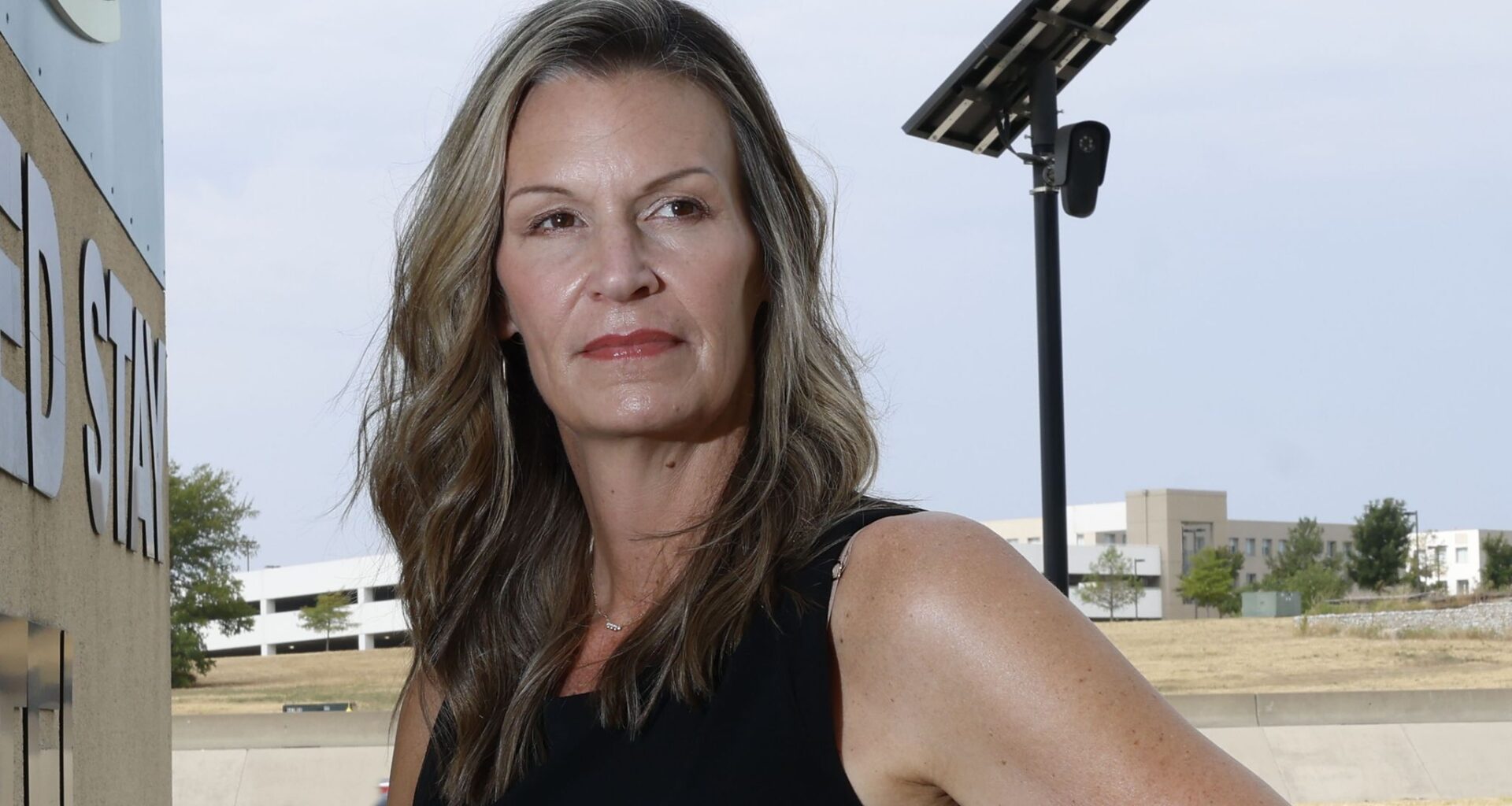
Trophy Club resident Jennifer Olson stands by a Flock Safety camera mounted to a pole. She’d like the cameras in her town removed.
Chitose Suzuki/The Dallas Morning News
Jennifer Olson saw something coming.

Back in 2021, the Trophy Club resident started asking uncomfortable questions about Flock Safety cameras and the license plates they photograph. I wrote about her concerns in 2022.
At the time, few people seemed interested.
Article continues below this ad
Today, privacy concerns surrounding Flock’s growing network of cameras are suddenly everywhere.
So I asked Olson, who serves as the chairperson of the Trophy Club Ethics Review Commission, what she thinks happened — and whether the concerns she raised five years ago have finally caught up with the technology. It’s a natural fit because her pet causes are accountability and transparency.
Q. Jennifer, how does it feel to be one of the first North Texans to raise privacy concerns about Flock street cameras? I shared your story in 2022 (“Welcome to Trophy Club, where everyone who drives into town gets their license plate photographed”). And no one seemed to care. But now it’s one of the hottest issues in America. To what do you attribute this sudden concern?
A. It is somewhat surreal. When I became concerned in 2021, I wasn’t questioning whether Flock could help law enforcement. I was concerned about what the system could become without meaningful limits, transparency and oversight.
What once seemed hypothetical is now much easier to understand because people have seen how these networks can be searched, shared and, in some cases, misused.
Article continues below this ad
Q. For those who haven’t studied this, these are the cameras that photograph the license plate of every vehicle entering or leaving a city. Dallas is the area leader with the latest count at around 670 cameras with many more in the rest of Dallas County. The $5.7 million budget included federal and state grants. Police say it helps them find stolen cars and sometimes actual criminals. What say you?
A. I don’t dispute that they can be effective law-enforcement tools. But effectiveness is only part of the question. We also need to know who can search the data, why, how far it can be shared and what happens when access is misused.
Public safety and privacy should not be treated as mutually exclusive.
Q. Why is it troubling to photograph not only license plates but a car’s color, make and model, the last visit to town and whether the car is registered to a resident?
A: The concern is not one photograph. It is what happens when vehicle information is collected over time and becomes searchable, allowing patterns of movement to emerge.
Article continues below this ad
Flock systems are also used by HOAs and private communities. What safeguards protect residents when the authorized user is a private citizen?
Q. Under Trophy Club’s policy, the cameras also check if drivers have outstanding warrants, are the subject of an Amber Alert, a sex offender or subject to a protective order. It can also check if they are crime victims and witnesses in cases. What’s so bad about that?
A. I don’t think all of those examples should be treated the same. An active Amber Alert or outstanding warrant is very different from tracking someone because they are on a registry, or because they are a victim or witness.
There should always be a lawful purpose, clear limits and review of who is being searched and why.
Q. But the drivers are not photographed.
Article continues below this ad
A. They don’t have to photograph your face to learn where your vehicle has been. Most people are closely associated with their cars, so repeated vehicle data can reveal a great deal about a person’s movements.
Q. In one case, Burleson law enforcement used the cameras to investigate an abortion. What are your thoughts on that?
A. The Johnson County case is exactly why I worried about how broadly this technology could be used. A system promoted for finding stolen cars and criminals was used to search a nationwide network in an abortion investigation.
Whatever someone’s view on abortion, the larger question is who decides what this technology can be used for and what safeguards apply.
Q. Are there still no signs in your town identifying the cameras which look like solar street signs?
Article continues below this ad
A. I still have not seen signs identifying the Flock cameras. I have always believed residents and visitors should have some notice when this type of vehicle information is being collected.
Q. Do the camera findings give police a legal reason to search a car?
A. Not automatically. A Flock hit may support an investigative stop depending on the circumstances, but it does not automatically authorize a vehicle search. A search still requires its own lawful basis.
Q. Have there been any abuses that you know about?
A. Yes. There are now documented cases and investigations elsewhere involving alleged improper or unauthorized use of Flock systems. That is exactly the risk I was concerned about from the beginning.
Article continues below this ad
Q. Is it true that U.S. Immigration and Customs Enforcement uses the cameras?
A. Not directly by default, according to Flock. But there have been reports of local law-enforcement agencies conducting Flock searches connected to federal immigration enforcement.
That is why people should understand not only who directly accesses the system, but how information can be requested and shared across agencies.
Q. Why did the city of Austin remove its cameras?
A. Austin ended its program after privacy and oversight concerns were raised, and a city audit found problems with compliance with its own search-documentation rules.
To me, that shows why oversight matters and why communities should be willing to reconsider these systems when safeguards are not strong enough.
Q. I see where others are shutting them down, such as the Hood County constables’ department, which said no more in April.
A. I think Hood County’s decision is significant because it shows officials are willing to reevaluate these systems after they have been adopted. That kind of scrutiny is healthy and is what I was asking for years ago.
Q. The constable said, “That kind of warrantless tracking doesn’t belong in a free society.” Your thoughts?
A. I agree with the principle. There is a major difference between investigating someone suspected of a crime and having the ability to search historical vehicle movements on a large scale. Intrusive surveillance should require justification.
Q. The Houston area seems a lot more involved in killing the mass-surveillance program. Back in 2024, it was reported that the region had 3,800 cameras. Many of those programs have ceased. I wonder why that hasn’t happened on a grand scale in our neck of the woods.
A. I think North Texas was slower to take the concerns seriously. When I raised them in Trophy Club in 2021, the risks were largely viewed as hypothetical.
The conversation changed as Flock became a national issue and examples of alleged misuse received more attention. I am encouraged that more people are now asking for accountability.
Q. Did you hear about the recent anti-Flock protest march in Houston? Could that ever happen here?
A. Yes, I think it could. Five years ago, few people would have imagined residents protesting over license-plate cameras.
I would rather see people become informed before it reaches that point – ask questions, review policies and insist on transparency and accountability.
Q. The Texas Legislature could ban them, right?
A. Yes. But the larger issue is whether Texas will create enforceable rules for this type of surveillance technology. Flock may be the company in the spotlight today, but another company could provide similar technology tomorrow.
Clear laws should govern access, sharing, auditing and consequences for misuse.
Q. Well, congratulations on helping to increase public awareness about this five long years ago. Anything you’d like to add?
A. I’m glad I spoke up. My concern was never simply the cameras; it was access, accountability and the possibility of misuse.
I have much more confidence in Trophy Club’s current leadership. The town provides more public information about the system today, and I believe legitimate concerns about misuse would be taken seriously and addressed appropriately.
I’m encouraged that people across Texas are now asking many of the same questions. Privacy and public safety can coexist, but only with transparency, oversight and meaningful safeguards.
Q. Flock CEO Garrett Langley told FOX News, “I value my privacy but what we’re talking about is safety as well.” If you could talk to him, what would you say?
A. I agree safety matters, but privacy and safety should not be an either-or choice. I would ask whether Flock’s safeguards are strong enough to prevent misuse by people who already have legitimate access. Technology this powerful needs equally strong accountability.