
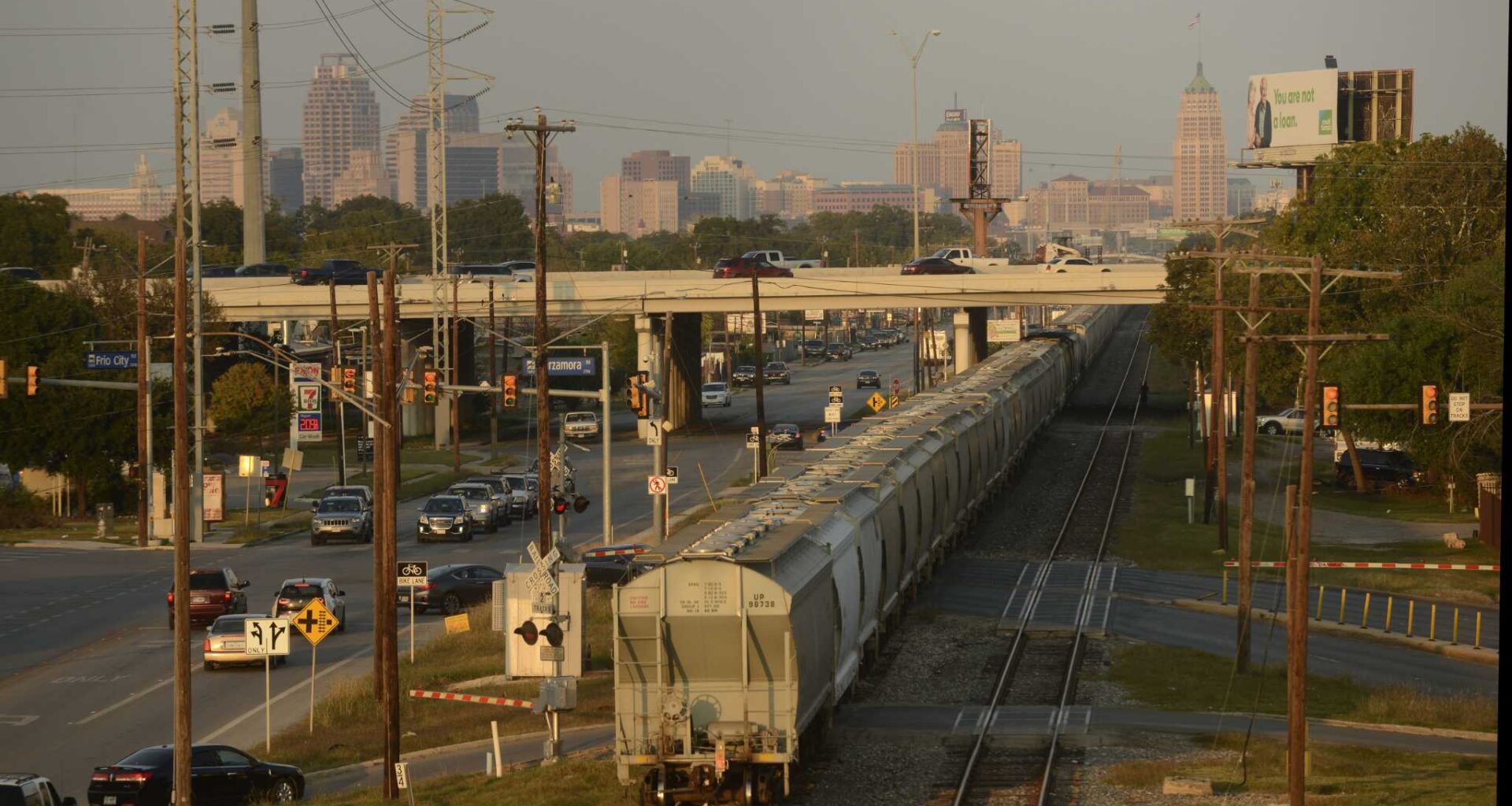
A Union Pacific train rolls along tracks near South Zarzamora Street and Frio City Road. The Texas Transportation Commission has awarded $5 million to help move the road and rail to different levels, so they do not directly cross paths.
Billy Calzada
Over the past five years, the Federal Railroad Administration has received 150 reports of trains blocking Walzem Road where the busy four-lane road passes over an also-busy double-track Union Pacific rail line on the Northeast Side.

The reports, made through the agency’s online system, describe ambulances forced to turn around, school buses blocked from taking children home, missed doctors’ appointments and late work arrivals, drivers struggling to stay cool in their cars and resorting to unsafe maneuvers to circumvent the train. The crossing, near Walzem’s intersection with Gibbs Sprawl Road, is near a Veterans Affairs outpatient clinic and a half-mile from a Bexar County fire station.
Article continues below this ad
Fifty of the reports said the train had blocked the road for more than an hour. Twenty-nine of those who made the reports said they’d witnessed pedestrians climbing over or under the stopped train; 27 said they’d seen first responders unable to cross.
ALSO READ: Study finds passenger rail route between S.A., Austin could cost $13.5B
Relief could be in sight for the area’s drivers after the Federal Railroad Administration this month awarded the Texas Department of Transportation a $756 million grant for rail grade separation projects. That typically involves raising a roadway so it passes over railroad tracks, allowing trains to come through without blocking traffic.
The grant will fund 12 projects across Texas, according to TxDOT, with two of them in Bexar County: at the Walzem crossing, and the crossing of that same rail line with Rittiman Road, about 1½ miles southwest.
Article continues below this ad
Also among the projects is the rail crossing near FM 78 and Country Lane in Guadalupe County.
TxDOT hasn’t yet determined how much funding each project will receive, spokesperson Ryan LaFontaine said.
The Walzem, Rittiman and FM 78 projects are in the planning process, he said.
Last year, the Federal Railroad Administration received 235 reports of roads blocked by trains in Bexar County — the 13th-highest amount among U.S. counties, according to the agency’s data. Houston’s Harris County ranked first, with 5,259.
Article continues below this ad
“San Antonio is one of the most rail-impacted (cities) in the nation,” said San Antonio City Council Member Jalen McKee-Rodriguez, whose District 2 includes both the Walzem and Rittiman crossings. “It’s not just an inconvenience, but a safety concern. If I’m taking someone to the hospital or I’m going to an appointment, these have real impacts. We see folks also make some pretty unsafe decisions to avoid trains.”
Growing problem in Texas
Eliminating rail crossings has grown into a more urgent issue across the U.S., but especially in Texas, as rail companies have made it a practice to run longer freight trains in a quest for higher profits, according to reporting in the Wall Street Journal. Longer trains tend to run more slowly.
The Union Pacific line is part of a crucial freight route originating in the Port of Laredo on the Texas-Mexico border, which has lately emerged as the nation’s top port, due in large part to the growth of the Texas-Mexico manufacturing ecosystem. Every day, tons of produce, auto parts and electronics roll through San Antonio on their way to other U.S. cities.
Article continues below this ad
In a recent filing with the Securities and Exchange Commission, Union Pacific reported an average train length of 9,890 feet, or nearly 2 miles, up from 9,410 feet five years earlier. The company said “capacity investments” and “optimization” of its transportation plan had enabled it to handle more carloads.
McKee-Rodriguez said he has received numerous complaints from residents in his district about trains blocking roads.
In February, he basked the city to develop a notification system to alert residents of train blockages through navigation apps such as Waze and Google Maps. The city is developing a pilot program, with $194,000 allotted in its proposed fiscal year 2027 budget.
Article continues below this ad
The railroad track that cuts across Walzem and Rittiman runs east along U.S. 90 toward Houston. Union Pacific operates a 100-acre loading facility, Kirby Yard, about 1 mile southwest of the Rittiman crossing.
Union Pacific “strongly supports” the city’s efforts to build overpasses above rail lines, company spokeswoman Robynn Tysver said in a written statement. “Rail shipments have significantly increased with the state’s growing economy. The Rittiman/Gibbs Sprawl area project will give drivers unimpeded access across the tracks as we deliver shipments to businesses that depend on Union Pacific to send and receive their goods.”
On an average day last year, 19,418 vehicles passed along Walzem Road just south of the rail line, according to TxDOT’s Statewide Traffic Count Map. For Rittiman that number was 20,937.
Blockages on Rittiman
The Rittiman Road railroad crossing is the subject of even more reports to federal officials, with 264 over the past five years, according to data from the Federal Railroad Administration. Of those, 84 complaints described the road as being blocked for an hour or longer.
Article continues below this ad
Five people have been killed and three injured in collisions between trains and vehicles at the Rittiman Road crossing since 1986, according to reports filed with the U.S. Department of Transportation. Most recently, at 5:50 a.m. on a Monday in December, a 20-year-old man was injured when he drove through a warning gate and hit a train. The last reported fatality occurred in 2011.
Traffic congestion at the crossing has grown so bad that over the past five years, more than 6,500 San Antonians have signed an online petition asking local leaders to do something about it.
“This railroad crossing is blocked at least once a day for 20-30 mins,” a person wrote in a complaint to the Federal Railroad Administration in March 2025. “On several occasions I’ve seen emergency vehicles such as police cars and fire trucks having to turn around to find alternate routes not to mention the backing up of traffic and major congestion this causes.”
ALSO READ: Council approves $220.5M contract for renovating S.A. airport terminals
Article continues below this ad
The city of San Antonio has been working on disentangling Rittiman and the rail line. Last year, the City Council voted to accept a $4.8 million federal grant and provide a matching $1.2 million to pay for engineering and environmental review work to raise the intersection between Rittiman Road and Gibbs Sprawl Road so Rittiman passes over the tracks.
The design work is expected to be completed by fall 2028, according to the city’s Capital Delivery Department. The city is seeking grants to cover the estimated $45 million to $50 million construction budget.
The Walzem project is being managed by the Alamo Regional Mobility Authority, an arm of Bexar County. The project is currently budgeted only through its design stage, county spokesperson Monica Ramos said.
The project’s construction cost is estimated at $40 million to $50 million, Ramos said. The authority has asked for $48 million in federal funds for construction; the authority will need to cover $6 million to $7 million in design costs.
Article continues below this ad
Local and state leaders have targeted another local railroad crossing for elimination, near South Zarzamora Street and Frio Street on the Southwest Side.
In March, the Texas Transportation Commission, which oversees TxDOT, approved $160.4 million for five rail grade separation projects in Texas, including $5 million for a city-led project at Zarzamora and Frio. The project is expected to cost $65.7 million, the agency said.
The city also received a $18.9 million grant from TxDOT for that project, according to its Capital Delivery Department. The project’s design is complete, and the city is working to acquire the land the project will occupy and adjust nearby utilities.
Freight traffic growing
It isn’t realistic to expect all rail crossings in San Antonio to be eliminated, said McKee-Rodriguez, the District 2 councilman.
Article continues below this ad
A more workable solution, he said, is a notification system alerting residents when roads are blocked by trains. Houston has developed something like that, called Train Watch, that alerts the city’s residents through a website.
“I think this is going to be an innovative program,” McKee-Rodriguez said. “We’re leading on this — this is not something that’s happening widespread across the country.”
ALSO READ: VIA board mulls bus fare increase as costs escalate for planned rapid lines
During a June meeting of the council’s Transportation and Infrastructure Committee, the city’s Public Works Department outlined the challenges it would face in doing so, including a lack of information about approaching trains. For security reasons, rail companies do not publicly release their freight schedules.
Article continues below this ad
The committee approved creating a pilot program that would work with the local Southwest Research Institute to develop a prototype based on video detection of approaching trains.
“I think sometimes we just have to think about what is the simplest solution possible. We’re working to get some of these at-grade crossings eliminated… But those are hundreds of millions of dollars in projects that are really difficult to fund, and they require support from the state, federal government and Union Pacific,” McKee-Rodriguez said. “The simplest, most cost-effective strategy would be if everybody were to be notified on their GPS.”
There are 379 at-grade rail crossings in Bexar County, according to the AAMPO Regional Freight Study, a report published last year by the Alamo Area Metropolitan Planning Organization, a regional transportation planning agency.
By 2050, the region will see “unprecedented growth” of freight traffic, according to the report – meaning that without infrastructure improvements, train blockages on roadways will get worse.
Article continues below this ad
The AAMPO region — encompassing Bexar, Guadalupe, Comal and Kendall counties and part of Medina County — handled 160.1 million tons of freight in 2019, according to the report. By 2050, that is expected to rise to 330.3 million tons.
Since 2016, a total of 42 people have been injured and 12 killed in train-vehicle collisions in San Antonio, according to data from the U.S. Department of Transportation.
Last year, Texas legislators created the Texas Off-System Rail Grade Separation State Fund Program to pay for the elimination railroad crossings, and allocated $250 million for the effort. That pot of money is the source of the state funding for the Zarzamora project.
Of all railroad crossings in Bexar County, those at Rittiman and Walzem have had the most reports of rail blockages, according to federal data. But they still represent only a fraction of the total reports: Since 2020, 1,136 complaints have been made in the county.
Article continues below this ad
In April, one complainant wrote of the Rittiman crossing: “This train just stops here all the time… it’s everyday at any hour… it makes it horrible to drive by.”
That same month, another report said simply: “Couldn’t get home.”