
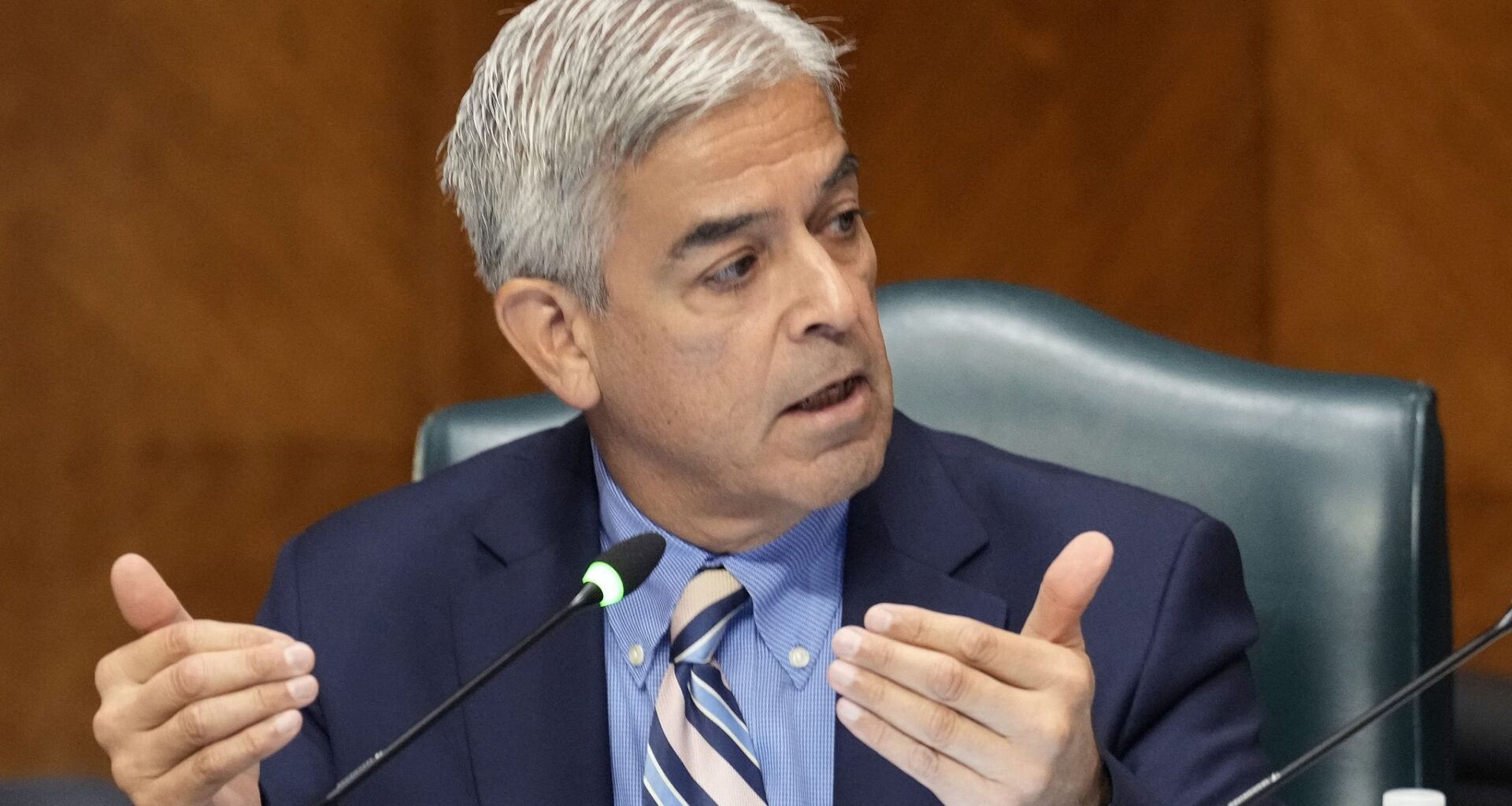
City Council Member Julian Ramirez, At-Large Postion 1, speaks during a city council meeting in Houston, Wednesday, July 8, 2026.
Brett Coomer/Houston Chronicle
Political candidates seeking office at Houston City Hall could soon face stiffer penalties for some campaign finance violations under a new proposal being considered by city officials.
Filing campaign fundraising reports late — or failing to file them at all — is a criminal offense under state and city laws and can be subject to hefty fines. But in practice, the city doesn’t enforce those rules, leading to routine violations from officeholders and their challengers alike.
A new proposal filed by Council Member Julian Ramirez seeks to encourage more timely reports by requiring the city secretary to file a sworn complaint with the Texas Ethics Commission anytime a candidate misses a deadline.
Article continues below this ad
“With no penalty assessed for not meeting the deadline, filers can ignore the requirement with impunity,” the proposal reads. “Because violators are not held accountable, the public’s confidence and trust in its government is undermined.”
Ramirez is pushing the idea through Proposition A, which allows any three City Council to place an item on the city council agenda. The proposal, which is also supported by Council Members Amy Peck, Sallie Alcorn and Joaquin Martinez, must pass a legal review before being scheduled for a vote.
Ramirez and other council members have engaged in more than a year of talks at City Hall over ethics reforms. Mayor John Whitmire campaigned on rooting out waste, corruption and conflicts of interest in city government, but various proposals, from reviving the city ethics commission to reforming the Office of the Inspector General, have not advanced.
READ MORE: Mayor John Whitmire vowed to clean up City Hall. Council members say oversight gaps remain.
Article continues below this ad
Ramirez’s proposal also would require City Secretary Troy Lemon to post the names of delinquent filers on a city website within 24 hours after each filing deadline.
Under state law, contenders for Houston mayor, controller, and city council seats are required to post reports with donations and spending twice a year, with extra reports due before each election day.
In theory, violations of those rules could be addressed in two ways, Ramirez said. Complaints could be routed to the Office of the Inspector General or to the city ethics commission, but in practice, Houston has not used either mechanism to enforce its laws.
The ethics commission, in particular, does not appear to have met for at least a decade.
The result is that, in recent election cycles, up to 25% of all candidates failed to file reports of contributions and expenditures on time, or at all. In some cases, candidates only filed after being contacted for comment by the news media.
Article continues below this ad
Ramirez’ proposal takes a third route, explicitly asking the state to step in.
“It shouldn’t solely be on the Chronicle to hold people accountable for not filing or for late filing,” Ramirez said.
The eight-member Texas Ethics Commission, appointed by state leaders, is generally tasked with regulating state lawmakers and candidates but does take up local matters when a Texas resident files a sworn complaint.
Missing campaign finance filing deadlines can carry up to $5,000 fines under state law, but generally have resulted in much smaller penalties. The commission gave a failed candidate for Maverick County commissioner a $500 fine last year for failing to file two reports, for example. The mayor of Liberty Hill received a $250 fine for failing to file two reports and filing a third one late.
LATE FILERS: Nearly 1 in 4 Houston Council candidates haven’t filed their campaign finance report
Article continues below this ad
Others have been punished for failing to disclose donor names or leaving basic information like addresses or expenditures blank.
The Houston proposal would be unique because the city itself would serve as the source of the complaint, rather than an everyday citizen or watchdog group. No other Texas cities appear to have created a formal policy outsourcing ethics enforcement in this way, Ramirez and two campaign finance experts said.
Still, the solution is limited to requirements codified in state statute, like filing deadlines, that are under TEC’s purview.
City-specific laws, like contribution limits, will still go unchecked unless Houston pursues its own ethics enforcement, said Andrew Cates, an Austin-based attorney who regularly practices before TEC.
Other major cities, including Austin and San Antonio, generally have functioning ethics bodies to enforce rules governing everything from campaign reports to lobbyist filings.
Article continues below this ad
“Kicking that responsibility over the state, that’s fine, but what are you going to do if someone breaks your city code?” Cates said.
Ramirez said he still hopes to see broader city-level reforms, such as changes to the information the inspector general could make public as the office investigates misconduct.