
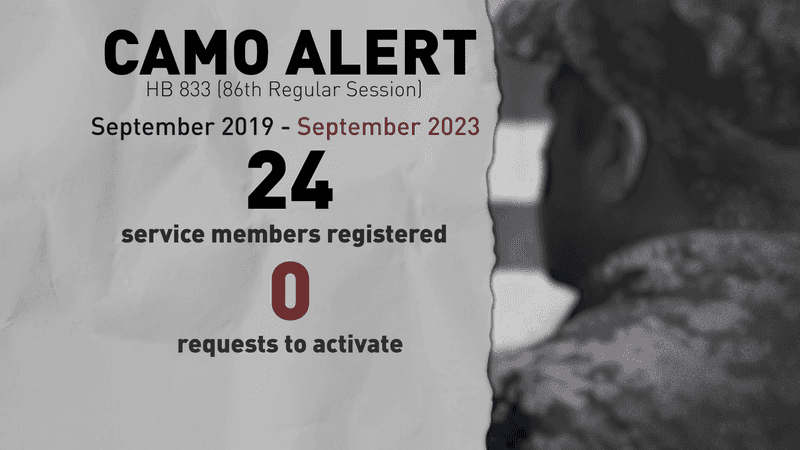
Texas created a special missing-person alert intended to help locate veterans in mental health crisis. But records obtained by the News 4 I-Team show only 24 veterans enrolled before the program expired in 2023 — and no Camo Alert was ever issued.
Now, veterans and lawmakers say Texas must answer for why the program never reached the people it was designed to protect, and they are pushing to bring it back with major changes.
What Camo Alert was supposed to do
The Legislature created Camo Alert through House Bill 833, which took effect in 2019. It was designed to work similarly to Amber and Silver Alerts for current or former members of the armed forces — including the National Guard, reserve and auxiliary units — reported missing while experiencing a mental illness, such as post-traumatic stress disorder, or a traumatic brain injury.
Under the law, a law-enforcement agency was supposed to verify that the veteran was missing, had a qualifying condition, and faced a credible threat to their own health or safety, or the health or safety of others. DPS would then confirm the information and issue the alert to media outlets and other partners.
The Texas Department of Public Safety said Camo Alert expired Sept. 1, 2023. While it was active, the agency said, it was meant to notify the public when a current or former service member was reported missing under specific circumstances.
Jason Allen, who served in the Marines, helped create the idea for a Camo Alert, telling lawmakers about it as early as 2017.
“All these families could do was post on Facebook because [veterans] hadn’t been missing 24 or 48 hours. They couldn’t file a police report,” Allen explained. For the elderly or for children, that’s when police would issue an alert. “Why couldn’t we do the same thing for veterans?”
Allen says he’s spent years trying to get answers about where the program went wrong.
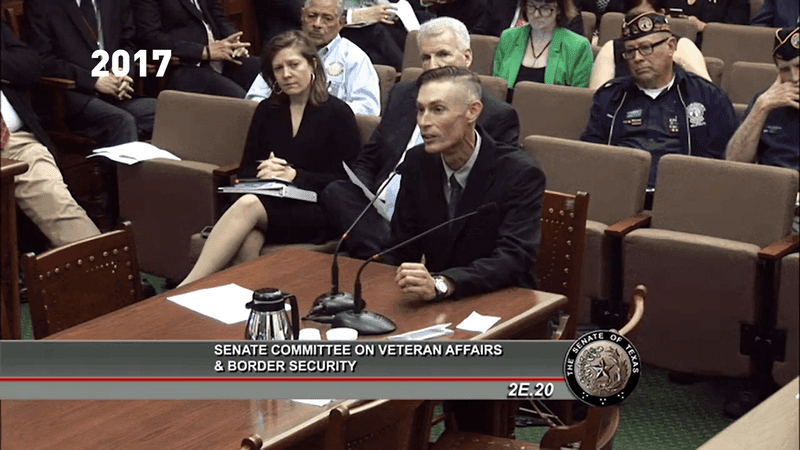
Jason Allen testifies about the Camo Alert in 2017 (Texas Senate)
‘The state of Texas failed’
Steven Price, a veteran and leader of VOICES for our Veterans in Bexar County, said he was shocked he had never heard of Camo Alert.
“The fact that there was never one issued questions exactly how it was implemented in the first place,” Price said. “Me, as a local activist and working throughout the state, I’ve never even heard of it myself.”
Records show that just 24 veterans enrolled during the program’s period of operation. Price said the low enrollment and lack of alerts suggest the program did not reach the veteran community it was designed to protect.
“Obviously, it makes me feel like the veterans were dropped off and nobody looked into it,” he said.
State Rep. Josey Garcia, an Air Force veteran and the only female veteran to serve in the Texas legislature, said she had not heard of Camo Alert until the News 4 I-Team asked her about it.
She took office in early 2023, the year that the law establishing the alert expired.
“What does that say to you that over the course of five years it was never used at all?” reporter Jordan Elder asked.
“The state of Texas failed,” Garcia said.
Garcia, who served in the Air Force from 1995 to 2014, said Texas cannot simply say it supports veterans.
“Texas can’t just say, ‘Oh, we’re patriotic.’ You have to show that,” she said.
State Sen. José Menéndez, one of the original backers of the 2019 law, said the alert was not well known and may not have been adequately publicized.
“We think of the best way to solve a problem, but we don’t think about, how does it work in practice in the real world?” Menéndez said. “We can do better. We must do better.”
Texas ‘Camo Alert’ expired with no alerts issued; veterans push for a new approach
Advocates say self-enrollment created too many hurdles
A central concern raised by advocates and lawmakers is that a veteran had to enroll in Camo Alert before a crisis, with a witness signing off.
Allen questioned why veterans had to take that extra step.
“You don’t have parents going out and registering their kids for the Amber Alert, and you don’t have kids registering their parents and grandparents for the Silver Alert,” Allen said. “Why did veterans need to register for this?”
Garcia said the requirement did not account for the stigma many veterans may feel about disclosing struggles with PTSD or other mental-health issues.
“Combat veterans are not going to volunteer to put themselves on a government registry saying that they’re struggling with PTSD or any other illness or issues,” Garcia said. “That’s just not feasible.”
She said a new version of the law should allow immediate family members, mental-health professionals and other trusted people to report a veteran in crisis to law enforcement.
“We need those families to be able to contact law enforcement immediately,” Garcia said.
Menéndez agreed that family members should be able to seek help when a veteran may not be in the right frame of mind to do so.
“An immediate family member should have the same right to report someone as that person themselves,” he said.
Garcia said she plans to file legislation to revive Camo Alert with more substantial changes. Price said the message around mental health help must change, too.
“That’s a hero act, not a weak act,” Price said. “It’s a strong act. It takes courage to do that.”
We’re also investigating why so many veterans hadn’t heard of the Camo Alert.
The original law required DPS to coordinate the alert program with other state agencies and law enforcement, establish procedures for issuing alerts and recruit partners to help develop and implement the system.
DPS did not grant our request for an interview but provided the following statement:
Today, DPS is responsible for administering multiple alerts as part of the Statewide Alert Program, including several other alerts that, depending on the circumstances, could be utilized to assist law enforcement in locating individuals who previously qualified for the Camo Alert. Each of these alerts — and the criteria needed to activate them — is established by laws passed by the Texas Legislature. The Statewide Alert Program issues urgent public safety warnings meant to warn the public of possible danger for themselves or a missing person. Each is designed to speed up the apprehension of a violent criminal and/or locate missing persons and children by generating tips and leads for the investigating agencies, therefore giving those agencies the best opportunity to apprehend a criminal or rescue someone who is at-risk. At this time, the Statewide Alert Program includes AMBER, Silver, Blue, Endangered Missing Persons, CLEAR, Power Outage and Active Shooter alerts.
Garcia argues that more veterans live in Texas than any other state, and they deserve their own individualized alert, especially if they don’t fall into any of the current alert categories.
For veterans in crisis, the Veterans Crisis Line can be reached by calling or texting 988 and pressing 1, or by chatting online through the U.S. Department of Veterans Affairs.
Bexar County Military and Veterans Services Center: Helps veterans and families connect with benefits, claims help and local support. 210-335-6775.
Texas Veterans Commission: Free help with VA claims, employment, education and other benefits. 1-800-252-VETS (8387); tvc.texas.gov.
VA South Texas Health Care System: Mental-health and other VA care for eligible veterans. 210-617-5300; southtexas.va.gov.