
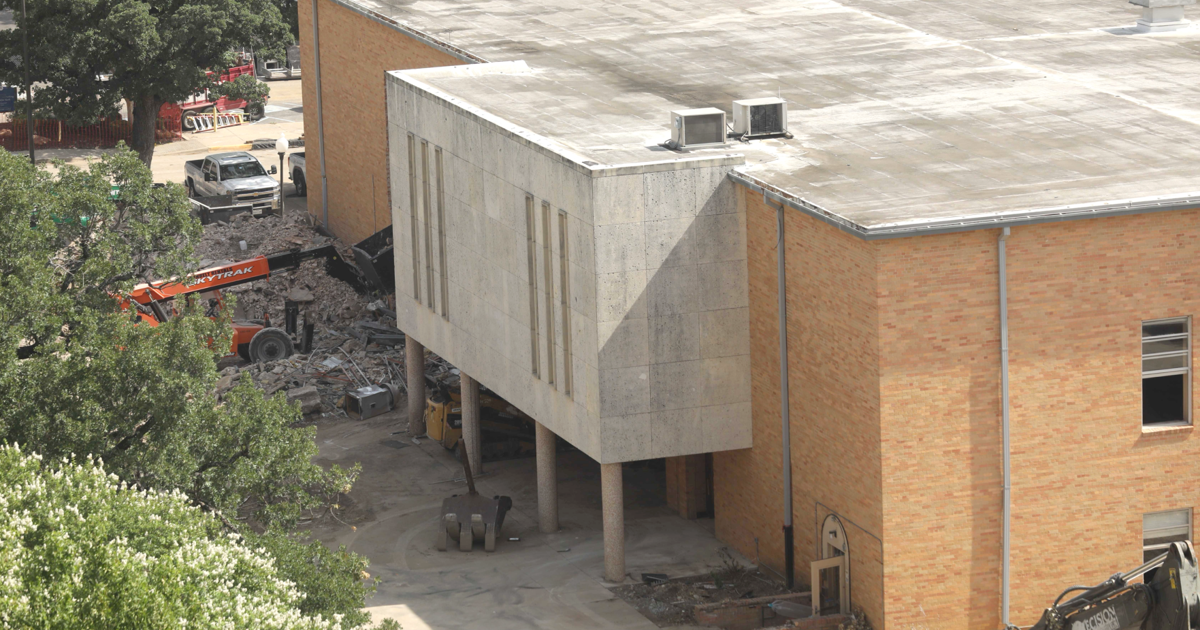

Sunlight reflects off the side of a University Center facade Aug. 14 at 300 W. First St. The architectural design of the facade is international-style modernist, an architectural movement that came to America in the 1930s and during World War II.
Every day for the past 50-plus years, students have walked between two of four mosaic-tiled pillars when stepping into the west side of the University Center.
Walking in to go to the post office on the left or to The Market on the right, students unknowingly walked through one of the older parts of the building.
Back outside, the pillars in front of the doorway held a massive limestone rectangle, geometrically sequenced into segmented blocks. Three more rectangles on each side of the front of the facade made up the windows.
But now it is gone.
The demolition and reconstruction project is set to give the UC a facelift, and the new structure and renovation will add years of use on a building that has served students for more than 70 years already.
In the 1960s, the facade was added when the university installed a mess hall into the building. The post office was also added in the same decade.
Marisa Gomez Nordyke, a lecturer in the school of architecture who teaches multiple architectural history courses, classified the early-60s addition to the UC as international style modernism —not brutalism.
Brutalism is an architectural form that involves exposed concrete that has the memory of construction, Gomez Nordyke said.
“When you build something in concrete, you pour it into a formwork, and brutalism is going to preserve the rough, raw texture,” she said.
While the facade could look similar to a brutalist structure to the untrained eye, Gomez Nordyke said the primarily brick facade and the limestone structure is more of a refined material.
Apart from presentation, the time frame of its construction also leads to the classification of modernism.
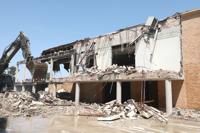
An excavator cleans rubble from the west facade of the University Center on Aug. 24 at 300 W. First St. The substantial completion of the center is set for late December 2028.
George Sowden helped design the UC and was instrumental in the planning of many public school and university buildings throughout the state in the ’50s and ’60s, according to research by Gomez Nordyke.
Sowden was also at Cornell University when modernism began to take off.
Modernist architecture came to America in the 1930s and during World War II, then boomed after it was over.
“There’s a postwar boom in all sorts of ways,” Gomez Nordyke said. “You have the baby boom but you also have a building boom, and the campus expansion of UTA is really reflecting the postwar prosperity of the U.S.”
Modernist architecture explored the avant-garde at the time, somewhat taking on a “less is more” mindset. The facade at the UC matched this approach.
“To me, it’s like a big glaring sign for American hopes and dreams after World War II, rather than just a facade or just a style,” Gomez Nordyke said.
The limestone, or similar material, that made the facade is not thick.
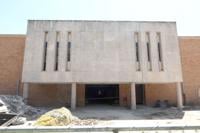
Construction debris sits under the west facade of the University Center on Aug. 14 at 300 W. First St. Construction on the center will cost $160 million.
Bear Lunce, UC and Commons associate director, said there was actually a hole in the wall from when someone banged a table into it.
For a long time, the inside of the facade was used as a storage area.
“I think about all the tables and stage parts that are stored in the closet on the other side of those windows that you can’t see,” Lunce said.
“I’m sure it had a function when it was first built, but now it’s like, ‘Man, that sure is a decorative closet,’” he said.
The trees that somewhat covered it were uprooted and taken away, and the doors that greeted students directly below it were ripped from their frames.
On Aug. 24, the facade slipped away too.
@j.e.journalism