
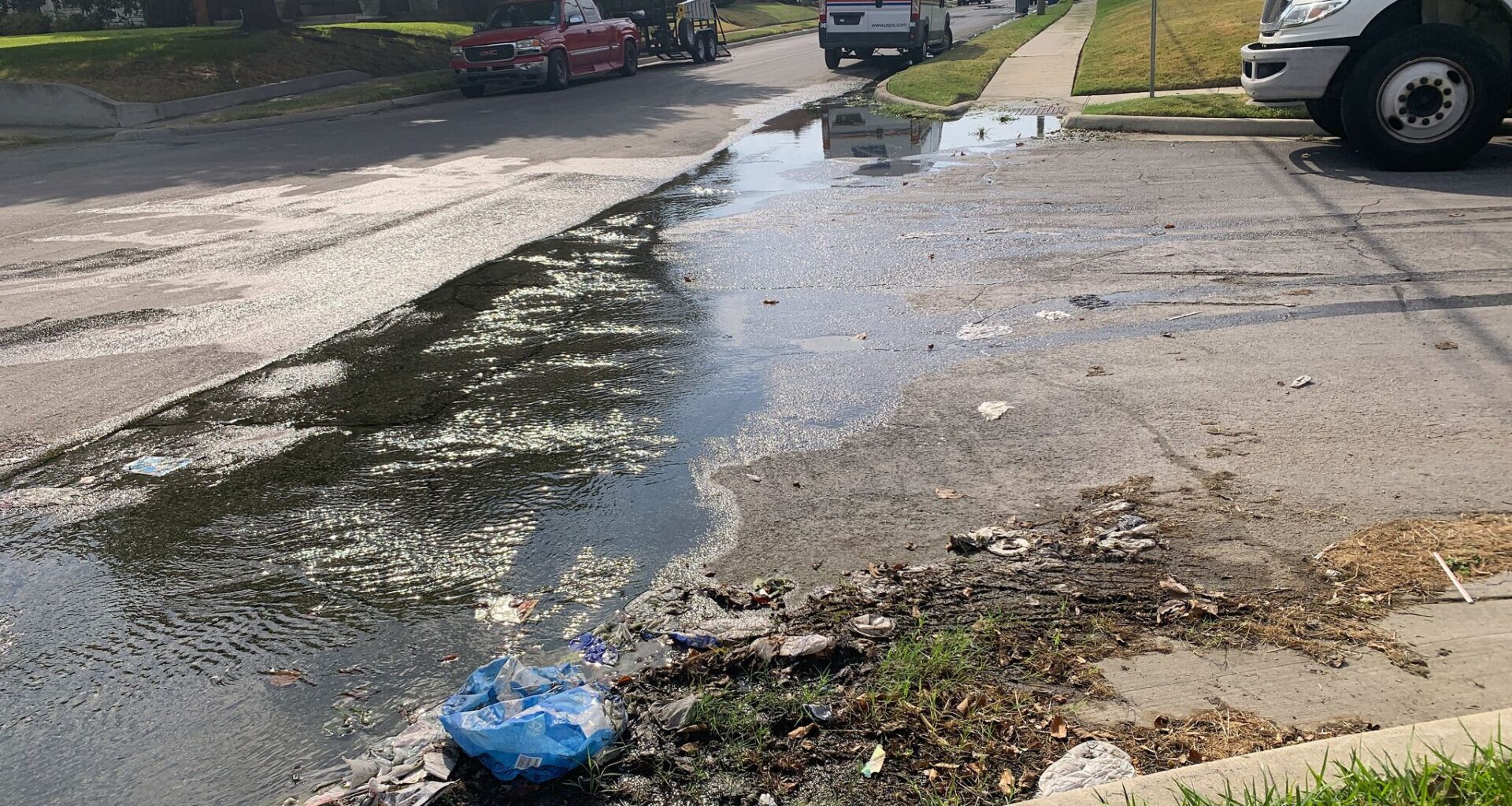
Jeanette Bolden invited me for a walk along her neighborhood’s creek Wednesday morning. Runs about a quarter mile. Filled with the usual floating junk — water bottles, trash bags, beer cans, candy wrappers. Bugs, too — bees, flies, wasps. But the rushing, rippling water was clear as Waterford. As it should be.
Because that was city water. Drinking water. Which has been filling Bolden’s historic Fair Park neighborhood for as far as the eye can see. Since May.
“It’s been running like this for months,” Bolden said as we waded from her home on Park Row down Atlanta Street to Al Lipscomb Way, just across from the baseball fields at Billy Earl Dade Middle School. The water stretched all the way to the historic marker planted on South Boulevard. “It’s crazy!”
Water was bubbling up through the concrete. I said it looked and sounded like a natural spring. Bolden laughed, but not because she thought it was funny. “Yeah,” she said, “it’s kind of soothing, just a little bit.” If only sarcasm could plug a busted water line.
Article continues below this ad
Which, I guess, is what this is about — a broken pipe burbling drinking water all over South Dallas streets for months. About why it took so long to get it fixed. About the cold shoulder residents say they got from City Hall. About the damage wrought just out of sight by this brutal, endless summer. About a broke and seemingly broken city. And about how everyone I talk to can no longer contain their anger about ANY OF IT.
They finally patched the leak Wednesday night, after South Dallas council member Adam Bazaldua and I asked about it. But repairing (gesticulating wildly) all of this seems very far off.
When I told Jeanette Bolden the water-line leak on Al Lipscomb Way looked like a natural spring, she laughed. But not because she thought any of this was funny.
Robert Wilonsky/Staff writer
Bolden and residents in and around the South Boulevard-Park Row Historic District have been complaining about their water-logged, algae-slicked, bug-ridden streets and trash-clogged storm drains for more than three months, they said, begging City Hall to make it stop. They sent service requests to 311; called, too.
“Each time my 311 cases were closed, I immediately opened another case again,” Bolden said. “A prime example of what my neighbor said: ‘Don’t complain anymore.’” In other words: You’re wasting your time.
Article continues below this ad
Bolden finally emailed the city manager’s office last week: “We are highly upset to see such a waste of running water with trash and green messy stuff down the City street. Please help!” That email was forwarded to someone in the Transportation and Public Works Department, where someone forwarded it to Dallas Water Utilities, who said they’d already heard about this from Bazaldua’s office.
Bazaldua told me Thursday morning he knew nothing about the leak until he was texted photos on Wednesday.
“That was the first our office had been told about it, and we reached out to DWU,” he said. “I don’t know why it was running that long, but when I found out about it, it was fixed within 24 hours. It was not brought to my attention, which is frustrating, because I would have gotten on it much sooner.”
Water and trash ran all the way from Al Lipscomb Way to South Boulevard, about a quarter of a mile from the leak.
Robert Wilonsky/Staff writer
Bolden, by the way, already has a foot inside City Hall, as a member of the Landmark Commission’s South Boulevard-Park Row Task Force. She’s spent years raging against the city for the “selective enforcement” that takes place in her neighborhood, where historic homes fall down and, just last week, burn up while the city shrugs. Pity the rookie who’s never had to navigate these waters.
Article continues below this ad
“Last time I called, they told me there was no need to keep calling,” said Charlotte Savage, who lives in the duplex where the street sprung a leak. Savage was already hot about the state of Lipscomb, which has two school-zone signs but not a single flashing light nor a crossing guard each morning to help kids walking to Dade, including her grandson. She said she’s been calling the Dallas ISD and Dallas police about it for two years, to no avail.
Then the street started to bubble in May, when Savage, like Bolden, said she started letting the city know Al Lipscomb had sprung a pretty big leak.
“They said, ‘We know there’s a problem, it doesn’t affect your water bill, quit calling,’” Savage told Bolden and me Wednesday morning. “I’m so tired of it.”
“That’s awful,” Bolden said after she’d introduced herself to the neighbor she’d never before met. “You don’t ever tell a citizen if there’s a problem not to call. But they just expect South Dallas to lay down and take it.”
Jeanette Bolden said a Dallas Water Utilities worker had come by to mark the leak on Al Lipscomb Way, which had been obvious to residents for months.
Robert Wilonsky/Staff writer
When I recounted all of this Wednesday to Sarah Standifer, the director of Dallas Water Utilities, she was mortified.
Article continues below this ad
“Every call that we receive is expected to be addressed professionally, honestly and with a sense of urgency,” she said, “where we can explain what we’re going to do, how we’re going to do it and when we can do it.”
So let’s get to that last part first.
Standifer said DWU records about the leak on Lipscomb don’t appear until July 1, at which point a crew went to look at the spot — just look. Ten more service requests followed. And each time, Standifer said, a supervisor was dispatched — “to see if the condition had changed.”
An Aug. 17 visit revealed that the leak had gotten worse. So “it was raised in the priority database,” Standifer said. But nothing was done until Wednesday, when, Standifer said, “supervisors went out and said it has changed and needs to be addressed.” A crew was dispatched a little after 4:30 Wednesday afternoon. Savage texted photos as they pulled up to fix what Standifer said was likely a neighborhood line.
Standifer said this summer has especially been brutal on the city’s water system: More than 700 million gallons a day, she said, are being pushed through the pipes — higher than usual. And “when you’re running that much water through the system,” she said, “you see an increase in main leaks and service or neighborhood leaks.”
Article continues below this ad
Jeanette Bolden spent Wednesday giving me a tour of the algae-streaked creek that ran all the way from Al Lipscomb Way down Atlanta Street all the way to the historical marker on South Boulevard.
Robert Wilonsky/Staff writer
The mains are the bigger pipes pushing water to the smaller neighborhood lines. And in just June and July alone, Standifer said, there have been 128 main breaks and 310 neighborhood line leaks — in addition to 139 fire hydrants that needed servicing. DWU — an enterprise fund with its own budget separate from the general fund — employs 18 crews to deal with all of that, with main leaks and breaks as the priority, since they push the most amount of water.
A June memo to the City Council warned that water loss was up last year: 10.36 billion gallons — an 11.9% water loss blamed, in part, on aging infrastructure. It’s not yet clear how many gallons were lost because of that leak on Lipscomb, but that memo warned that despite ongoing investments and water-line replacements, the city will still need “additional contracted repair resources to supplement existing in-house capabilities.” To that end, Standifer said she’s had to contract with an outside operator to deal just with the hydrants.
Which all sounds very reasonable. But it’s not what residents want to hear when their 311 cases are closed without a single peep from the city and their soaked streets are streaked with algae and their storm drains are full of trash during a drought.
Article continues below this ad
As Bolden and I walked along the water, her next-door neighbor Lincoln Stephens pulled up. Stephens, a former ad man who founded a nonprofit aimed at diversifying ad agencies, lamented “the waste of God’s resources” flooding his neighborhood’s streets for months. But it didn’t surprise him.
“Between the Forest Theater and Fair Park, we’re the missing middle,” Stephens said. “An afterthought.”