
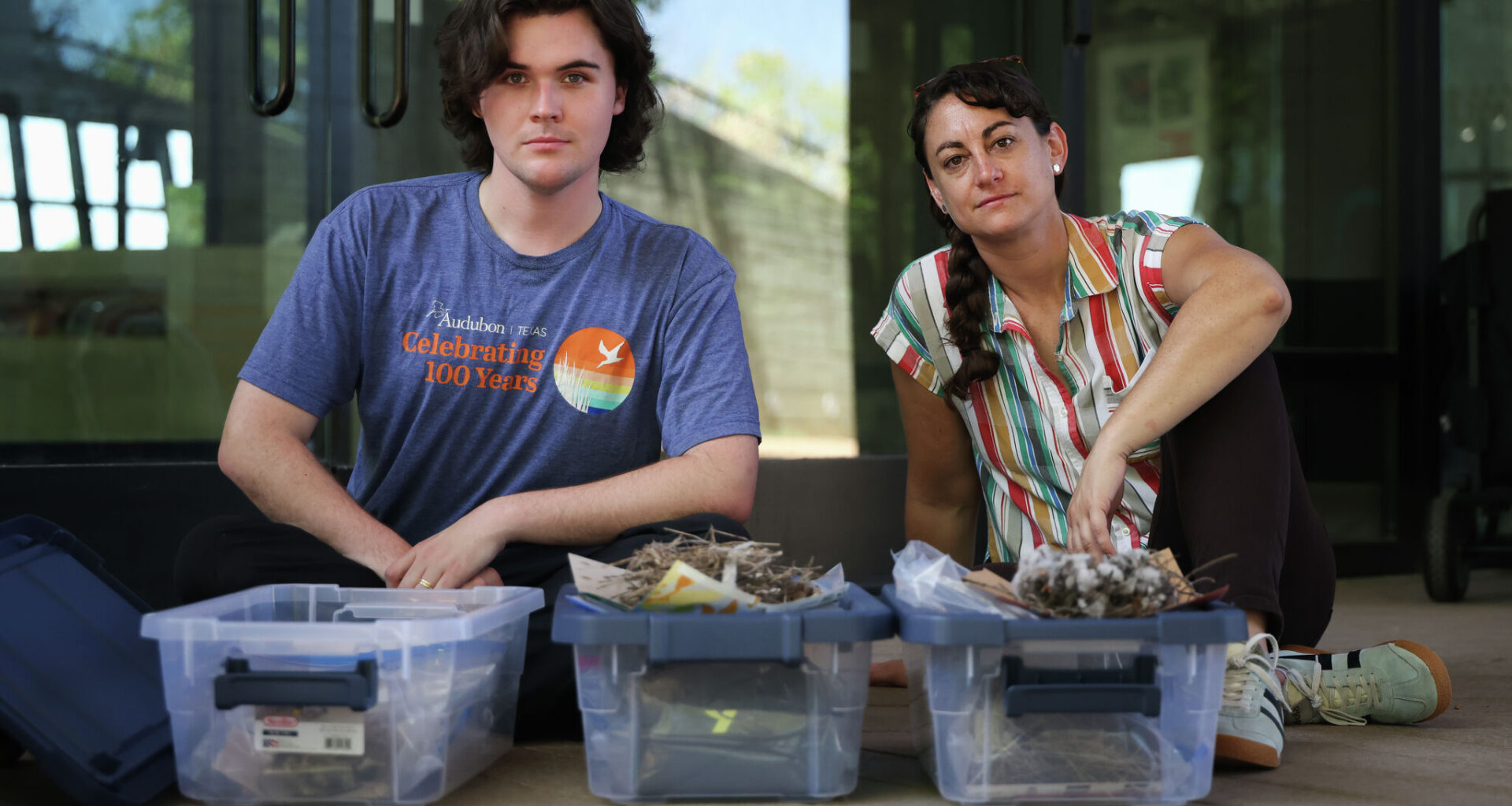
Nathan May (left), an educator at the Trinity River Audubon Center, and Katie Fisher, a lecturer at the University of Texas at Arlington, sit in front of a collection of bird nests entangled with plastic waste on Wednesday, August 19, in Dallas.
Joe Snell/The Dallas Morning News
It looks like an ordinary bird’s nest: twigs, grass, moss and lichen woven tightly together.
Then Nathan May points to a strip of plastic bag threaded through the fibers. Nearby, a fragment of food packaging carries the words “warning: choking hazard.”
Article continues below this ad
The nest, likely built by a white-eyed vireo, was found near a trail at the Trinity River Audubon Center, a 100-acre nature preserve in southern Dallas. It was low enough for children to see and close enough to the Trinity River to glimpse traces of the city around it.

Researchers are tracking how birds incorporate humans’ trash into their nests across North Texas. The project is still in its early stages, but when completed, the details will be shared with Texas Parks and Wildlife.
Joe Snell, The Dallas Morning News
Researchers are tracking how birds incorporate humans’ trash into their nests across North Texas. The project is still in its early stages, but when completed, the details will be shared with Texas Parks and Wildlife.
May, an educator at the Audubon Center, and Katie Fisher, a lecturer in visual communication design at the University of Texas at Arlington, don’t yet know how widespread the behavior is or what effects the materials may have.
Related: To save more birds, Kay Bailey Hutchison Convention Center will adopt special glass
Article continues below this ad
The nests offer a visible record of how discarded plastic can move through the environment — how shopping bags and food wrappers end up in waterways, trees and wildlife habitats.
They aren’t evidence of one person’s carelessness but of a much larger plastic ecosystem starting with how products are packaged to what happens when they are discarded.
National researchers have also documented birds weaving plastic into nests, where it can pose risks such as entanglement or exposure to harmful materials, according to a review by Beyond Plastics.
A nest becomes evidence
Fisher was hiking with her family last year when she noticed that a plastic bag had not simply landed on a nest. The bird had woven it into the structure.
Article continues below this ad
The nest made her think about the plastic bags she uses to carry her groceries home and where those bags go after people are finished with them.
Since last October, Fisher and her collaborators have collected more than 15 nests across North Texas containing plastic or other human-made materials. The collection is too small to show how common the behavior is, but Fisher sees it as the beginning of a larger archive.
A bird nest entangled with plastic waste at the Trinity River Audubon Center on Wednesday, August 19, in Dallas.
Joe Snell/The Dallas Morning News
Fisher hopes the project will eventually reveal patterns in the materials birds use, where those materials are found and whether certain types of trash appear more often in nests from different parts of North Texas.
Her students will help document the nests and create data visualizations. The Audubon Center plans to use the findings in an educational exhibit.
Article continues below this ad
Birds offer an accessible way for people to understand environmental changes, May said.
They live in neighborhoods, parks and backyards. People hear them in the morning and see them flying over roads and apartment complexes, even if they never visit a nature preserve.
The Audubon educator spends much of his workday teaching visitors how to spot nests along the trails and identify birds by their calls. Visitors learn how the center’s habitat connects to the larger Trinity River ecosystem.
What the river carries
Pollution doesn’t stop at the boundaries of a nature preserve.
Article continues below this ad
The Audubon Center is protected and maintained, yet the nest still contained plastic and food packaging.
A wrapper dropped on a street, a plastic bag carried by the wind or trash left near a creek can eventually move through storm drains and waterways. Birds may encounter those materials along the river and use them to build their homes.
“Everything ends up somewhere,” May said. “Everything is connected.”
Related: Dallas green sanctuary, Trinity River Audubon Center, has a new director
That connection can be easy to miss in a city. A plastic wrapper may disappear from view after it is tossed into a trash can or blown into a gutter. But it can continue moving long after people stop thinking about it.
Article continues below this ad
The nest offers a way to see that system in a form people can hold and understand.
Nests give researchers a tangible way to study the environment. They can be photographed, examined and compared across locations.
“It sits in the middle,” Fisher said. “It’s tangible. It’s visible.”
From a distance, the nest looks natural. Up close, it carries a record of the world humans have built around it.
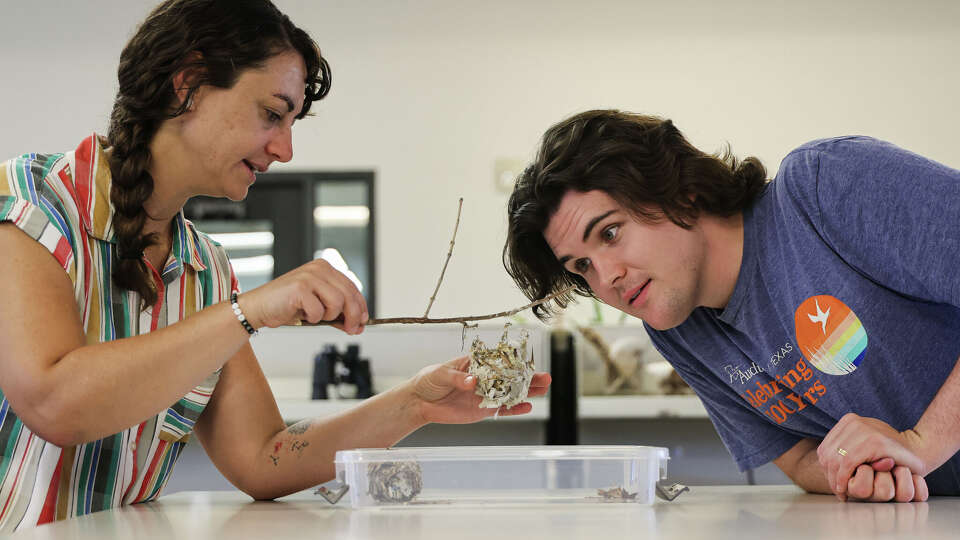
Katie Fisher (left), a lecturer at the University of Texas at Arlington, points out a bird nest entangled with plastic waste to Nathan May, an educator at the Trinity River Audubon Center on Wednesday, August 19, in Dallas.
Joe Snell/The Dallas Morning News