

Tesla says its robotaxi fleet has driven 380,000 unsupervised miles with zero notable incidents.
A passenger filmed one of those robotaxis shove through a row of plastic bollards that have sat on the same Austin curb since 2024.
Both of those things are true at the same time. That’s the drama online.
Critics say the September 3 event is more of a tightly controlled launch for a still-limited service than a sudden jump to mass autonomy. Defenders say the purpose-built, no-wheel Cybercab is the real inflection point after years of software work.
The Gap Between the Video and the Ride
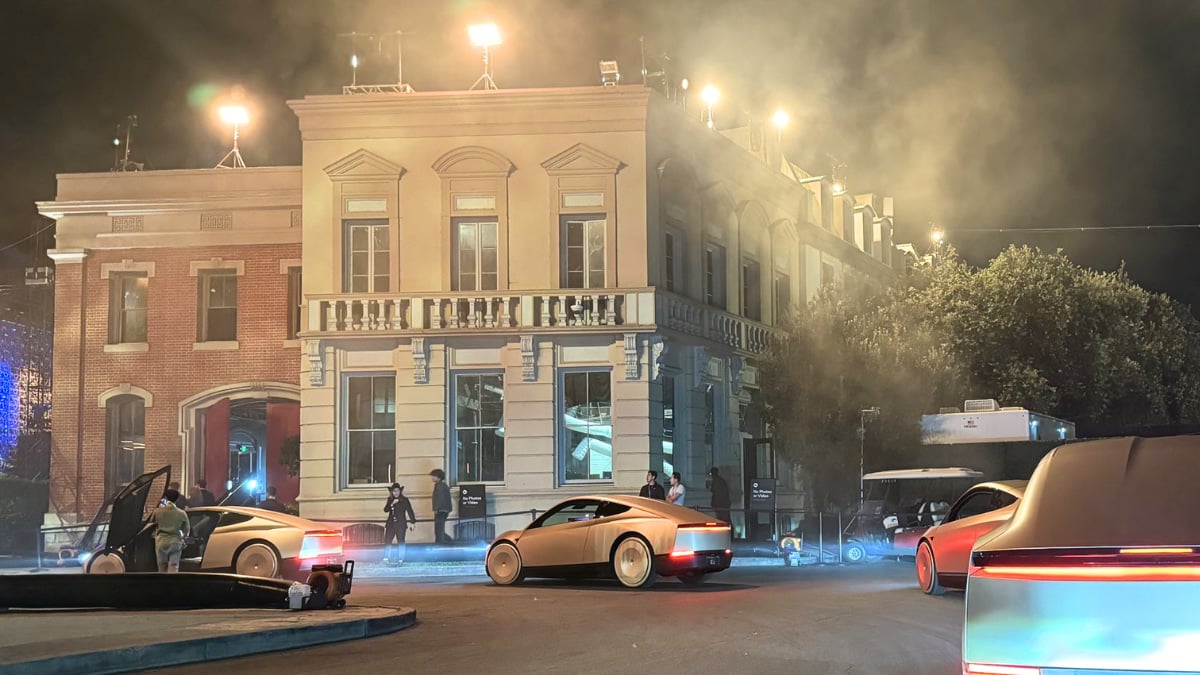
Tesla AI lead Ashok Elluswamy posted video this week of a two-seat, steering-wheel-free Cybercab rolling through Austin. “The streets won’t be the same anymore,” he wrote. Tesla quote-posted it hours later with three words: “Less than a week away.”
The launch event is Thursday, September 3, at Gigafactory Texas. Invite-only. Livestreamed.
What’s actually arriving isn’t a concept car. Production Cybercabs have been rolling off the Giga Texas line since February, joining a Robotaxi app that’s already run unsupervised Model Ys in limited Texas and Florida zones for more than a year.
The hardware is real, but the service underneath it is still small.
“Zero Notable Incidents” Meets a Row of Bollards
On Tesla’s Q2 earnings call, Elluswamy told investors the company had driven “more than 380,000 miles of unsupervised robotaxi… across six cities in two different states” with “zero notable incidents.” He called the record impeccable.
Weeks later, Electrek reported a clip of an unsupervised Model Y creeping into a curb extension, pausing, then pushing through plastic bollards that Street View shows have been there since at least February 2024. “It hit em, it hit em,” the rider says on the tape. No one was hurt. The car kept driving.
Tesla counts a clean mile ledger, but the critics count a car that chose the posts over the open lane.
Riders Are Filing the Complaints Now, Not Just Analysts
Reggie Overton, a self-described Tesla Ambassador, writes on X the Robotaxi app quoted him 66 minutes for a 2.3-mile trip. Support called it a bug. The estimate dropped to 16 minutes, then jumped back to 57. His group got out and called an Uber. Tesla refunded the ride after the post went viral.
A four-time Tesla owner posting as TexasTSLA logged missed pickups (Electrive) and a late-night drop-off three miles from his car because the vehicle’s service window was ending.
These aren’t hypothetical edge cases, but rather paying rides inside Tesla’s own geofence.
More than a year after the Austin launch, the active unsupervised fleet is still sitting in the low dozens, not thousands.
What the Critics Are Actually Arguing
The skeptic case isn’t “the car is fake.” Their voices think September 3 is a tightly controlled launch for a still-limited service bolted onto a service that hasn’t solved routing, scale, or a safety case with real statistical weight.
Advertising
Electrek editor Fred Lambert made the software point ahead of the launch: the Cybercab “is not the bottleneck,” safety and convenience are, and a cheaper two-seater doesn’t fix either one on its own.
“The Cybercab is not the bottleneck. It could improve unit economics slightly, but as Elon himself admitted, safety and convenience remain the bottleneck. Cybercab doesn’t fix that,” he wrote in a June 30th tweet. But almost two months has passed since then and Tesla has probably recorded more improvements.
The sharpest number belongs to Waymo. Its own Safety Impact Hub data through March 2026 shows 220.6 million rider-only miles, fully driverless, no human in the seat, across multiple cities. Tesla’s 380,000 unsupervised miles is real. It’s also less than two-tenths of one percent of Waymo’s published total.
Tesla has also filed 22 automated-driving incident reports with NHTSA since Robotaxi trials began, mostly other drivers hitting stationary Teslas. The filings still exist either way.
A car with no steering wheel draws its own regulatory attention. Some launch invitations reportedly bar content-creator guests. Independent video from inside the room may be thin.
What the Defenders Are Actually Arguing
Supporters aren’t claiming the Model Y fleet is Uber-scale yet. Their argument is that removing the wheel is the point, it forces the software to actually finish.
Photographer ARTSIMAGE, whose Austin clip Tesla amplified (referenced above), called it a “huge mile stone” for the whole Tesla AI team, no steering wheel, no pedals, driving fully autonomously on public roads.
The cost case is the other half. EPA paperwork points to a 48 kWh pack, a single front motor, and roughly 290 to 300 miles of real-world range. Bulls treat that as the first consumer-priced, purpose-built robotaxi a factory can actually stamp out, not a lidar-stacked prototype.
Musk framed the slow ramp on the Q2 call as caution, not failure, warning that injuring even one person would bring “worldwide headline news” and fast regulatory pushback. Defenders read the small fleet size as evidence he means it.
Cole Grinde, an investor tweeting on X, called it the company’s “iPhone moment.”
“It’s like their iPhone moment. The car is cheaper to make, will cost the customer less to take per ride and will come with no steering wheel and pedals. Tesla plans to make millions of these vehicles over time. This is a historic launch for the company,” he wrote in a tweet, on Aug. 18.
Bulls say the Model 3’s mocked-then-scaled arc is starting again here, once Cybercab-specific data catches up to the hardware.
What September 3 Actually Proves, and What It Doesn’t
So, Tesla’s upcoming Cybercab event is real, and the car is real. Production has started, and the gold Cybercab on Austin pavement isn’t a render.
It doesn’t prove unsupervised driving is solved at city scale. It isn’t a nationwide network. On current evidence, it isn’t a jump from two dozen unsupervised cars to thousands.
An important thing to keep in mind: The livestream can announce the hardware, but it can’t manufacture a safety record.
Advertising
Four Things Worth Watching After the Lights Go Down
Don’t treat Thursday as a verdict.
Watch how many Cybercabs a normal rider can actually hail in the app the following week, not how many sit parked on the Giga Texas lot.
Watch whether the routing failures shrink. A 66-minute quote for 2.3 miles isn’t a sensor debate. It’s a product failure.
Watch the mile count and what “notable” actually excludes. Waymo’s 220 million rider-only miles are the public benchmark whether Tesla likes the comparison or not.
Watch the regulatory response. A car no human can drive is a different legal object, and how NHTSA and Texas treat it will outlast any single launch clip.
Both Sides Are Arguing Past the Same Car
Tesla and its defenders are pointing at a factory-built, controls-free robotaxi most rivals haven’t put into consumer-priced production. Critics are pointing at a still-tiny fleet, a thin safety sample, and rider videos that look nothing like “the streets won’t be the same.”
The honest read sits narrower than either side wants. September 3 confirms Tesla built the car it promised and is willing to put it on public roads with nobody in the seat. It doesn’t confirm Tesla has earned the right to scale it the way it scaled the Model 3.
A livestream won’t settle this argument. Paying strangers getting to the right address, in under an hour, without hitting the furniture the city bolted to the curb, will.
Which Number Would Change Your Mind?
Would a visible week-over-week climb in fleet size be enough to convince you Tesla’s unsupervised miles are real progress, or does the 220-million-mile gap with Waymo make the comparison pointless until Tesla closes it?
And if the routing failures like the 66-minute quote keep showing up after September 3, does that matter more to you than the hardware milestone of a car with no wheel at all?
Return tomorrow, or check our Torque News Home Page for more interesting automotive news articles.
Images by Armen Hareyan.
About The Author
Armen Hareyan is the founder and Editor in Chief of Torque News, where he has covered the automotive industry for over 15 years. Now based in the Charlotte region (Indian Land, SC, he founded Torque News in 2010, which since then has been publishing expert news and analysis about the automotive industry. Armen holds three Masters Degrees, including an MBA, and has become one of the known voices in the industry, specializing in the landscape of electric vehicles and real-world stories of actual car owners. Armen focuses on providing readers with transparent, data-backed analysis bridging the gap of complex engineering and car buyer practicality. Armen frequently participates in automotive events throughout the United States, national and local car reveals and personally test-drives new vehicles every week. Armen has also been published as an automotive expert in publications like the Transit Tomorrow, discussing how will autonomous vehicles reshape the supply chain, and emerging technologies in vehicle maintenance.
Read more of Armen’s work on his author profile page.
You can also follow Armen here:
Images by Torque News render (inspired by Phoenix Self-Driving X user) and user Brandon, posted under the embedded X discussion and shared here under the relevant U.S. Copyright Law for news-reporting purpose.
Follow us today…


