
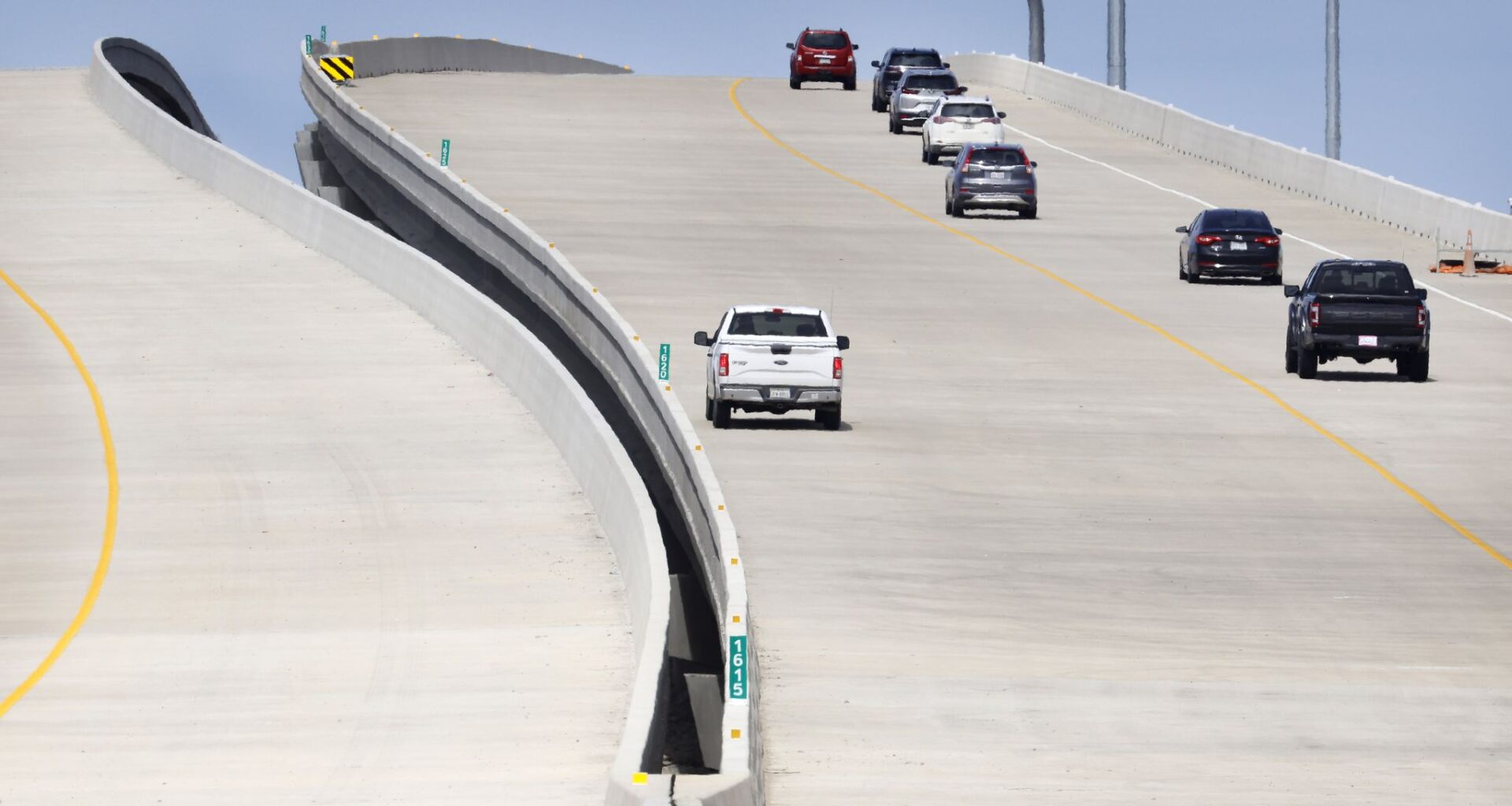
Northbound traffic on the Dallas North Tollway (right) climbs the newly opened bridge over U.S. 380 in Frisco, March 13, 2023. The North Texas Tollway Authority (NTTA) has opened the extension into the Town of Prosper to help meet future traffic demands due to growth and economic development in Collin and Denton counties. Contributor Maggie Parker writes that the line between growth and neglect keeps creeping north.
Tom Fox/Staff Photographer
If southern Oklahoma is the new frontier, then Dallas is the new “southern sector.” The relentless northward urban sprawl should push our thinking about what it means to live in neighborhoods with history and legacy, and how to navigate dynamic shifts in the shape of our communities.
I’ve been thinking about this because of the recent Preston Royal zoning case, which has brought about a lot of conversations around neighborhood density and engagement. If new luxury, high-density development experiences significant opposition on a major thoroughfare within 500 yards of the Dallas North Tollway, then where does new development make sense within the city limits?
At the Aug. 6 City Plan Commission meeting, Commissioner Mike Sims summed up these questions directly: “So I think the question really before this commission right now is what does that stretch look like 20, 30 years in the future? And I think, from perspective, we cannot out-suburb the suburbs, right? We do not have the land.” He also said, “We do not have the space to put in more single-family homes on cul-de-sacs with strip centers nearby.”
Article continues below this ad
As an Oak Cliff resident, I have to note that while north Dallas may not have the space anymore, southern Dallas still does. Developers with aligned interests, you’re welcome to come develop with us.
State Sen. Royce West speaks at a ceremony celebrating infrastructure improvements for a planned mixed-use development in University Hills, Dallas, Thursday, Aug. 13, 2026. The southern half of the city has lots of open land for development, Parker writes.
Angela Piazza/The Dallas Morning News
But in north Dallas, Sims is right. The line of demarcation between north and south, between large lots and high density, between affluent and underinvested is changing rapidly.
Darrell Herbert, vice chair of the City Plan Commission, captured this sentiment well. “I’m from the southern sector, the city, our fight is much different than your fight … But my fear is that the southern sector is now becoming south of 635. The northern suburbs are taking over. They’re taking our incomes, they’re taking our dollars, they’re taking our jobs. They’re taking our children, right? Think about that as you oppose developments in your neighborhoods.”
Even more directly, “Preston Hollow is no longer a suburb. You are the city of Dallas. You may not look at yourself like that, but the entire city looks at you as ours, as us, and not a suburbial lifestyle,” he said.
Article continues below this ad
A generated rendering of a proposed $800M mixed-use development at the southwest corner of Preston Road and Royal Lane. Some neighbors oppose the plan, but if greater density doesn’t belong at a major intersection like that, it doesn’t belong anywhere, Parker writes.
Courtesy of GFF
Times have changed. It’s no longer north Dallas versus southern Dallas. It’s the city of Dallas versus southern Oklahoma. The demarcation line of investment and growth continues to be pushed north, and increased density in Preston Hollow is now a sign of the need for development to keep Dallas competitive.
We shouldn’t miss the irony in this conversation, though, not just for Dallas but for the region. Preston Hollow, like many other Dallas neighborhoods, was once a northern suburb developed in the 1930s for affluent homeowners seeking to escape the city. Northwest Highway was yesterday’s LBJ Freeway, today’s George Bush Turnpike and Sam Rayburn Tollway and tomorrow’s State Highway 380. The growth keeps getting pushed north.
This isn’t just a Dallas problem. We are seeing this in inner-ring suburbs too. Irving is a good example. At one time, most of Irving’s residents lived south of Highway 183. Then came Las Colinas, a 7,000-acre master-planned district, built in the 1960s. In the next 20 years, Irving continued to grow north, expanding Las Colinas and moving into Valley Ranch. The north-south divide used to be Highway 183; now it’s Highway 114, or maybe LBJ.
In fact, over 15 years ago The Dallas Morning News reported: “The school district encompasses south Irving and does not include the more affluent areas of Las Colinas and Valley Ranch to the north. At the end of June [2010], about 80 percent of students in Irving schools were in poor families — close to Dallas ISD’s 87 percent as of last fall. Twenty years ago, just 30 percent of Irving children were in low-income families.” The data shows the direct and ongoing shift.
Article continues below this ad
Neither Irving nor Dallas invented this pattern. Rather, it’s a matter of time and money that every current and prior suburb experiences this shift.
New is only new for 20 to 30 years. Preston Hollow and Irving were once the new frontiers. The question isn’t where the line moves again, it’s whether Dallas keeps pretending the line is fixed. At some point, it won’t be southern Dallas versus north Dallas or Dallas County versus Collin County. We’ll be competing across state lines, deep in the heart of … Oklahoma.
Maggie Parker is founder and managing partner of Innovan Neighborhoods.
Have thoughts about this? Send a letter to the editor using our letters form or email letters@dallasnews.com. Letters should be no more than 200 words and include the first and last name of the writer and city of residence.