
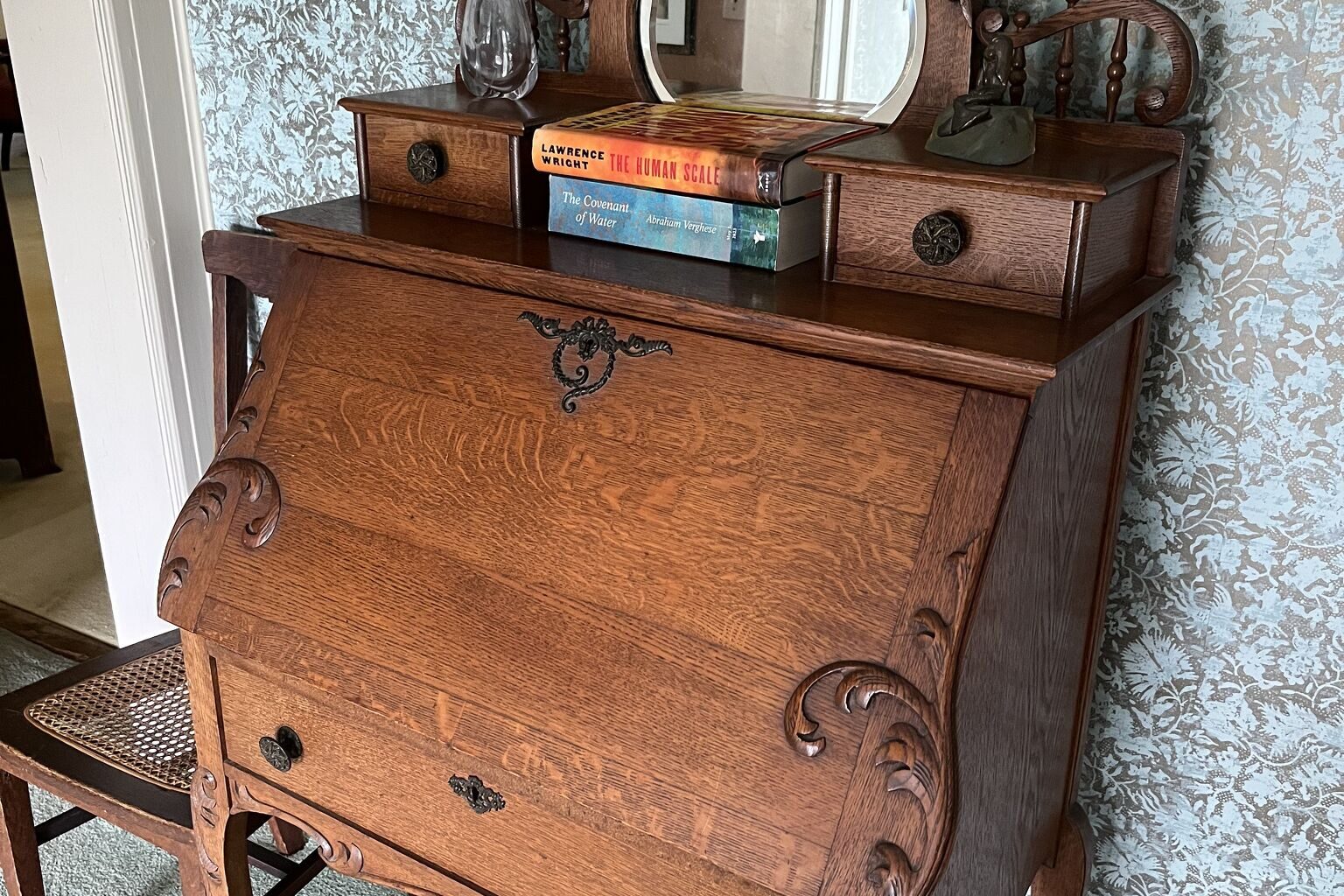
The desk first owned by F.W. McAllister, bought at Stowers Furniture while it was still on Commerce Street. Judging from the price, it probably was one of the store’s higher-end pieces.
Courtesy Taddy McAllister
A handwritten inscription from F.W. McAllister, hidden for more than a century, records a desk as a gift from his wife Lena in 1894. It was bought at Stowers Furniture; McAllister may have known the owner from his work with the Retail Merchants Association.
Courtesy Taddy McAllister
The post office and federal building on Alamo Plaza was completed in 1937. It was built on the site of the 1907 Elks Club building, first in San Antonio to be built of reinforced concrete and demolished in 1932 to make way for its replacement.
UTSA Special Collections
The Clower (later Stowers) Building is shown here under construction circa 1909. When it was completed early the next year, it was the tallest building in San Antonio. It housed the Clower Installment Co. store until 1912, when Stowers Furniture moved in. The building was imploded in 1982.
Courtesy Maria Watson Pfeiffer
Shown here in 1910 on an islet in the Guadalupe River, Willard Simpson acted as structural engineer for the Elks Club, built in 1907. Just out of college, Simpson introduced reinforced concrete to San Antonio, combining flint rock and granite with plaster.
UTSA Special Collections

Columns about Clower’s and Stowers Furniture stores (Aug. 15) and a mention of the Stowers Ranch (same original owner, George A. Stowers) that became part of Shavano Park (Aug. 22) both brought back reader memories that include a husband’s sweet souvenir, downtown demolition, a wartime favor for a country singer and a legendary racehorse.
Article continues below this ad
“After reading your column about the Clowers and the Stowers,” wrote Taddy McAllister, “I couldn’t resist sending you this picture.”
Following the 2018 death of her mother, civic leader Edith McAllister, “I was cleaning things out. Mother had a little desk in the hall, and when I pulled out one of the drawers to dump some pencil stubs and stuff into the wastebasket, there on the bottom of the drawer was this writing.”
The handwritten note reads, “Bought Dec. 13, 1894 from Stowers Furniture Co. My Christmas present from my better half – F.W. McAllister, San Antonio, Tex. 322 S. Flores Street.” Also recorded: “This desk cost $16.50.”
That was about three years after George A. Stowers started his store here. Judging from the price, this was probably a very nice desk. In 1894, according to Stowers’ newspaper advertisements, you could buy an antique bedroom chair for 59 cents, a dining-room chair for a dollar and a solid-oak wardrobe for $10.
Article continues below this ad
Frank William McAllister (1856-1907) was a grocer, insurance agent and manager of the local Retail Merchants Association. He and his wife Lena – the “better half” of the inscription – were the parents of Walter W. McAllister Sr., known as “Mayor Mac” during his five terms (1961-1971) as mayor of San Antonio.
Quotes from a “longtime friend” in F.W. McAllister’s obituary in the San Antonio Light, Oct. 3, 1907, praise “his courteous, gentle manners (and) pleasant personality.” McAllister also was said to be “in touch with the chief business interests of the city and did all in his power to influence their growth and importance.”
At the time of the desk purchase, Stowers Furniture was on Commerce Street – the premises that preceded the company’s early 20th-century high rise.
RELATED: Clower’s/Stowers furniture Aug. 15
Article continues below this ad
Local historian Maria Watson Pfeiffer sent a photograph of the Stowers Building (covered here Aug. 15) and noted that the building, constructed from 1909 to 1910, was “as far as I can determine, San Antonio’s first reinforced concrete frame building.”
The Clower (later Stowers) Building, was declared “the highest building in San Antonio and one of the highest in the South” in the San Antonio Light and Gazette, June 5, 1910. A local “skyscraper” at 10 stories, “not including the basement and roof garden,” it was built for the Clower Installment Co. That credit-friendly store was Stowers Furniture’s alter ego; the building was renamed for the parent company in 1912.
During the construction period (May 1909-January 1910), the Clower was in a race toward completion with one of the other skyscrapers of the era, the Gunter Hotel, says the Light, Aug. 1, 1909. Both missed their projected Oct. 15, 1909, completion dates. The latter, with its mere eight stories, won in November 1909, but the furniture tower always got a lot of attention.
At the northwest corner of Houston Street and Main Avenue, the Clower was “of steel and brick construction, thoroughly modern and fireproof,” says the Light, March 14, 1909. A detailed statistical summary in the Light’s June 5, 1910, story, says it was made of 100 tons of steel and iron, 80,000 pressed or enameled bricks and 500,000 common brick. Several other notable contemporaneous buildings are covered, but none of their descriptions mentions reinforced concrete.
Article continues below this ad
That distinction for 1909-1910 goes to a two-story garage “on East Crockett Street between Navarro and Losoya, erected of reinforced concrete … the walls being molded flat and then raised,” says the Light, Dec. 26, 1909. As such, the new space “for the repairing and assembling of automobiles” – then commonly shipped knocked down in crates – was heralded as the “first building of its kind in the South.”
Most likely, the first tall, reinforced concrete building in San Antonio was built even earlier. With the Clower Building photo, Pfeiffer mentioned another major downtown teardown, “of the old Elks Club Building at the corner of Travis Park.”
Built in 1907, the Elks Club on Avenue E was “the first and toughest reinforced concrete building in Texas,” says the San Antonio Express, May 22, 1932. With six stories, plus a basement pool and a roof garden, it was “known to veteran builders for the distinction it gained for itself and San Antonio and for the progressive step it achieved in structural engineering.”
It was the first project planned by Willard Simpson (structural engineer for the Tower Life Building), right after he graduated from Massachusetts Institute of Technology or MIT. “America had had her start of the reinforced concrete age in 1900,” said the Express, “but the development did not reach San Antonio until work was started on the Elks project.”
Article continues below this ad
Made with a mixture of flint rock and granite, Simpson told the Express, “a denser mixture of concrete has never been poured in the state.” It took “10 weeks of steady pounding away by wreckers to budge the dense concrete, dulling their (equipment) with almost every blow.”
RELATED: Shavano Park included former Stowers Ranch Aug. 22
By the time it was razed, it was already “the old Elks Club building,” because the Elks had moved out in 1920 and relocated to the former Travis Club building on St. Mary’s Street. Since then, it had housed an Army service club operated by the YMCA. This sturdy space made way for a new post office and federal building completed in 1937, now the Hipolito F. Garcia Federal Building.
The old Elks cornerstone was removed and placed in the Elks lodge “as a monument to the progress of the fraternity.”
Article continues below this ad
By contrast, the Stowers Building – empty after the furniture store’s suburban move – was imploded without much fuss in 1982, having been sacrificed in a deal between the San Antonio Conservation Society and Frost Bank. According to Lewis F. Fisher in “Saving San Antonio: The Preservation of a Heritage,” the Society “agreed not to oppose Frost Bank’s demolition of the Stowers Building” in exchange for a purchase option that ultimately saved the Rand Building, another early skyscraper built in 1913 with eight stories to house the Wolff & Marx department store.
The demolition of the Stowers Building “was over in a matter of seconds,” says the Light, Feb. 8, 1982. “There were 12 distinct explosions, the walls started to crumble, a roar of delight went up from the crowd and the 10-story building … was nothing but a 20-foot-high pile of rubble and dust.”
An office building was constructed on its site.
Thanks to Beth Standifird, research librarian of the San Antonio Conservation Society Foundation, for her help with Clower Building background.
Article continues below this ad
Next week: Guitar legend; country roads
historycolumn@yahoo.com | X (formerly Twitter): @sahistorycolumn | Facebook: SanAntoniohistorycolumn