
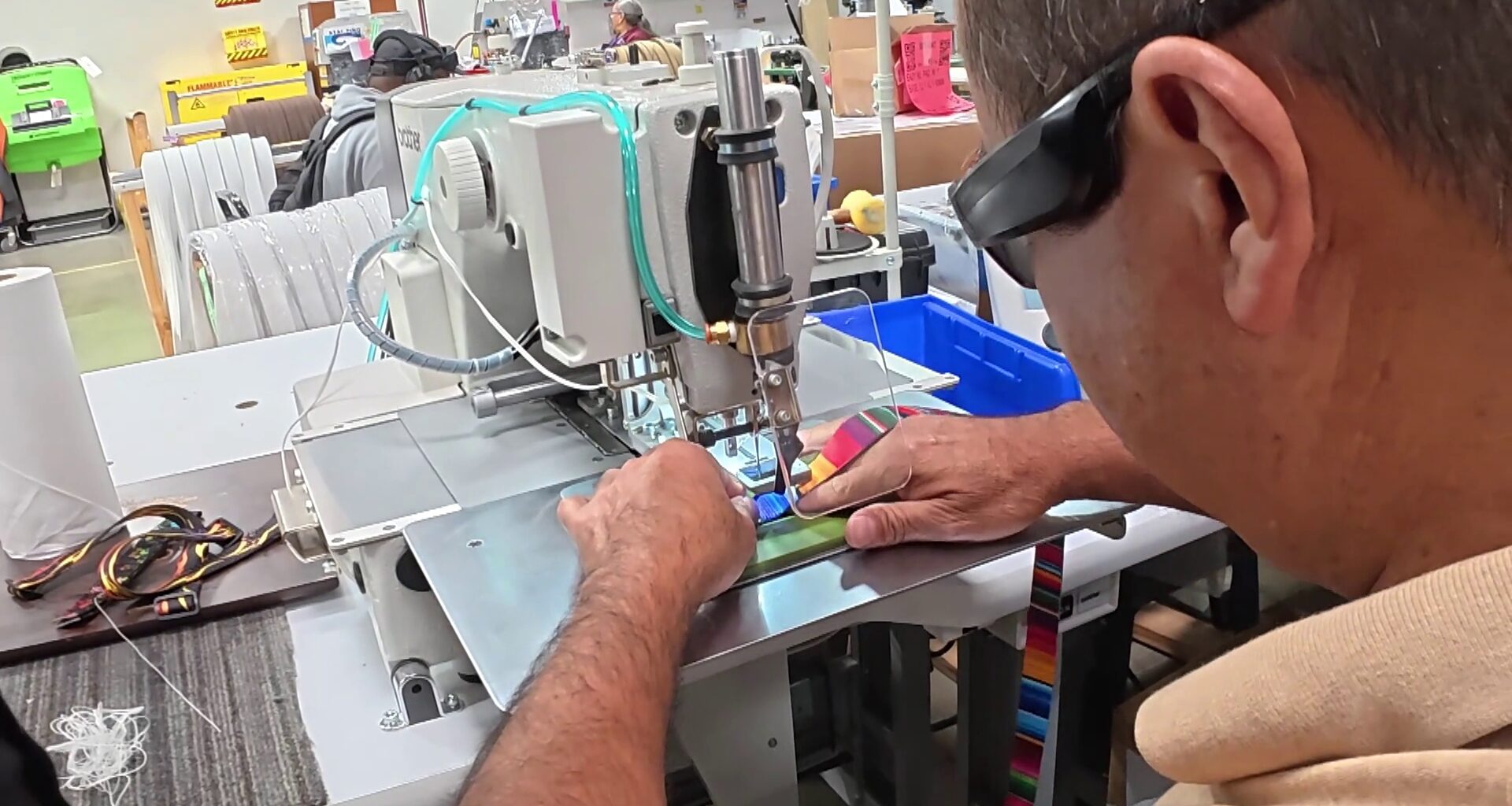
At Austin Lighthouse for the Blind, blind and low-vision employees manufacture products, fostering careers and independence, and contributing to the local economy.
AUSTIN, Texas — A southeast Austin warehouse is helping blind and low-vision employees build careers and financial independence while manufacturing products sold across the country.
At the Austin Lighthouse for the Blind, it takes hundreds of hands to make everything from belts and military accessories to soap products and, more recently, dog collars.

This story continues below.
For employee Andres Briones, the work has helped him build a life he once may not have imagined.
Briones was diagnosed with retinitis pigmentosa when he was 16. He’s been working at the Austin Lighthouse since 2008.
“I am blind, but I can do anything,” Briones said.
He said his job has allowed him to fully build and pay off his home.
“This kind of company, they made me be more strong,” Briones said.
The Austin Lighthouse employs about 400 people and roughly half are legally blind. Employees work inside a 300,000-square-foot facility where they manufacture a variety of products. The operation produces roughly 1,000 to 1,500 cases of Purell and Gojo soap each day, along with belts, military accessories and other products.
The facility recently added Blindspot Pets dog collars to its lineup. The collars are being sold at local artisan shops and fairs.
CEO Jim Meehan said the operation is a commercial business, not one dependent on government contracts.
“So, it’s really a commercial thing. There’s no government business in here,” Meehan said.
For Meehan, the products also demonstrate what blind and low-vision employees can accomplish when they’re given the opportunity.
“We as a society think that blind people can’t, they can’t do stuff because they can’t see,” Meehan said.
He said employees who come to the Austin Lighthouse receive training, learn new skills and gain confidence.
Because about half of the workforce is blind or low-vision, the facility is designed with accessibility and safety in mind. Braille is used on signs throughout the workplace, and additional safety measures are in place around machinery and equipment.
Briones pointed to the sewing machines as one example.
“If you go to the sewing machine, you’re going to see a lot of plastics around it,” he said.
Meehan said employing people who are blind or low-vision can also have an economic impact beyond the workplace.
“You’ve got to have a job,” Meehan said. “Now, all of a sudden, you’re not on public assistance, you’re not a tax consumer; now you’re a taxpayer.”
The goal, he said, is to help employees become financially independent while contributing to the broader Texas economy.
For Briones, that opportunity has already made a difference.
The Austin Lighthouse for the Blind continues to provide jobs and training for blind and low-vision workers in Central Texas, helping employees build greater independence through work.