
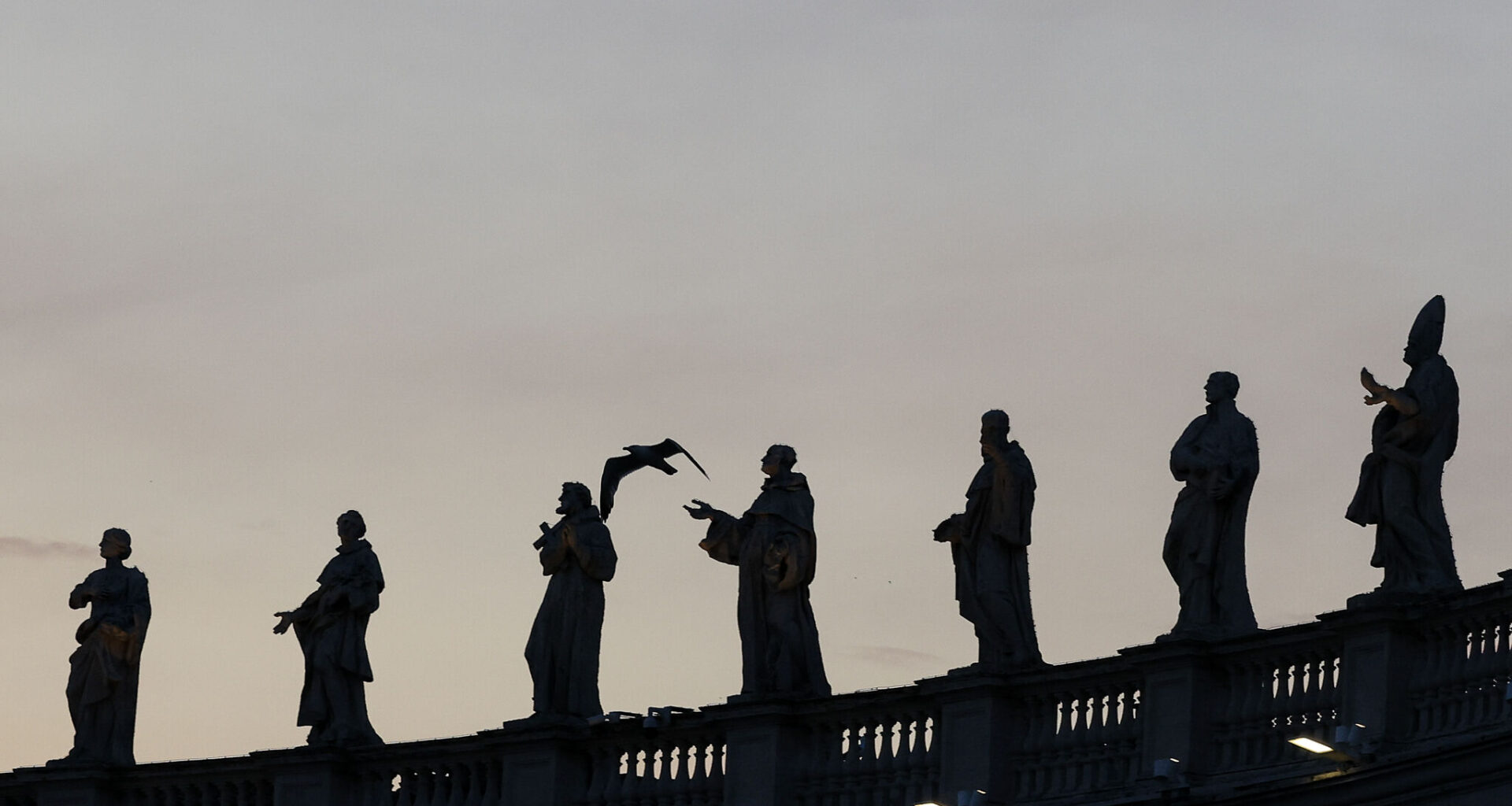
A silhouette of a seagull flies past the statues of the colonnade of St. Peter’s Square in Vatican City.
Anadolu/Anadolu via Getty Images
Months after the Vatican formally declared the Society of St. Pius X, or SSPX, to be in schism with the Catholic Church, one San Antonio parish has been left at a crossroads.

The Vatican’s declaration has echoed far beyond the hallowed hallways of St. Peter’s Basilica and into San Antonio’s St. Joseph’s Roman Catholic Chapel, where the traditionalist group’s only local chapel has long occupied a tenuous place within the archdiocese.
Article continues below this ad
During a Wednesday afternoon devotion, the chapel’s small parking lot was peppered with a handful of vehicles — some bearing bumper-sticker messages like “Patriot” and “Texans for Vaccine Choice.” Despite the church’s size, the chants emanating from behind its heavily bolted double doors cut through the buzzing summer cicadas and passing traffic.
After the devotional concluded, several smiling faces emerged from the chapel: older women with long dark clothes and lace mantillas draped over graying hair; older men in casual jeans and polos that quickly became sweat-drenched under the broiling South Texas sun. Some women leaned sideways to clasp the hands of small children as they toddled along the walkway. Others only held Bibles in their hands while talking with friends in fellowship.
What are your thoughts on the Vatican declaring the Society of St. Pius X schismatic?
When asked if they’d be open to comment on the Vatican’s recent announcement, each parishioner remained silent before turning away. Eventually, one parishioner came forward and said, “We just don’t want to say anything wrong.”
Article continues below this ad
For these San Antonio Catholics, the declaration has tangible consequences. In a July 2 statement, Archbishop Gustavo García-Siller instructed Catholics in the Archdiocese of San Antonio to stop attending Mass at St. Joseph’s Church.
He also revoked permissions previously granted to SSPX priests to officiate marriages and urged the faithful to refrain from financially supporting the society — including its ongoing campaign to build a new church in Schertz.
Days later, however, the grave tone García-Siller conveyed hung heavy inside St. Joseph’s Church.
“What did we do wrong?” the Rev. Stephen Zigrang asked parishioners during a July 5 homily before adding, “It’s a free country, right? You can come to Mass. All are welcome.” In a later homily, Zigrang told parishioners “the excommunication does not apply,” based on the belief that the bishops were consecrated out of necessity “to continue the work of the society.”
Article continues below this ad
The conflicting messages highlight a long-simmering dispute that has reached a boiling point for many Catholic traditionalists. While the Vatican says the unauthorized episcopal ordinations severed the Society’s communion with Rome, SSPX leaders maintain they have not changed their beliefs or practices — and argue they are simply continuing to preserve Catholic tradition.
In a July 20 sermon, Zigrang read aloud a statement from SSPX Superior General Davide Pagliarani, who denounced the Vatican’s declaration.
“This condemnation, wholly unjust, represents an immense humiliation for people who have no other aim than to defend the true Faith and to work for the salvation of souls,” the statement read. “Ultimately, it is Tradition itself, which we cherish above all else, that is excommunicated in all those who embody it. It is evident that, before God, such a condemnation cannot be valid, for it would condemn what lies at the very heart of the life of the Church.”
Why was the Society of St. Pius X formed?
Jason King, a Catholic ethicist and theologian at St. Vincent College, said the conflict is often misunderstood as a debate over the Traditional Latin Mass.
Article continues below this ad
In the 1960s, Catholic bishops and other delegates gathered for the Second Vatican Council. It would lead to one of the most significant updates the Catholic Church has seen in modern times.
Before the Second Vatican Council, King said the Church’s prevailing mindset was “‘You’re either in the church and saved, or you’re outside the church and you’re going to hell.’ And pretty much all other religions, all other Christians and most of modern society was in that ‘going to hell’ basket.”
The Second Vatican Council deliberately softened that framework, adopting a more open position toward other Christian denominations, religions and engagement with modern society. And while the Church maintained the stance that it possessed the “fullness” of Christian truth, it acknowledged that other Christian denominations contained pieces of it.
“Vatican II discerned there’s some good stuff in the modern world,” King said. “There are places of divergence, but because you have those overlapping similarities, there’s good things in other religions, good things in other Christians.”
Article continues below this ad
According to King, that didn’t sit well with Archbishop Marcel Lefebvre, who viewed the Catholic Church’s reforms as a dangerous departure from traditional Catholic teachings. “When that position took over at the Second Vatican Council, Lefebvre was like, ‘That’s dangerous. We have the truth. We’re the right way. You’re leading people astray by saying there’s good things outside (the church).’”
In response, Lefebvre founded the Society of St. Pius X in 1970 and consecrated four bishops in June 1988 — a move that also led to the Holy See’s first condemnation of the society.
“That created an immense tension at that point,” King said, although there was “significant overlap in basic doctrines.”
What led to the Society’s excommunication?
Those differences simmered for decades as successive popes sought to reconcile the Society with Rome. King said the Vatican repeatedly attempted to accommodate and engage with the Society before the conflict reached a boiling point, with the Vatican concluding that the latest unauthorized bishop consecrations represented a definitive break in Church unity.
Article continues below this ad
The Vatican decided it couldn’t hold on to a “false unity,” King said. He argued that the conflict is not over the older form of the liturgy itself, but over communion with the Catholic Church after the Second Vatican Council.
Zigrang, however, portrayed the Vatican’s announcement as the latest chapter in a long-simmering dispute rather than a decisive separation.
“Archbishop Lefebvre consecrated the four bishops, and we were out of the church, OK? We’re not Catholic. Pope Benedict came. You’re OK now. Pope Francis came. You’re kind of OK. Pope Leo? You’re not OK anymore,” he told parishioners, referring to the Society’s changing relationship with recent pontiffs before asking, “What did we do different?”
He also sought to reassure congregants that neither they nor Society clergy had been excommunicated and encouraged them to remain steadfast despite criticism from friends and relatives.
Article continues below this ad
“The problem is, of course, family, friends … they’ll look at us crooked,” he said. “But just smile, right? Say, ‘We like the old Mass.'”
King said those differing interpretations reflect the heart of the dispute.
From the Vatican’s perspective, the unauthorized consecration of bishops without papal approval represents a rejection of the pope’s authority and the unity of the Catholic Church. From the Society’s perspective, preserving what it sees as authentic Catholic tradition justified the extraordinary action.
Whether those positions can eventually be reconciled remains uncertain. For now, however, Zigrang told parishioners to “Continue as we’ve been doing … no matter what.”
Article continues below this ad
King said the Vatican’s position now appears settled, although the Holy See has laid out a path for the Society to return to Catholic communion.
“The Catholic Church still engages in dialogue with other Christian religions. There may be some eschatological hope that they’ll come together. But I think (the Catholic Church is) trying to build relationships, understanding and collaboration down the road.”
The remaining question, King said, is whether the Society of St. Pius X will ultimately seek renewed communion with Rome, or if it will continue further down a path of separation.
“At some point,” he said, “SSPX will have to make a decision about how far along this road they’re going to go.”
Article continues below this ad
Since the Vatican declared the Society of St. Pius X schismatic, Zigrang has departed St. Joseph’s Church to serve as a resident priest at Queen of Angels Priory in Dickinson, Texas. Zigrang addressed the congregation one last time before leaving San Antonio for his new post.
“Why do we need the church to go to heaven? … Of course, our chances for heaven are much better if we remain secure in the arms of the Catholic Church, despite the recent disasters.”
Neither Zigrang nor representatives for St. Joseph’s responded to the Express-News’ requests for comment. The Express-News also reached out to the Archdiocese of San Antonio, led by Archbishop Gustavo García-Siller, which pointed the publication to earlier statements.
Article continues below this ad