
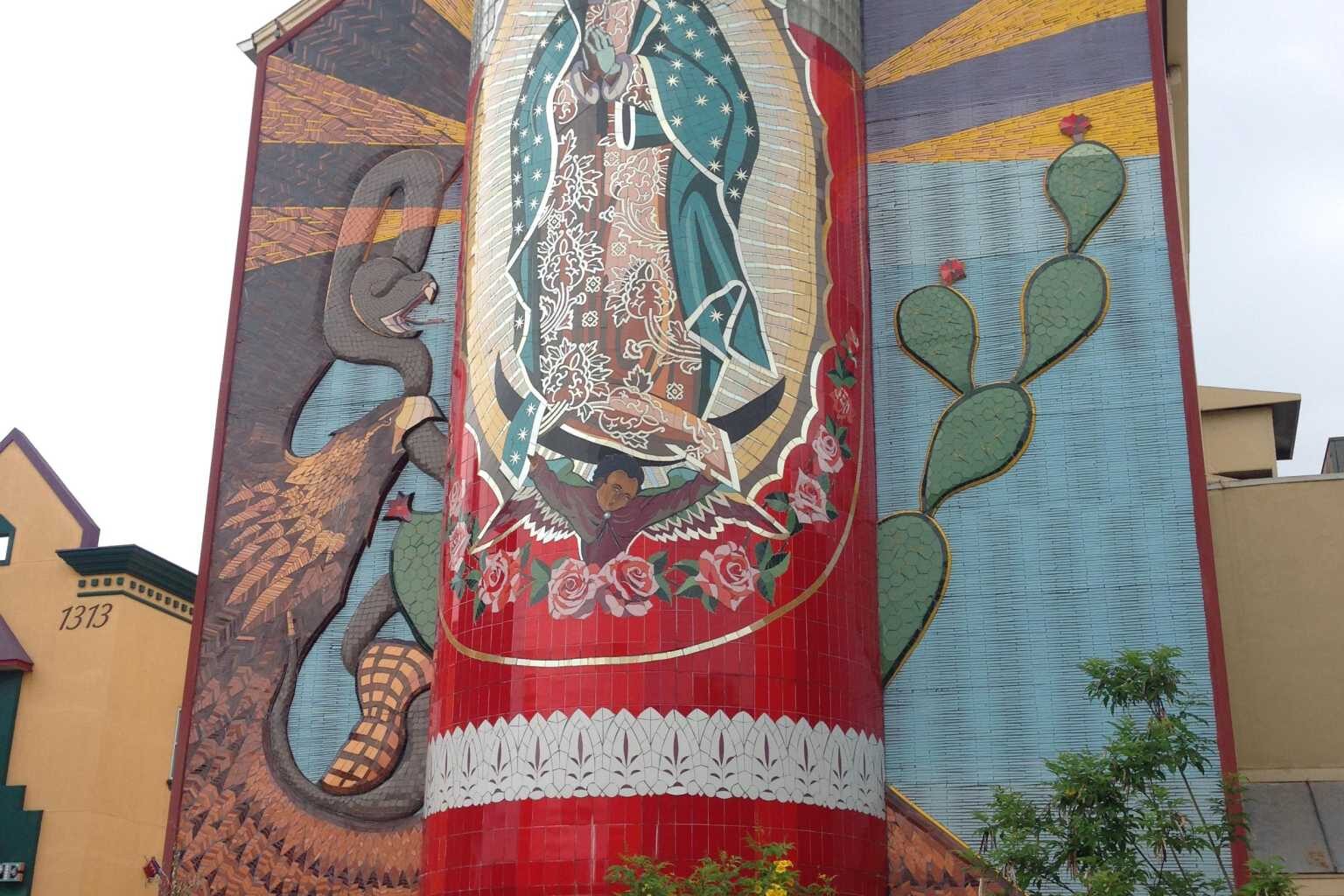
“La Veladora of Our Lady of Guadalupe” is a towering three-dimensional mosaic tile mural that has adorned San Antonio’s West Side for over 20 years.
Greg Morago / Greg Morago
San Antonio artist Jesse Treviño works on “La Veladora” in a West Side warehouse in 2003.
BOB OWEN/SAN ANTONIO EXPRESS-NEWS
A cyclist stops to take a photo of “La Veladora” outside the Guadalupe Theater in this undated staff file photo.
Kin Man Hui /San Antonio Express-News
Benedict John Garza eats his lunch as he visits “La Veladora” in 2023. Those who live and work near the mural say it’s common for locals and residents to visit it, where they pray, reflect and take photos.
Billy Calzada / Staff photographer
Late artist Jesse Treviño, shown in his studio in 2017, said he created “La Veladora” to help draw visitors to his beloved West Side.
Alma E. Hernandez / For the San Antonio Express-News
Artist Jesse Treviño’s towering three-dimensional mosaic tile candle has adorned San Antonio’s West Side for over 20 years.

Created as a traditional rendering of La Virgen de Guadalupe, the 20-by-40-foot “La Veladora of Our Lady of Guadalupe” is one of the city’s best-known pieces of public art.
Article continues below this ad
Erected on the side of the historic Guadalupe Theater and facing the vibrant Guadalupe Street corridor, “La Veladora” was intended to be a cultural representation of the predominantly Mexican American neighborhood surrounding it.
“When you talk about culture, I think about the Virgen de Guadalupe,” Treviño told the San Antonio Express-News on the eve of his work’s highly anticipated 2003 unveiling. “I remember seeing my mom lighting up a candle, my friends lighting up a candle to the Virgen de Guadalupe.”
ALSO READ: Dolly Parton’s impact in San Antonio went beyond music
Cristina Ballí, executive director of the Guadalupe Cultural Arts Center, which oversees the Guadalupe Theater and has served as a steward of “La Veladora,” regards the mosaic tile mural as one of the city’s most recognizable landmarks.
Article continues below this ad
“I like to say the ‘Veladora’ is the other major icon of San Antonio — the other being the Alamo,” she said.
The iconic artwork, its years-long creation and its legacy as a West Side landmark are explored in this week’s San Antonio Explained.
Its creation
Jesse Treviño, an internationally celebrated San Antonio-based artist known for his photorealist paintings and large-scale murals, worked on “La Veladora” for two years.
Article continues below this ad
Setting up shop inside a West Side warehouse, Treviño and his assistants assembled the mosaic tiles bit by bit “like a jigsaw puzzle,” as one newspaper article described it.
“La Veladora” depicts the Virgen de Guadalupe with her hands in prayer and clothed in a blue robe sprinkled with stars on a three-dimensional mosaic tile candle formed by a half-cylinder affixed to the wall. The candle is flanked by an eagle holding a writhing snake in its beak on one side and a cactus studded with spines on the other.
The word veladora means religious candle, and many Catholics light veladoras in prayer. According to Catholic belief, the Virgen de Guadalupe appeared to Juan Diego, an indigenous convert, in Mexico on Dec. 12, 1531. That date is celebrated as her feast day.
A native of Mexico who grew up on San Antonio’s West Side, Treviño came up with the idea for “La Veladora” after passing by the Guadalupe Theater and seeing the empty space outside it. “How it was almost screaming out for something,” Treviño said in February 2001, shortly after the Guadalupe announced plans for the project.
Article continues below this ad
ALSO READ: San Antonio Explained: How racing the Puffy Taco became a local tradition
“There’s a need for some form of art that speaks out, that says something about the community,” Treviño said at the time.
Funds to help pay for the estimated $300,000 to create “La Veladora” came from various means, including corporate donors and grants. To help spur donations, limited-edition prints of the mural signed by Treviño were given to individuals who donated a minimum $1,000, newspaper archives show.
“La Veladora” was unveiled Dec. 12, 2003, in a celebration that included live performances of original music composed for the event.
Article continues below this ad
Its meaning
Visitors to “La Veladora” pray, reflect and capture special moments at the iconic artwork.
“People have their daughter’s quinceañera portraits taken there, couples take wedding photos in front of it, and people simply come because they want to be photographed with it,” Ballí said.
It’s also been a site for devotion, with visitors leaving photos, religious medals, candles and other offerings in prayer.
Article continues below this ad
“I think that’s part of what makes La Veladora so powerful. It is a work of public art, but it is also part of people’s faith and traditions,” Ballí said.
ALSO READ: How San Antonio arcades keep classic gaming culture alive
Its impact
While he was working on “La Veladora,” Treviño said he believed the mural had the potential to draw people from all over the city to the West Side.
Article continues below this ad
“What I see as happening here is that eventually people would cross the (Commerce Street) bridge from downtown to the West Side, which very few people actually do,” he told the Express-News. “This would sort of tear down the wall, eliminate the bridge.”
“La Veladora” is among the most acclaimed works by Treviño, who died in 2023.
READ MORE: Before the medals and merch, Jesse Treviño gave Fiesta its first iconic poster
The towering artwork is expected to get a touch-up as part of a planned $18.5 million renovation of the Guadalupe Theater. Renovations on “La Veladroa” are part of a “larger vision behind the Guadalupe Cultural Arts Center’s capital campaign,” Ballí said.
Article continues below this ad
Two recent professional assessments of “La Veladora” show it’s in need of tile restoration and structural repairs after years of being exposed to the elements. Plans also call for the small courtyard in front of it to get new landscaping. The Guadalupe also wants to make sure “La Veladora” is cared for long-term, so the renovation budget includes the establishment of a fund to cover ongoing maintenance.
“Public art tells us who we are. It preserves stories, culture and history in spaces that belong to everyone,” Ballí said. “When we take care of a work like ‘La Veladora,’ we’re doing more than preserving tiles, mortar and a physical structure. We’re preserving the legacy of Jesse Treviño.”