
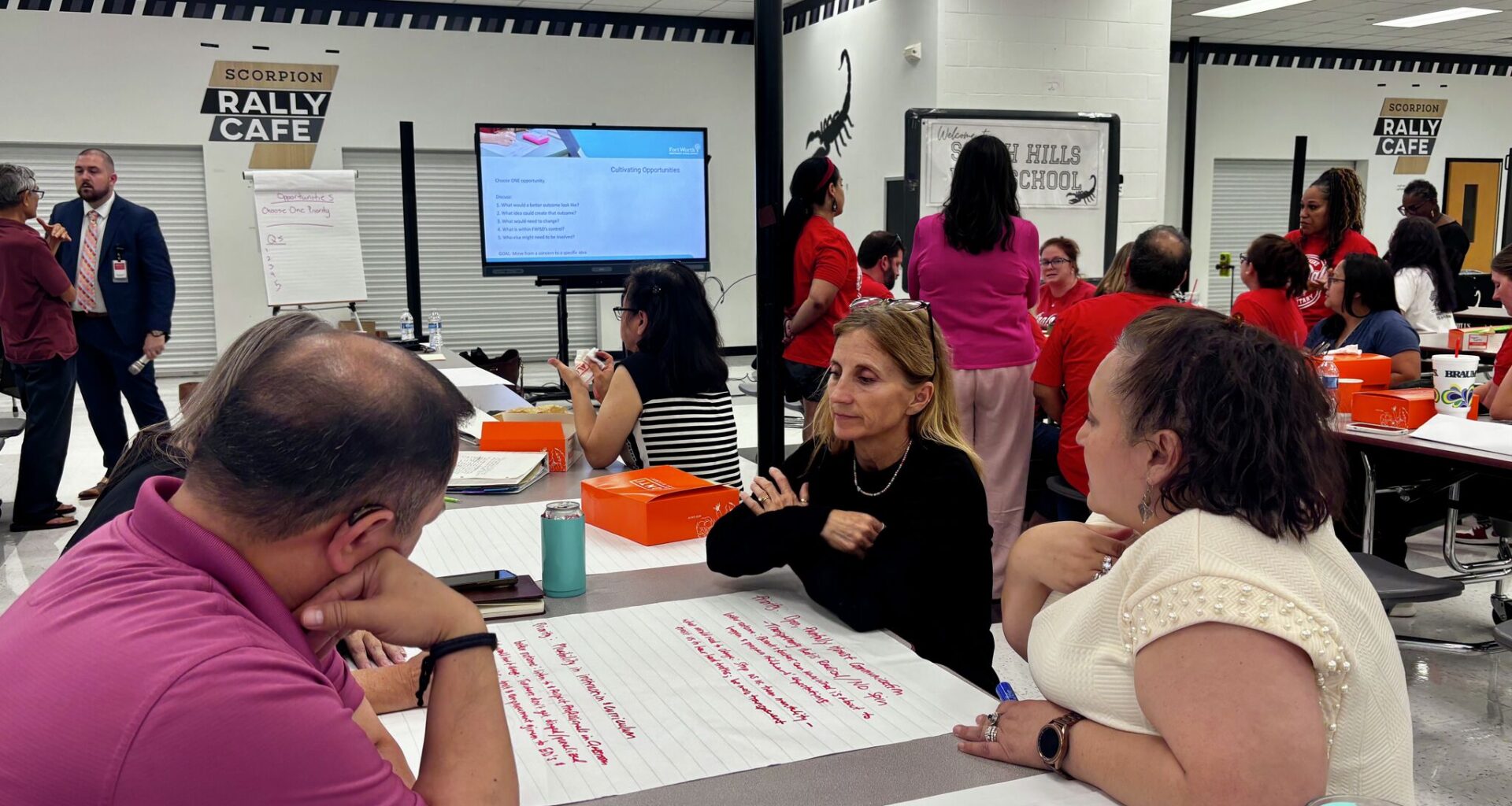
Fort Worth ISD community members gathered at South Hills High School to voice concerns, share feedback, and identify solutions, amid a controversial state takeover.
Jessica Ma/The Dallas Morning News
The concerns among the crowd gathered in the high school cafeteria spanned wide.

To name a few: air conditioning issues in classrooms, the looming closure of an elementary school, and the exodus of teachers.
About 30 Fort Worth ISD parents, teachers and students had the rare chance to share those worries and brainstorm solutions with the superintendent Monday evening at South Hills High School. The series of meetings, called Superintendent Strategic Action Sessions, seek to increase transparency during a controversial state takeover.
Article continues below this ad
Related: ‘They need to see themselves’: Dallas leaders examine educational challenges facing Black students
Superintendent Peter Licata acknowledged the anger: over the takeover, over poor test scores, over the lack of communication.
“These are the groups that we have to listen to, and they’re not always right. They’re not always wrong,” he said. “We have to work together.”
Fort Worth ISD fell under state control after a campus received a failing rating for five consecutive years. Now, a state-appointed superintendent and board of managers, rather than elected trustees, are shepherding the district. Since the takeover, parents say they’ve been left in the dark and worry how the changes ushered in by the new administration will play out in the classroom.
Related: Fort Worth ISD starts school year under state takeover
Article continues below this ad
For example, district leaders want to maximize instruction time from the start to the end of the day. If teachers waste as little as five minutes each day, Licata previously said, it can add up to weeks of lost time over a school year.
During the meeting, Graydon Jones, a parent, said rigidity of the curriculum and micromanagement in the classroom leaves “no margin for kids to be kids.”
Jones pointed out that Licata extended the listening session by 20 minutes, because Licata wanted to ensure that those who arrived late had the chance to speak.
“That was a moment of discernment, of leadership, and of clarity,” Jones said. “Those are the kinds of things that are not always being afforded to our teachers, our educators, and our principals right now.”
Licata responded: “Thank you for that. You’re right. Agreed.”
Article continues below this ad
Who will still be around to teach was also top of mind. One attendee described the retention rate as unbelievable.
In the three months after the takeover started, nearly 800 educators submitted resignations, citing chaotic leadership, intense micromanagement, and challenging working conditions. Over the summer, the district launched a hiring blitz, but many new teachers lacked teaching certifications.
Related: Nearly 800 Fort Worth ISD teachers resigned after state takeover
Meanwhile, Rachel Cotto worries about the future of J.T. Stevens Elementary School, which was slated for closure before the takeover. With the new leadership, she sees an opportunity to save the school — as long as district officials show up to the table.
“That’s the concern above all,” she said. “I believe the TEA takeover is an opportunity for our school to remain open … or are we looking at a worse situation?”
Article continues below this ad
Attendees worked in small groups to exchange ideas, which they transcribed onto poster paper. Licata moved around tables and listened in on conversations. By the end of the night, the posters hung on the wall near the cafeteria doors.
“One of the things about keeping these is making sure we refer back to them constantly,” Licata said, gesturing toward the posters. “There’s been a lot of really good talk, and we own some of our mistakes.”
Related: Fort Worth ISD seeks extension to hire uncertified teachers
He and parents agreed that Monday’s listening session was more productive than a public comment during a board meeting, which can stretch for hours. This way, they can respond and converse, rather than solely listen.
Attendees said the meeting wasn’t perfect. At times, tensions were on display.
Article continues below this ad
But parent Dionna Deardorff was glad it happened. She will try to make future sessions.
“They’re baby steps,” she said. “A lot more to go.”
The remaining sessions are:
Thursday, Aug. 27 at 6:30 p.m. at Diamond Hill-Jarvis High School (1411 Maydell St, Fort Worth, TX 76106)
Monday, Aug. 31, at 6:30 p.m. at Polytechnic High School (1300 Conner Ave, Fort Worth, TX 76105)
Tuesday, Sep. 1, at 6:30 p.m. at Arlington Heights High School (4501 West Fwy, Fort Worth, TX 76107)
Article continues below this ad
The DMN Education Lab deepens the coverage and conversation about urgent education issues critical to the future of North Texas.
The DMN Education Lab is a community-funded journalism initiative, with support from Bobby and Lottye Lyle, Communities Foundation of Texas, The Dallas Foundation, Dallas Regional Chamber, Deedie Rose, Garrett and Cecilia Boone, Judy and Jim Gibbs, The Meadows Foundation, The Murrell Foundation, Ron Steinhart, Solutions Journalism Network, Southern Methodist University, Sydney Smith Hicks, and the University of Texas at Dallas. The Dallas Morning News retains full editorial control of the Education Lab’s journalism.