
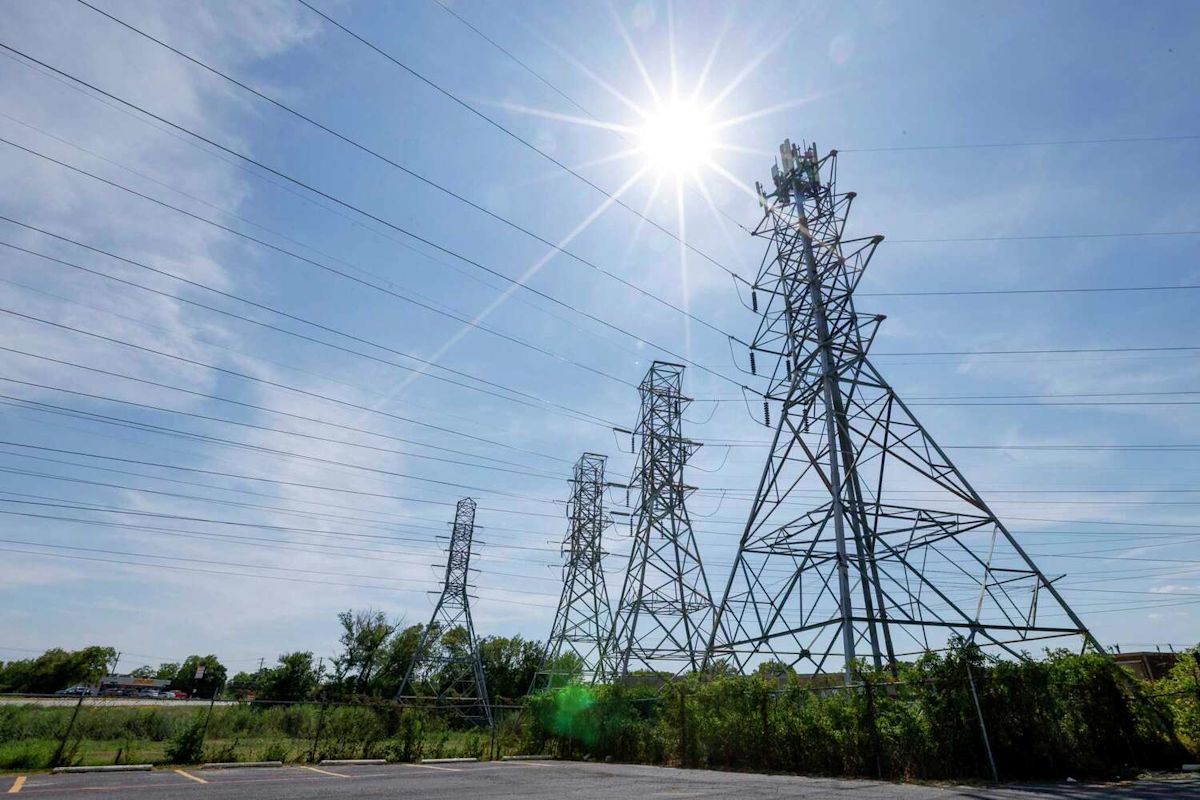
With opposition mounting, state regulators delayed a decision on the route of a massive transmission line that would run from San Antonio through the Hill Country to West Texas, but gave their approval to another from North Texas.
Both lines are part of the $33 billion Permian Basin Reliability Plan designed to provide power to the energy-rich region of West Texas by building three massive 765-kilovolt transmission lines.
But the way the Public Utility Commission, grid operator the Electric Reliability Council of Texas and utilities have carried out the plan has sparked public outrage from landowners concerned about what they say is a compressed timeline and lack of transparency. Hundreds of people have shown up to make their voices heard at House and Senate committee hearings, regulatory agency meetings and protests.
Shortly after Friday’s meeting, Attorney General Ken Paxton filed a brief calling for the projects to be paused until the legislative session that begins in January, when a “full and thorough review” can be done.
READ MORE:
Texas lawmakers turn against massive power lines they ordered after outcry
His action came after calls from lawmakers – who approved the plan in 2023 – to delay the project to give the state time to find a way to provide more transparency in the process and more time for public input.
On Aug. 21, 31 Texas House members filed a request calling for utility regulators to pause the project until reforms to the permitting process can be made in the next legislative session. The request was made less than an hour before the commission met to discuss the North Texas transmission line.
North Texas transmission line
At that meeting, commissioners heard from Texans opposing the planned line, which has two segments. They delayed taking action on applications from Oncor to build the 235-mile Dinosaur-Longshore segment from Somervell County to Howard County and the 160-mile Longshore-Drill Hole segment from Howard County to a switch near the Culberson County-Reeves County line.
After taking a week to consider the applications and the feedback they had received, the commissioners on Friday approved the applications and final routes for both segments. But the commission also adopted an order requiring Oncor, which is constructing both parts, to work with landowners to identify routing changes that could avoid bisecting properties.
After the vote, PUC Chair Thomas Gleeson said balancing the competing interests is difficult.
“I know we heard from some that the feeling is the participation isn’t meaningful,” he said after the vote on the line. “I want to tell everyone it is meaningful. Everyone who participates in this process and the people up here takes it seriously.”
RELATED:
Texas House members urge state regulators to pause massive power line plan
The commission then turned to the Howard-Solstice line, a 370-mile transmission line from San Antonio to Fort Stockton. Its proposed routes have raised opposition from farmers and other landowners who say unique Hill Country landscapes are threatened by the project.
Landowners challenge Hill Country route and timeline
Dozens of Texans took turns addressing commissioners – some wearing yellow pins that read “No 765-kv,” others who had donned suits to address commissioners – to share how having the line bisect their land would, as one speaker put it, bisect their dreams.
Several questioned the route proposed by CPS Energy, the San Antonio utility that is building the Howard-Solstice line in partnership with American Electric Power, because it doesn’t run parallel to existing transmission lines in the region.
Paul Tough, who spoke on behalf of Zachry Hughes Group, said the proposed route was “one of the worst performing routes in paralleling compatible right-of-ways.”
“On a route that is 370-miles long, paralleling less than 4 miles of existing transmission line is 1%,” Tough said. “That’s tantamount to nothing.”
Kirk Rasmussen, an attorney representing CPS, explained that zigzagging the route to avoid landowners’ properties is costly. The price rises quickly with every angle added, he said.
“We were not deaf to their concerns during this process, but at some point we’re also trying to be stewards of the rates, of all (ERCOT) ratepayers,” Rasmussen said. “When these projects start to increase in costs significantly, we’re all going to pay for those.”
SA INC.:
Get the week’s top local business stories in your inbox
Speakers also brought up what has proven to be a major point of contention for landowners: the 180-day deadline for the PUC to approve or deny applications for new transmission projects under the reliability plan.
“The largest obstacle we have seen in this proceeding is the compressed timeline,” said Louis Newsom of the Office of Public Utility Counsel. “It is a common theme in these 765-kilovolt lines (applications).”
Parties were given two days to submit a route adequacy challenge, 16 days to prepare direct testimony or a statement of position and a handful of days each to object to intervenor and staff testimony, to submit initial briefs after the conclusion of the hearing on the merits of the route and to read about 70 initial briefs and then file replies to them.
“A landowner unfamiliar with this process only had 17 days from learning of this requirement to dismissal from the case,” Newsom said.
He said the State Office of Administrative Hearings adopted a procedural schedule to remove those who failed to file testimony within that timeline, resulting in hundreds of Texans being dismissed for failing to meet the procedural requirements.
READ MORE:
Texas leaders warn of ‘catastrophic’ effects from pausing plan for massive power lines
Debate extends to need for new power lines
Among the earliest critics of the reliability project is Amanda Griffin, who is part of the grassroots organization Hill Country Preservation Coalition. Griffin questioned the stated reasoning for building the lines.
“They’re all sitting there like choir boys, acting like they’re saving the world by increasing the grid reliability for your grandma,” Griffin said. “We know that’s not the primary purpose of these projects. This is not for us.”
PUC’s Gleeson recently pointed out that the Permian reliability plan was drafted before an analysis from the grid operator forecast that peak demand could more than quadruple by 2032.

“I know we heard from some that the feeling is the participation isn’t meaningful,” Public Utilities Commission Chairman Thomas Gleeson says. “I want to tell everyone it is meaningful. Everyone who participates in this process and the people up here takes it seriously.” (Jon Shapley/Staff photographer)
Instead, he said the plan was “mostly based on oil and gas electrification and other things … that are increasing the amount of demand in the Permian that require us to move more power there.”
Todd Staples, president of the Texas Oil & Gas Association, echoed this in his comments Friday, saying West Texas was facing having to curtail critical infrastructure.
“Reliability is what will keep us safe during the next winter storm,” Staples said. “If West Texas cannot be reliable, the rest of the state has no chance for security.”
RELATED:
This project promises power grid reliability for Texas. Hill Country residents aren’t happy.
The commission said it will take up the applications for the Howard-Solstice line at a future open meeting.
“Like we did with previous dockets, I think we have a lot to go back and go through,” Gleeson said.
Applications also are pending for the third line. It also has two segments, Big Hill to Sand Lake and Bell County East to Big Hill.
Subscribe
There’s more to San Antonio with the Express-News. Subscribe today for just 25¢.
This article originally published at Texas regulators delay route decision on Hill Country power line route amid opposition.