
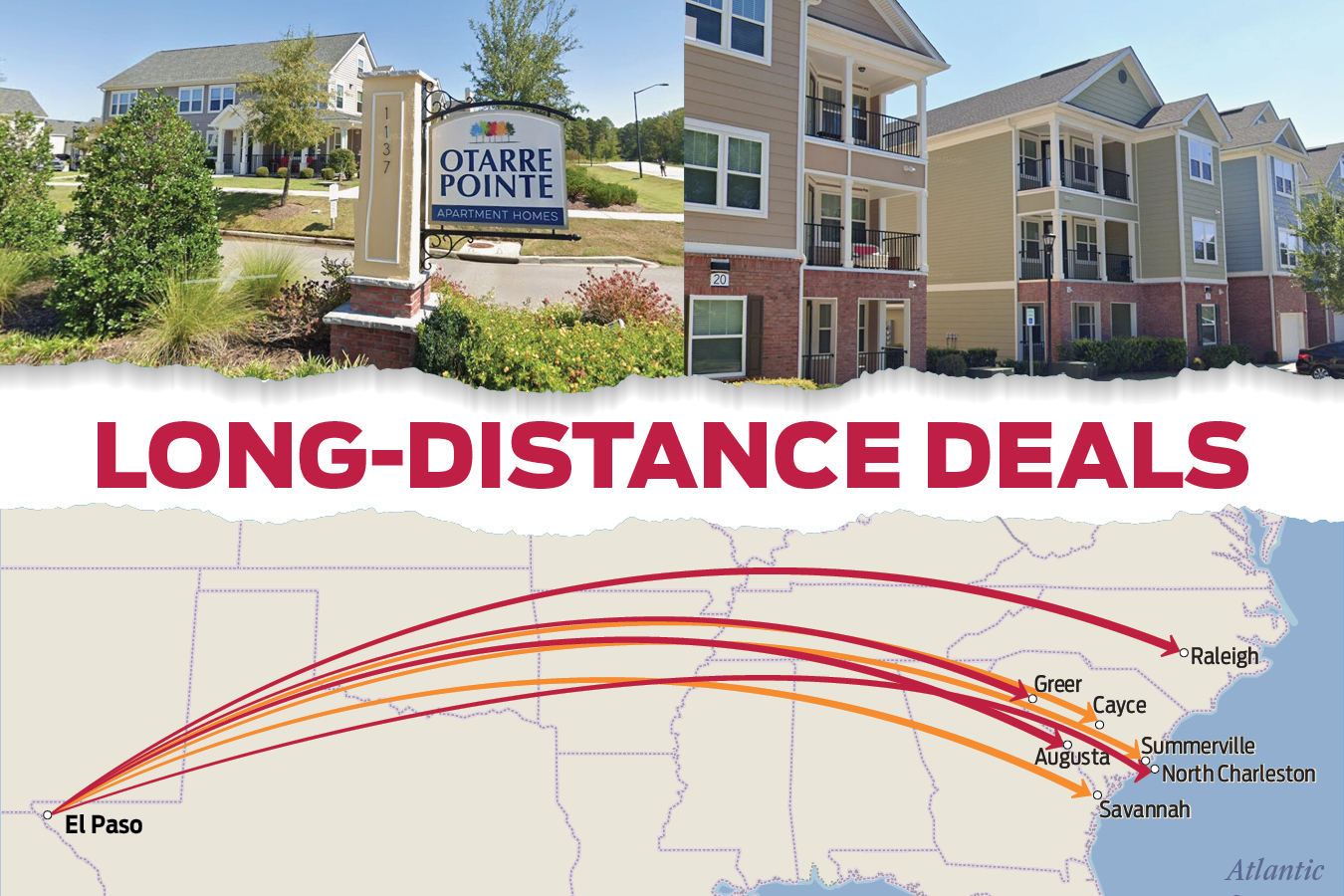
A secretive nonprofit formed by the El Paso housing authority has spent hundreds of millions of dollars buying apartment complexes in South Carolina — Cayce, North Charleston, Summerville, and Greer — as well as Raleigh, N.C., Augusta, Ga. and Savannah, Ga.
Staff illustration by Susan Barber and Ken Ellis
Earlier this year, residents of an upscale multi-family apartment complex in a suburb of Columbia, South Carolina, received an unusual letter.
It advised them that their homes at the Otarre Pointe Apartments had been sold, recalled City of Cayce Mayor Pro-Tem Phil Carter. The new owners would be converting most of the 299-unit complex into affordable housing. The upshot: Residents who did not meet the new lower income requirements would have to leave when their lease was up.
The demand struck Carter as odd. “It’s just wrong to put people out of their homes,” he said.
Article continues below this ad
EPIC FALL OF A ‘FIN-FLUENCER’: Texas real estate guru settles securities case, must offer some investor refunds
Equally strange, he said, was the identity of the new owner: A mysterious nonprofit attached to El Paso HOME, a Texas public housing authority located more than 1,500 miles away. Carter said his attempts to reach officials there were met with silence.
“It’s been crickets,” he told the local newspaper.
Cayce isn’t the only distant place where the new entity, Sixteenth Floor Residential, has been scooping up property, either. Public records show that over the course of barely a year, the El Paso organization has acquired hundreds of millions of dollars-worth of multi-family real estate — about 2,000 apartments — in South Carolina, North Carolina and Georgia.
El Paso HOME’s foray into distant jurisdictions is unique, said Stuart Nicol, an S&P Global analyst who follows affordable housing. “This is the first public housing authority we’ve come across doing this,” he said.
Article continues below this ad
Why is a nonprofit operated by a far West Texas public agency, charged with providing affordable lodging for a mid-sized city, accumulating a large real estate portfolio on the other side of the country?
Sixteenth Floor would prefer not to say.
Executive Director Gerald Cichon declined several interview requests. In response to open records requests from the Houston Chronicle, Sixteenth Floor insisted that it is a separate nonprofit company that isn’t required to disclose financial details of its growing business.
The line dividing Sixteenth Floor and the El Paso housing authority is thin. According to public records, HOME formed Sixteenth Floor last summer. A Texas law appears to say that a nonprofit formed by a housing authority is considered a public entity subject to open records laws.
The new nonprofit’s board of directors is the same as HOME’s board of commissioners. The two organizations share an executive director — Cichon. They operate out of the same office. The organizations hold meetings together, convening at the same time and place, public records show.
Article continues below this ad
El Paso HOME’s commissioners are appointed by the El Paso mayor. Mayor Renard Johnson did not respond to multiple messages.
El Paso housing authority CEO Gerry Cichon is pictured in a 2018 TEDx El Paso presentation on public housing.
YouTube video
A legal adviser to Sixteenth Floor, attorney Adam Harden, did not respond to interview requests. Harden is one of a handful of lawyers who attained notoriety in Texas housing circles in recent years for utilizing cracks in the state’s affordable housing laws that allowed private developers, lawyers and money men to earn millions at the expense of local taxpayers.
Many of the deals produced little real affordable housing. In 2023 and again in 2025, infuriated state lawmakers closed the loopholes, but not before they had erased billions of dollars-worth of property from local tax rolls without informing city or county officials who had to deal with the fallout. Several appraisal districts have filed lawsuits seeking to recover some of the lost money.
Affordable housing experts said one reason for the distant deals would be for El Paso HOME to profit from the rent and fees it could collect from arranging them. Because Sixteenth Floor Residential is keeping details of its transactions under wraps, it’s difficult to know their precise terms.
Article continues below this ad
CHRONICLE IMPACT: State Lottery Commission, ex-director face felony charges in 2023 Lotto scheme
At the very least, Texans making decisions affecting citizens in far-away states raises questions about control of affordable housing, an issue typically handled at the city and county level.
Such concerns have arisen in both North and South Carolina, where in recent years out-of-state dealmakers have taken advantage of loose laws to buy up properties in the name of affordable housing and remove them from tax rolls. Local officials say the rush of deals has cost their communities — which often had no idea they were happening — millions in lost revenue with scant input from the people who live there.
“Whatever one’s view of affordable housing policy,” said former state lawmaker and Cayce city attorney James Smith, “a transaction that can fundamentally change an existing community, remove substantial property value from the local tax base and affect the residents already living there deserves transparency and meaningful scrutiny.”
Sixteenth Floor hits the ground running
According to meeting records, the El Paso housing authority’s board of directors voted to create Sixteenth Floor Residential Inc., a new nonprofit entity, in May 2025. The stated purpose was “to address and remedy the shortage of available, affordable rental housing, and for the purpose of lessening the burden on government in addressing the rental housing immediate and long-term projected shortage of affordable housing in the United States of America.”
Article continues below this ad
Sixteenth Floor approved its first far-away apartment complex purchase three months later, the 292-unit Latitude at Wescott, in Summerville, South Carolina. In the year since, it has acquired multifamily properties in Greer and Cayce, South Carolina; in Augusta, Georgia; and in Raleigh, North Carolina. It has approved the purchase of at least two more properties, in Charleston and Savannah, according to board minutes.
Although not all of the deals have publicly reported purchase prices, the portfolio could be worth as much as $400 million, according to announced transactions and bond sales figures. El Paso HOME issued bonds to finance some deals; several of the purchases were made in partnership with the South Carolina Jobs-Economic Development Authority, which also issued bonds to finance them. The agency’s director, Jesse Smith, did not respond to interview requests.
Over the past two years, both North and South Carolina have been swamped with applications from nonprofits, some based outside of the states, to convert existing, property-tax paying multi-family apartment complexes into affordable housing exempt from paying the taxes.
Above, two of the properties owned by a nonprofit formed by the El Paso housing authority in South Carolina. Below is promotional material from the housing authority website.
Google images, El Paso housing authority homepage
In North Carolina, a court decision loosening the definition of nonprofit ownership has prompted a skyrocketing number of such conversions, said David Baker of the North Carolina Association of County Commissioners. The numbers have accelerated sharply in the past two years, he said.
In Wake County, home to Raleigh, the number of properties being converted to property tax-exempt doubled between 2021 and 2025. The county alone has seen revenue losses from the tax break jump from $1.7 million in 2021 to $11.4 million in 2025.
In all, Baker said local North Carolina local governments are losing about $100 million annually because of the boom in conversions. Because the law’s definition of “affordable” is loose, he added, in many cases rents at the newly designated affordable housing complexes are little changed from when their owners paid property taxes.
“There’s just too much money being lost for too little gain,” Eric Stein, an executive with Self-Help, a credit union and community development organization that has studied the issue, said last spring. Proposed changes in state law to tighten up the requirements have stalled in the Legislature.
CHRONICLE EXCLUSIVE: FEMA’s Harris County maps may be missing over 200k high-flood-risk properties
A spokesman for Wake County’s Department of Tax Administration said Sixteenth Floor had not yet applied for a property tax exemption on the Crest at Brier Creek, the 291-unit Raleigh apartment complex it closed on in late July. He said the new exemption application period opened January 1.
Thanks to a 2020 law passed by the South Carolina Legislature, that state, too, has seen a similar boom in nonprofit-driven deals that have transformed tax-paying properties into tax-exempt units, erasing millions of dollars from local budgets. Angering local officials, in particular, are deals in which private developers team up with a nonprofit that owns only a fraction of the property, but which still can use its status as a charity to qualify the apartments for a valuable property tax break.
As in North Carolina, city and county lawmakers are struggling to account for the lost revenue while rents in some of the properties have not appreciably dropped. In response, the South Carolina Legislature earlier this year placed a moratorium on the deals, although Smith said exemptions have allowed many to continue.
‘I don’t want to be run out’
On its website, Sixteenth Floor Residential describes its mission as providing “high-quality, mixed-income affordable housing that empowers working families and individuals to thrive in the communities where they live and work.”
El Paso HOME is a widely respected agency, considered an affordable housing pioneer in some ways. Cichon is a charismatic leader who has energetically championed and expanded public housing. “Management has substantial expertise and experience, in our view, and has demonstrated a solid track record,” the rating agency S&P Global wrote in its most recent report, which gave HOME its top bond score.
Despite the relatively small size of the El Paso community, it is the fourth-largest housing authority in Texas. It has announced its intention to aggressively grow its portfolio by 1,200 units a year.
And like many states, North and South Carolina are short thousands of affordable housing units, meaning the new income-limited developments arranged there via West Texas could help solve a pressing problem.
“They may be providing affordable housing,” said Heather Way, a University of Texas School of Law professor who studies affordable housing policy. “But it’s puzzling why they’re doing it in other states, so far outside their jurisdiction.”
“It’s rare to see a housing authority take such a gunslinger approach to real estate deals, and extraordinary to see one do it across state lines,” added Hiten Samtani, publisher of commercial real estate newsletter The Promote, who noticed the purchases earlier this year.
One reason may be money, according to a recent bond analysis by S&P. Noting that El Paso HOME recently embarked on “an extensive growth strategy,” the ratings company added that “(i)n 2025, the growth strategy expanded to include other geographical footprints where acquisitions would also provide further financial stability to EP HOME’s operations.”
‘A DOSE OF DISRUPTION’: Read the Chronicle’s full investigative series on Houston-based Empower Pharmacy
Affordable housing experts said the El Paso housing authority could earn generous fees from bond sales, as well as for arranging any property tax breaks. In a written statement, Robert Blumenfeld, an attorney for El Paso HOME and Sixteenth Floor Residential, said that he had no public documents showing HOME had received any payments from Sixteenth Street’s deals. Asked if the housing authority would earn money from the nonprofit’s business in other states, Blumenfeld stopped returning phone calls and emails.
It’s unclear if Cichon, the executive director for both of the entities, would earn additional money. El Paso HOME refused to release his compensation, saying such information was not public.
The last time Cichon’s salary was released appears to have been more than a decade ago, and then only after a legal fight. In 2014, he reportedly earned $228,000 a year, with opportunities for bonuses.
Another Texas housing executive controversially used nonprofits that his agency created to earn extra money. Last year, after an open records fight, Corpus Christi television station KRIS-6 revealed the director of that city’s housing authority, Gary Allsup, collected $786,000 annually in salary and payments from nonprofits — nearly double the compensation of the Houston Housing Authority’s director. Allsup was fired last September.
Back in Cayce, Aimee Rish said she had been living at the Otarre Pointe Apartments for six years when rumors began flying earlier this year about a new owner with plans to shake up the place. Residents eventually confirmed Sixteenth Floor’s intention to turn the complex into affordable housing well before they heard it officially.
Since then, she said, “I’ve watched a lot of people leave. But I don’t want to be run out.”
Clyde Alley, a five-year resident, said he contacted Cayce’s city council as soon as he learned about the conversion. “I asked, ‘Do you guys know what’s going on here?’ And they said they knew nothing about it.”
Smith says Cayce officials are committed to aggressively fighting the West Texas incursion into their community. “The city supports affordable housing,” he said. “But it’s being part of that conversation that’s important. And the people closest to the community, who are the most important, are being excluded from it.”