
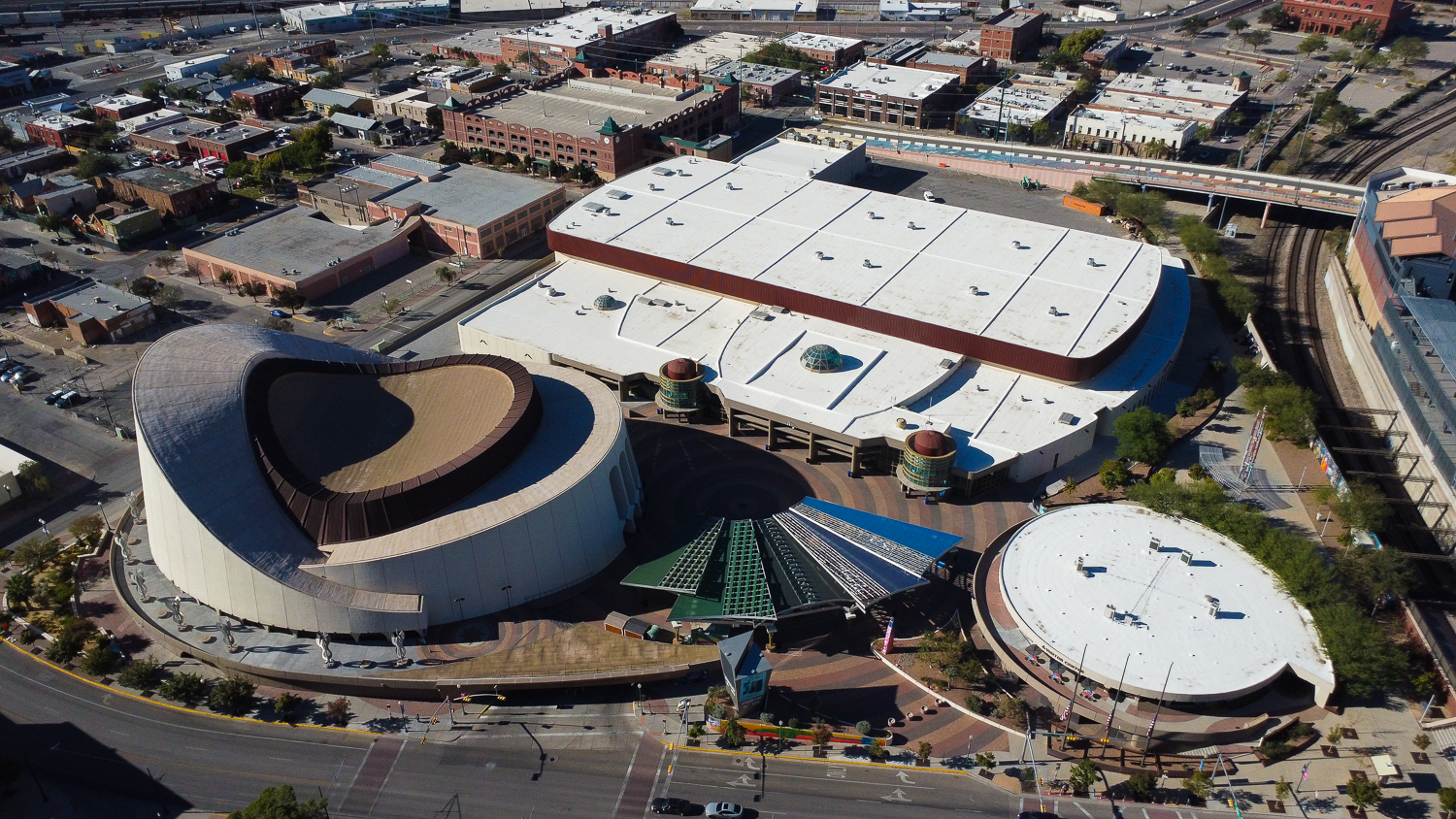
A long-proposed expansion of El Paso’s Downtown convention center could be on the horizon after City Council this week approved the purchase of three properties across the street from the venue.
After the purchases this week, the city of El Paso now owns the entire block between West Overland and West San Antonio avenues and Leon and Chihuahua streets. City Council approved the purchase of two other properties on the block in April. In all, the city paid just shy of $8 million to acquire the five parcels that will be used to expand the Judson F. Williams Convention Center’s footprint. The city also owns the properties in the Duranguito neighborhood between Santa Fe and Chihuahua streets where it once sought to build an arena.
“Our convention center, while it does brisk business, we are starting to become less and less competitive with a lot of the needs and expectations of 21st century convention planners, meeting planners, trade show planners, et cetera,” said Ben Fyffe, the city’s managing director of quality of life.
What the expansion will look like is still far from clear. Fyffe shared only vague details of how the city envisions the convention’s center renovation. The properties that the city acquired in recent months could feature a ballroom, kitchen facilities or breakout rooms for use during conventions and conferences.
Built in 1998, the 133,000-square foot venue was last upgraded and expanded in 2002 and can now accommodate up to 8,000 people. It features three halls, 17 breakout rooms and a parking garage with 975 spaces. The convention center plaza was renovated a few years back.
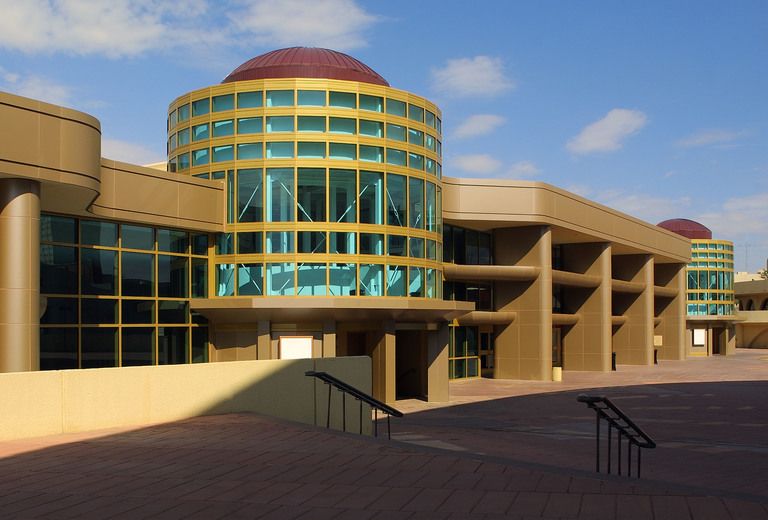 The Judson F. Williams Convention Center in Downtown El Paso (Courtesy Visit El Paso)
“The way conventions are structured right now, large-scale convenings, you oftentimes have centralized discussions, and then you have different breakout sessions. Right now, we don’t have enough spaces to be able to actually actively accommodate that,” Fyffe told reporters this week. “We also know that our kitchen, which is one of the number one revenue drivers for the convention center, really needs more space to be able to actively serve more people.”
He said the convention center can’t host large conferences because of a lack of accommodations.
City staffers in the spring will present to City Council more details and renderings of what the expanded convention center could look like, which will likely prompt the first discussions on a budget for the expansion and how to fund it.
The renovation plan is “really going to be determined, I think, by future consulting, architects, a lot of planning and input sessions, and ultimately coming to the council to be able to determine that,” Fyffe said.
A 2019 expansion analysis recommended a new 30,000 square-foot ballroom, 21,000-square-feet of meeting space, an expanded and renovated kitchen and expanded support areas.
The three properties approved Tuesday have a combined 19,200 square feet, a city presentation shows.
It’s also unclear how the properties the city purchased would connect across San Antonio Avenue to the convention center’s existing footprint. The city could build a skybridge over the street – similar to the bridge that connects the Union Plaza Transit Terminal parking garage to the convention center – or the city could create an underground pathway.
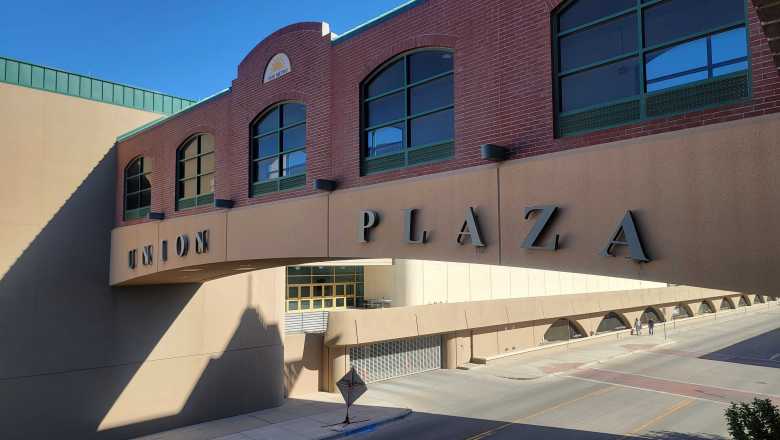 A skywalk connects the Judson F. Williams Convention Center to the Union Plaza Transit Terminal parking garage in Downtown El Paso. (Cindy Ramirez / El Paso Matters)
“We don’t know what that could look like, what connectivity could look like for that, whether that could be a sky bridge, whether it’s detached, whether there’s underground connections,” Fyffe said. “We’d probably be looking at all scenarios to understand what makes the most sense for flow, for efficiency, for traffic around us, and also with the budget that we’ll have.”
Another unanswered question is whether the city will demolish the buildings on the block it purchased.
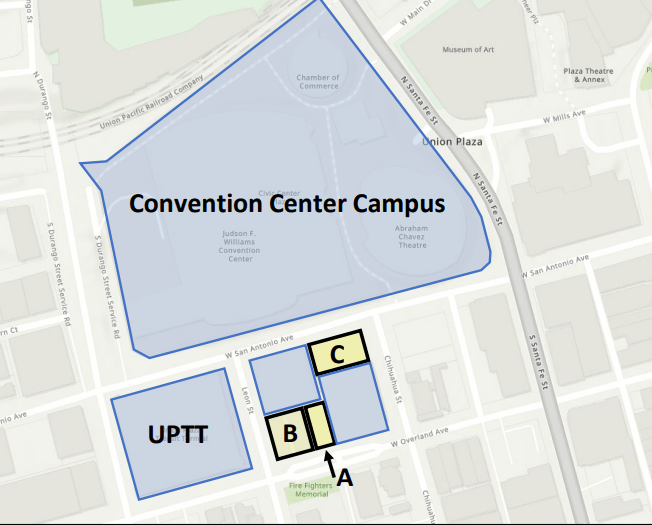 Map shows the Judson F. Williams Convention Center campus that includes the facility, the Abraham Chavez Theatre and the El Paso Chamber offices. At bottom left if the Union Plaza Transit Terminal parking garage. The buildings labeled A, B and C were purchased by the city Nov. 4, 2025, with the other two on that block purchased in April 2025. The city also owns buildings in the Duranguito neighborhood between Chihuahua and Santa Fe Streets. (Courtesy City of El Paso)
City representatives and staffers said they don’t plan to touch the 2,500-seat Abraham Chavez Theatre, which sits just feet from the convention center, as part of the expansion project.
The largest building on the block at one point was used as an automotive business and last housed the El Paso Exploreum children’s museum, which closed in 2015.
Fyffe said the buildings aren’t designated as historic, although he said the city could renovate the buildings instead of demolishing them.
“We have no plans to do anything but to fix it,” City Manager Dionne Mack said of the 51-year-old theatre.
City Council on Tuesday voted 6-1 to approve the $3.2 million purchase of the three remaining properties. District 3 city Rep. Deanna Maldonado-Rocha was absent, and District 7 city Rep. Lily Limón voted against the purchase.
Where did the money come from?
The city paid $7.93 million for the five parcels it bought – 301, 311 and 315 W. Overland, 320 W. San Antonio and a parking lot on W. San Antonio – from an entity called Lynx Industries owned by Mike Churchman and his wife Laurie Paternoster.
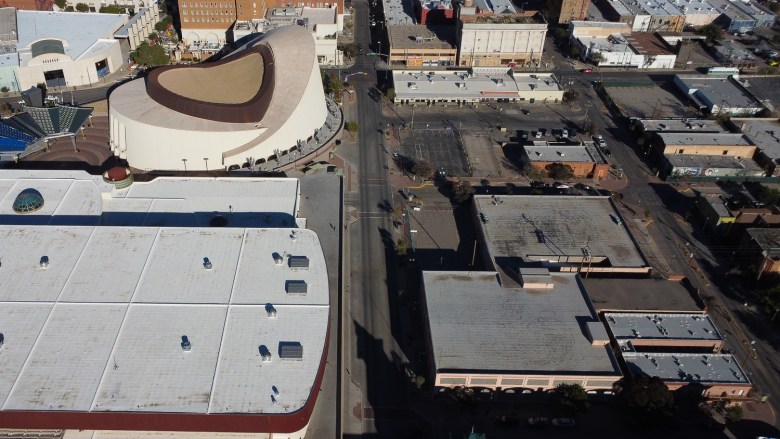 The City of El Paso plans to purchase three properties in the block immediately south of the Convention Center and W. San Antonio Avenue, Nov. 6, 2025. (Corrie Boudreaux/El Paso Matters)
That money came from revenue generated by the city’s hotel occupancy tax, a 17.5% tax that people who stay in hotels in El Paso pay in addition to their room price. The so-called HOT tax – distributed among the city, county and state – generated about $14.3 million in revenue for the city last fiscal year.
However, hotel tax revenue can only be used for “tourism promotion, cultural affairs and events and sports,” Fyffe said. The imposition, collection and use of HOT taxes in Texas are dictated under state code.
The overarching idea behind expanding the convention center is that it would allow the city to host bigger conventions and conferences that bring more people into the city than it can now with the existing venue. That would translate into more visitors staying in hotels, and therefore more hotel tax revenue available for the city.
“This is a much-needed improvement to our convention center so that we can attract tourism and conventions and other events to our community, and therefore produce more taxes for our community,” District 1 city Rep. Alejandra Chávez said before voting to approve the property purchases.
City staffers said most El Paso taxpayers aren’t paying for the property purchase because the vast majority of hotel tax revenue comes from visitors.
But Limón said the city was paying too much for the properties, and said she lamented the fact that family or friends who visit El Paso pay higher hotel prices because of the HOT tax.
“We are asking our taxpayers to pay an incredible amount for a piece of property,” she said.
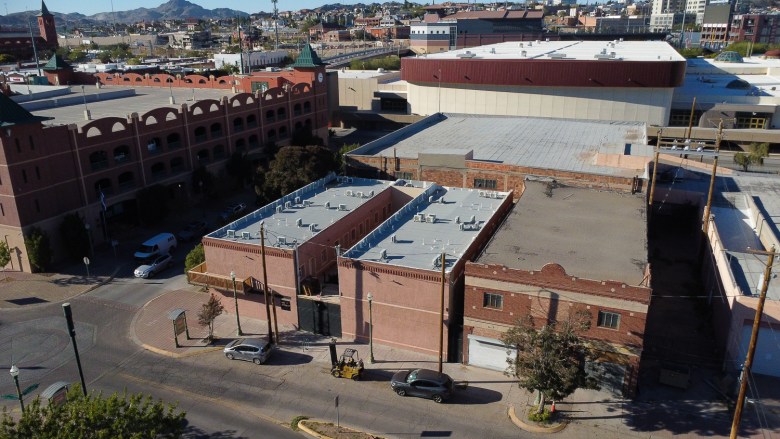 The City of El Paso is looking to acquire several properties in a downtown block bounded by Leon, San Antonio, Chihuahua, and Overland streets, Nov. 6, 2025. (Corrie Boudreaux/El Paso Matters)
Mayor Renard Johnson didn’t vote on the real estate transaction because the mayor under the City Charter is only allowed to vote to break ties. But he voiced support for the convention center expansion.
“It creates room nights for a lot of the hotels and gets people to eat at our restaurants in Downtown and across the city as a whole,” Johnson said. “I think this is something that the city deserves, and we need more convention space and we have to be competitive with other markets in the state of Texas.”
Downtown hotel impact
Fyffe said the private sector has invested $250 million developing hotels in the Downtown area in recent years – enabled with $60 million in city incentives – so the city wants to increase the number of rooms visitors are purchasing.
The number of hotels operating in El Paso County is expected to increase next year to 114, compared with 81 hotels throughout the county in 2016, according to the Borderplex Economic Outlook that’s published by the University of Texas at El Paso.
The report suggests the number of hotel room nights available in the county throughout the year will increase to about 4.45 million in 2026, compared with 3.33 million rooms available throughout 2016 – an increase of 33%. However, hotels are expected to sell about 2.75 million hotel rooms next year, an increase of only 24% compared with room sales in 2016.
That mismatch underlies the push to bring more visitors into El Paso for large conferences and fill up hotels that private companies have developed over the last decade with the help of city incentives.
“Room nights available in the Sun City will surpass 4.4 million by the end of” 2026, read the UTEP report, which was published by economics professor Tom Fullerton and economist Steven Fullerton. “Greater capacity causes the county occupancy rate to slip to 62 percent.”
Even after investors have developed numerous hotels throughout Downtown such as the Plaza Hotel at Pioneer Park, Hotel Indigo, Stanton House and several others, there are additional hotel projects ongoing in the area.
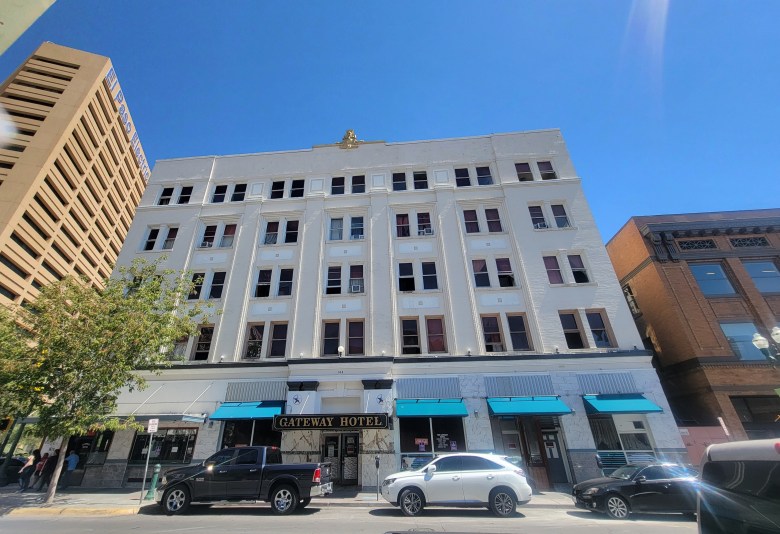 The Gateway Hotel in Downtown El Paso, September 2024 (Cindy Ramirez / El Paso Matters)
That includes the renovation of the former DeSoto Hotel at 309 E. Mills Ave., and the Texas Tower at 109 N. Oregon St. that the property’s owner, local attorney Jim Scherr, has said will become a Hampton Inn & Suites. And a Houston-based real estate company has said it plans to convert the troubled former Gateway Hotel at 109 S. Stanton St. into a La Quinta Inn & Suites.
There are big events that Fyffe said the city can’t currently host at the convention center such as the Texas Municipal League conference – which he said would result in 7,000 room nights sold – and the Science Teachers of Texas annual conference that would result in sales of about 4,200 hotel room nights.
City Council representatives have said the convention center must be available to host events during the renovation period. So, the timeline for the project is still uncertain.
“We know that this is going to be expensive,” Fyffe said, “and we probably will not have the resources to do it all at once.”
Who sold the properties to the city?
The Churchman family owned the properties between Overland and San Antonio avenues that the city purchased. Churchman and Paternoster used to operate the Exploreum museum, and their son Justin Churchman recently spent a handful of years renovating the former tenement building at 315 W. Overland Ave. into 16 apartment units.
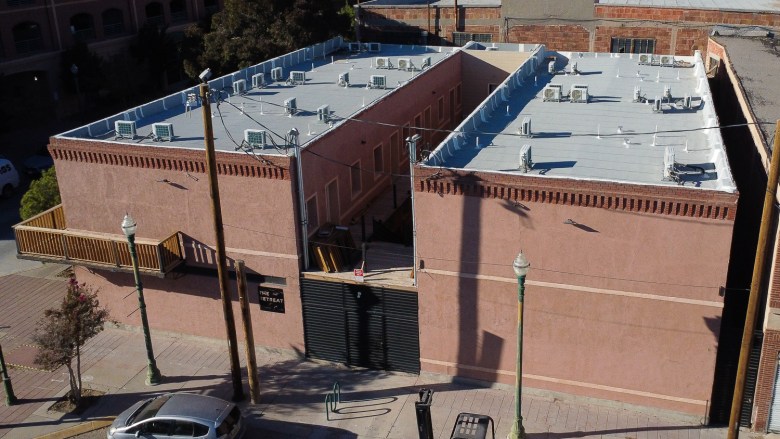 “The Retreat” at 315 W. Overland, a recently-renovated apartment block pictured on Nov. 6, 2025, is one of the properties that the City of El Paso intends to purchase for the planned Convention Center expansion. (Corrie Boudreaux/El Paso Matters)
Justin Churchman put the apartments up for rent last summer, and said he leased each of the units for about $1,000 per month within one or two months of putting them up for rent – highlighting the demand for housing in the Downtown area, he said.
It was the biggest real estate project he’s undertaken, and he said he was sad to sell the building about a year-and-a-half after finishing the renovation.
“It was unfortunate. It was a really cool investment for me,” Churchman told El Paso Matters. “I just felt like this is a calling of, like, you need to go invest in somewhere else.”
He said things aligned that made a sale to the city the best option rather than holding onto the property. The last apartment renter’s lease ended in September, so it was a smooth transition, he said. That was also part of the reason the Churchman family didn’t sell the apartment building in April along with a couple of other properties they owned on the block.
He suggested the convention center’s expansion could bring bigger events and more people into Downtown and accelerate the area’s revitalization more than a single apartment building could.
Churchman said he’s interested in investing in real estate nearby within the former arena footprint, but only if other investors joined in to renovate the area as well.
“I would love to work in the Downtown area in the future,” he said. “If the convention center expands and builds, that means you’re going to be bringing people in that will want to spend more money.”
Related
LISTEN: EL PASO MATTERS PODCAST